Welcome to Modern Agriculture!

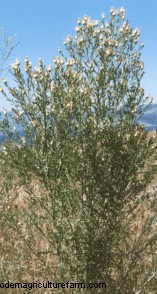
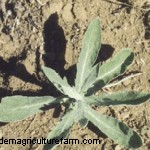
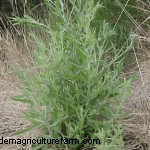
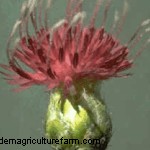
Russian knapweed (Centaurea repens) is a perennial weed that has proven to be expensive and difficult to control. In fact, it’s very resilience led researchers at Oregon State University to see how it might be used as a forage. Their results shows that it’s high in nutritional value, generally similar to alfalfa, and that cows and in fact there was no difference between alfalfa or Russian knapweed when they were used to supplement other low-quality feed. The the 2006 paper by Bohnert et al concludes with: “Thus, haying Russian knapweed in the spring and feeding in the winter may provide an alternative to controlling of large scale infestations.” Or – if you can’t beat it, eat it!
Russian knapweed is toxic to horses if they consume 60 to 70% of their body weight of the plant. The sesquiterpene lactone “repin” seems to be responsible for the problem in horses. Symptoms of the resulting “chewing disease” include a stiffening of the muscles used to pick up and chew food, giving the horse a “wooden” expression. Animals may hold food in their mouths attempting to chew and the saliva may cause froth around the mouth, giving them the appearance of rabies. There is no treatment for this poisoning and animals will die as a result. Be sure that pastures where horses graze have plenty of variety so that they are not forced to eat Russian knapweed.
The University of Idaho’s Targeted Grazing website notes that it takes repeated, intensive grazing over a period of years to significantly reduce this plant. They recommend removing 80% of the plant, three times per season, allowing 8 to 10 inches of regrowth between grazing treatments and repeating this for three or more years successively.
This prescription seems almost impossible for a producer to achieve and would likely put a high level of stress on any other forages growing in the vicinity. So I recommend looking at the plant in a different way. A plant that is as nutritious as alfalfa and can regrow 8 to 10 inches between grazings may be something that does not need to be eradicated. At the same time, a solid stand of this plant is not desirable either. We know that the plant is not shade tolerant and that when other forages have less stress on them, they will compete well with the Russian knapweed, and can even shade it out. Given that information, I would graze it at times that would stress it, and provide other forages with opportunities to grow. I would not go to the trouble of trying to eradicate this plant.
Want Your Livestock to Add Russian Knapweed to Their Diet? Our article “How to Teach Livestock to Eat Weeds” will give you the basics. Or you can visit my Livestock for Landscapes website to order books and DVDs that will teach you how to teach your animals.