
Welcome to Modern Agriculture!

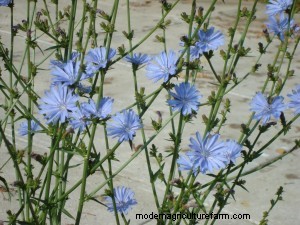
Chicory has a list of names longer than its stems: blue daisy, blue dandelion, blue sailors, blue weed, bunk, coffeeweed, common chicory, cornflower, hendibeh, horseweed, ragged sailors, succory, wild bachelor’s buttons, wild endive, and witloof. Most of us have it in our pastures and fields, and many of us probably think of it as a weed. But here’s a little information that might help you think differently – and maybe even add it to you list of valuable forages.
Thousands of years ago, chicory was eaten in Egypt. The plant originated in the Mediterranean and began to travel the world as a salad green. Fresh leaves are still sold as radicchio in Italy and the French produce a green they call whitloof chicory, Belgian endive, or French endive by forcing chicory roots to sprout while deprived of light. Beyond its use as a salad green, chicory roots have been commonly roasted and used as a coffee substitute or additive. They can also be eaten raw or boiled, or dried and ground, and used as seasoning.
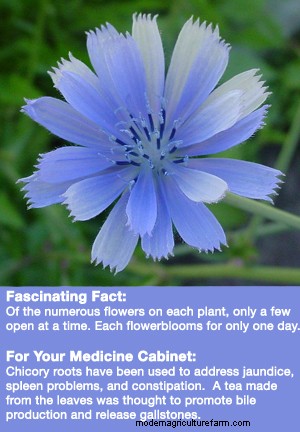 Chicory came to North America in the 1700s and was a cultivated plant for about 200 years. In 1950 or so, it lost its status as a purposefully planted crop when it became more economical to import chicory. While it was under cultivation, it escaped its planted fields and spread throughout southern Canada and the United States. Chicory now grows along roads and highways, and can also be found in pastures, fields, and lawns. It grows in all soil types, but prefers lime-rich soils. Since it doesn’t tolerate cultivation, its spread is somewhat controlled. It spreads by seed, with each plant producing about 3000 seeds.
It is a high quality forage crop that contains tannins valuable to address parasites in small ruminants, and as a plant, it does well in rotational grazing systems. Its leaves have protein levels are between 20-30%, and it has a digestibility level of about 90%. Flowers, though lovely, and their stems are lower quality forage.
Given all this, you may be want to consider chicory an alternative forage crop, rather than a weed.
Oh yeah – need to teach your livestock to eat this? Here’s how!

