
Welcome to Modern Agriculture!

Grazing your herd through the winter on standing forages in pasture is one way to reduce costs and improve your bottom line. It avoids the expense of baling, moving feed and then feeding. But is the feed giving your livestock what they need to survive and thrive? Here’s some data from a variety of locations to help you with the answer.
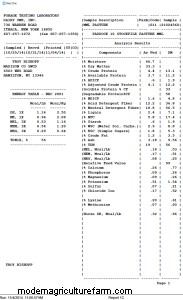
In his series of articles walking readers with him through his 2014-2015 grazing season, our resident Grass Whisperer, Troy Bishopp, went the extra mile to give his fellow graziers information that would help them to make the transition to winter grazing. He even tested his standing forage so that they would have an idea of what to expect. Here’s what he learned:
Troy’s experience is similar to results of three years of forage testing in southwestern Manitoba According to their testing,
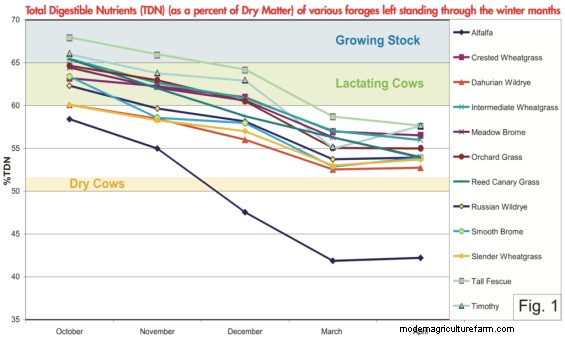
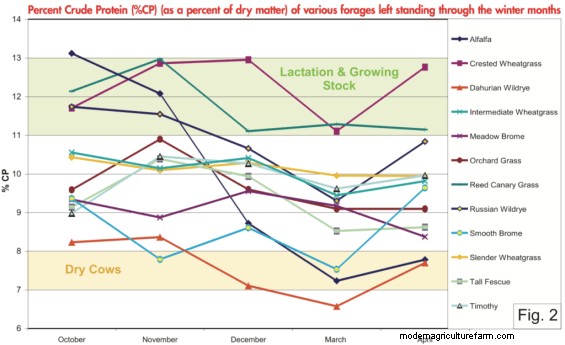
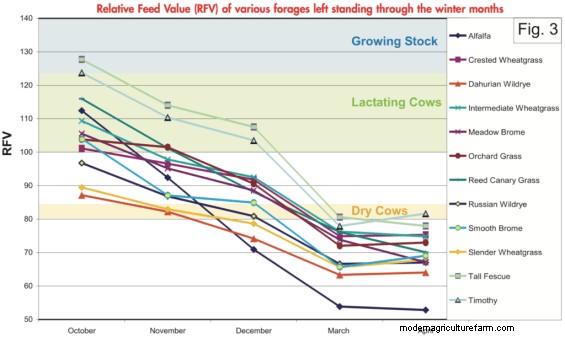
As the graph above shows, many of the grasses meet the needs of dry cows. However, after November in Manitoba, stockpiled grasses don’t contain adequate energy to support lactating cows that require 60 per cent to 65 per cent TDN to maintain milk production, or of young, growing stock that need 65 per cent to 70 per cent TDN to gain 2 pounds per day. Their forage tests for Crude Protein and Relative Feed Value, below, tell a similar story. But as you look at these graphs, keep in mind that your forage values may decline at different rates, depending on your latitude and climate. Discussion with your local forage extension specialist or NRCS or Conservation District staff can help you calibrate this information to your area.
Karla H. Jenkins, Aaron Berger and Gary Herbert of University of Nebraska-Lincoln conducted research on behalf of farmers and ranchers planting annual forages in pasture who want to graze them through the winter. Those producers wanted to know if these annual forages would provide adequate nutrition through these colder months.
For the study researchers planted annual forages after irrigated wheat was harvested, and some additional water was applied to the forage crop. (The total tonnage and the quality produced would likely vary if the forage was planted earlier in the summer and on dryland acres.) Then they tested them through the winter season. Interestingly, as you can see from the table below, quality changed very little over the winter.
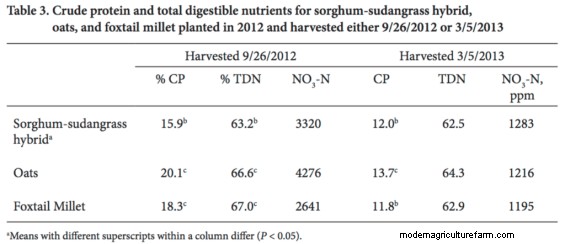
“While some nutrient loss did occur, all forages studied in both years maintained enough quality to support rumen function without additional protein. The available nutrients would also support about 1-1.5 lb/d gain on weaned calves if quantity was adequate,” said Karla Jenkins.
She also noted that the severe drought in the first year of the study raised nitrate levels about the recommended 1600 ppm for safe grazing when they harvested just prior to the frost, but that nitrate dissipated over the winter until forage was safe to graze in March. She cautions producers to sample forages for nitrates and nutrient content before beginning grazing.


