Welcome to Modern Agriculture!

Should we get rid of KY 31 endophyte-infected tall fescue? Greg Judy has said “No” throughout this 4 part series. Here’s his final argument, including all the reasons he has decided to keep his fescue. (Read the rest of the series here: Part 1, Part 2, and Part 3.)
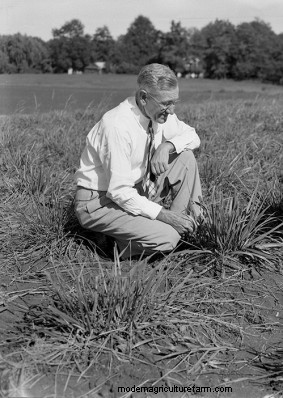
I covered all the negatives of Kentucky-31 endophyte-infected tall fescue earlier, now I will cover the positive aspects of this dirty endophyte-infected tall fescue. First and foremost it is one strong tough grass that is all most impossible to kill.
1. It is here to stay, hate it or not, we have it. I refuse to spend the rest of my life trying to kill something that eventually comes back.
2. The infected fescue is the only plant that I know of that you can trample to death in wet conditions and it comes back with a smile on its face.
3. It develops a very thick heavy sod that will hold up animals in what is normally impossible grazing situations with other cool season grasses.
4. The bottom portion of fescue remains green all winter long if it is not grazed off short. Not many cows will turn down a green plant in a January blizzard. (Just don’t graze fescue shorter than 3-4 inches in the winter.)
5. As the winter progresses the endophyte level in the infected fescue drops which makes it more palatable and better forage for your animals.
A couple winters back I went to move the cows early in the morning, it was 20 below zero with the wind chill factored in. There was 8” of snow on the ground. The 300-head mob of cows were huddled up in a tight ball using the heat from its neighbor to stay warm. They were all nestled down in a draw full of cedars escaping the powerful wind. My face was instantly froze when I stepped out of the truck. My eyeballs kept trying to freeze shut when I squinted my eyes to shield them from the ferocious wind that was ripping down the ridge. I decided to unroll three bales of hay for the mob down in the cedar draw out of the wind. This would allow them to fill up without facing the brutal wind up on the ridge of stockpiled fescue.
After rolling out the hay bales, I decided to go ahead and roll up the next paddock wire division that would give them access to the fresh stockpiled fescue. I thought maybe they might venture out for some grazing after cleaning up the unrolled hay. We had been grazing all winter with twice daily moves and harvesting the fescue buried under the snow with our cattle mob. This new stockpiled strip along the ridge had a hard north wind cutting across it. I took the video below to show how, as soon as the mob saw us heading to the wire reel to expose the next strip of fescue, every cow left the unrolled hay and stormed onto the stockpiled fescue ridge. They immediately started pushing through the snow and ripping out large mouthfuls of stockpiled green fescue. The mob of cows told me real quick which forage they preferred. The hay that was rolled out was darn good 2nd cutting clover/grass mixture hay. But guess what, it was not green like the winter fescue stockpile under the snow. Our cows will take good semi-green fescue stockpile every time over high quality hay, that was beat into my brain that morning. Just remember, cows know best!
We always keep several paddock strips of stockpiled fescue laid out in front of the mob using poly-braid and temporary step-in posts. There are several reasons for this. When winter strip grazing stockpiled fescue you should always plan for the unexpected. By always having strips of forage fenced off in front of your mob, there is a barrier fence to keep the mob from moving any further forward the the next fence. You need this insurance fence to protect your stockpile that is in front of the mob in case the poly braid is accidently knocked down. It is a terrible feeling to find your mob spread over the whole farm on your precious stockpile because you did not have an insurance fence in place in front of the paddock that they were grazing on when the wire was accidentally knocked down. We use no back fence when grazing winter stockpile, it is not needed.
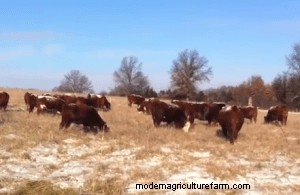 In wrapping up, I really believe it is the biggest money saver for our grazing farms for winter feed in fescue country. If God gave me only one choice for picking out the one single species of grass for our farms here in the Midwest, I would pick Kentucky 31 endophyte infected fescue. There is no other perennial grass species available that will stockpile well enough to keep our entire livestock herd pig-fat from October thru April 1st without feeding hay or supplement. If you have endophyte infected fescue stockpile, it is easy to coast through March – the mud month here in the clay hills. The fescue sod will easily hold them up and feed them at the same time without pugging up your entire farm. We have no sacrifice area for muddy periods. We just open up the size of the paddock and keep moving them.
 If stocked appropriately entering the fall dormant season after calculating animal days of stockpiled fescue on your farm, it is possible to graze all winter without feeding any hay. If you think about the fact that your animals are harvesting the forage right where it is grown, no equipment needed, that is a huge cost eliminated. You need to treat your stockpiled fescue like the precious gem that it is. Your cows will be healthier grazing winter stockpiled fescue along with your bank account.
Folks, there is no better feeling in the dead of winter than to turn your livestock into a beautiful, semi-green, lush stockpiled fescue pasture and watch the mob go to work. Everybody else in the neighborhood is feeding hay, your animals are feeding themselves. Just be careful not to graze the fescue into the ground, leave 3-4” of residual when exiting the paddock. This residual feeds the soil life, protects the ground surface and catches rainwater for your early spring growth of forage.
Our goal is to have the animals go to work every morning with a smile on their face and I have a smile on my face watching them harvest the lush stockpiled fescue.