
Welcome to Modern Agriculture!

This video by the Natural Resources Conservation Service in South Dakota does a great job of demonstrating that how we manage our livestock on pasture determines how sustainable we’ll be as farmers and ranchers. In an across-the-fence comparison using a simple water infiltration test, Jim Zimprich and Stan Boltz show the difference between a well managed, rotationally grazed pasture, and a pasture with a long history of season-long grazing.
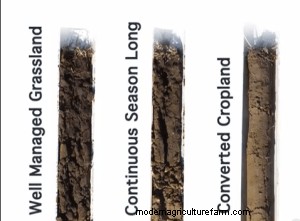
In this part of the world, it has been said that 150 – 200 pounds of production per acre is lost for every inch of water that isn’t absorbed. On a well-managed grassland, a spade full of soil reveals good granular structure which provides places for the water to seep into the soil. Good granularity also means grasslands with higher diversity and better overall palatability, and that maintain a higher plane of nutrition for a longer period in the growing season. Overgrazing on the other hand, either by overstocking or by grazing for too long a period, leads to compacted soil with horizontal layers that prevent water absorption.
In their demonstration, one inch of water is absorbed into the well-managed pasture’s soil in just 10.1 seconds. Across the fence in the season-long grazed pasture, it takes the same inch of water 7 minutes and 3 seconds to absorb. Since some farmers are choosing to convert their grazing lands to corn production in South Dakota, they run the same infiltration test on grassland converted to cropland just 9 months earlier. It took 31.5 minutes for the inch of water to infiltrate.
If you are reading this and thinking that, hey, I have sandy soil, so infiltration is not a problem, just remember that you want to have aggregation, too. The aggregation will help hold onto water that enters the soil so plants can take it up during dry periods.
SD NRCS staff members demonstrate how to monitor your soil health and water infiltration rates during the 2012 SD Grazing School. You can see how management impacts the soil profile and how rapidly it can absorb water.


![How Often To Water Plants In Clay Soil [And How To Make It Fertile]](https://modernagriculturefarm.com/article/uploadfiles/202211/2022111623303066_S.png)