
Welcome to Modern Agriculture!

General Hardness (GH or Total Hardness) is an important water parameter to shrimp keeping and breeding. Unfortunately, Carbonate Hardness (KH) and General Hardness (GH) are commonly confused.
General Hardness (GH) represents the overall concentration of salts (calcium, magnesium, iron, etc.) but does not identify which of these elements is/are the source of hardness. While Carbonate Hardness indicates the quantity of base present in water – bicarbonates, carbonates, phosphates, hydroxides, etc.
 Water high in calcium and magnesium is called “hard water” and water deficient in these minerals is called “soft water”.
In order to be successful in shrimp keeping hobby, it is absolutely important to understand what GH is, the difference between GH and KH and how these water parameters affect shrimp. I will try to keep it short and simple as I can. So bear with me a little bit.
Note: Carbonate Hardness is a confusing term because it does refer to hardness, but rather to the alkalinity (the ability of a solution to resist a pH change with an addition of an acid.) from the carbonates and bicarbonates. Other anions (such as hydroxide, borates, silicates, and phosphates) can contribute to the alkalinity. That is why some scientists believe that we should NEVER use the term “KH”; however, this is often referred to in aquarium literature.
Interesting: Usually, in freshwater, most of the cations are calcium and magnesium (In a 3:1 ratio) and most of the anions are carbonates. The levels for (GH) and (KH) will often be similar.
According to scientific definition, General Hardness is a measurement of total multivalent cations in the water. In practice and in simple words, it is the sum of the two most important elements, calcium, and magnesium in the water.
GH ≈ [Ca] + [Mg]
Why do we use sign approximately equal (≈)?
Because, actually, the correct formula is (according to its definition – multivalent cations):
GH = [Ca] + [Mg] + [Sr] + [Ba] + [Fe] + [Mn] + [Al] + …
Well, now it looks very complicated. However, there is also another science definition. General Hardness (GH) is a combination of temporary and permanent hardness.
General Hardness (GH) = Temporary Hardness (KH) + Permanent Hardness (NCH)
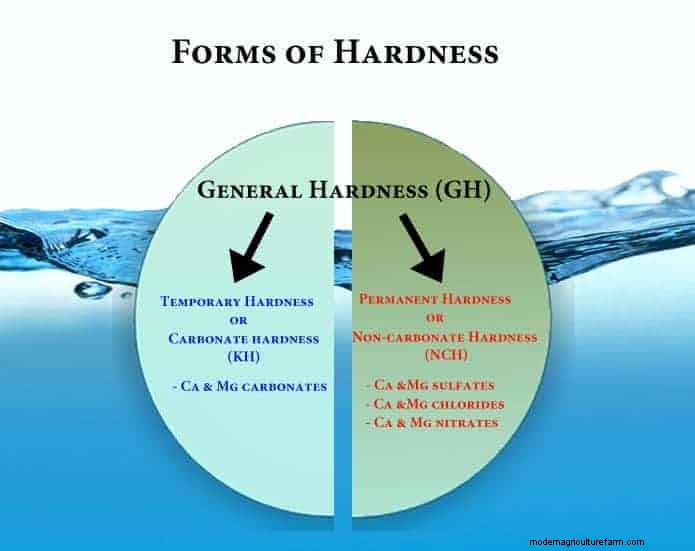
| As GH is a combination of both temporary and permanent hardness, making any changes to these will affect the GH. Therefore, either boiling water or using a deioniser will lower GH. Adding any calcium or magnesium salt will raise GH. |
Sometimes our tests show us that KH is higher than GH. How is it possible you can ask if GH = KH + NCH?
Well, we can blame KH tests.
It is not that they are wrong, of course not. Actually, the problem is that they are not measuring water hardness at all but alkalinity. In most cases, people use the terms “Carbonate hardness” and “Alkalinity” as synonyms. Well, actually, this is not right. These terms are very close but not the same. Let me explain.
As we know, the KH indicates the quantity of:
Both forms of carbonate are bound to metals, which normally would be calcium (Ca) and magnesium (Mg).
Important: The KH does not care what metal it is bound to. For example,
Therefore, a large amount of NaHCO3 would raise the (KH) and not affect the (GH). A large amount of MgSO4 would raise the (GH) and not the (KH). That is why the real formula is:
GH = KH + NCH + PsH
PsH is a Pseudo Hardness. It is the portion of the carbonate hardness that belongs to the monovalent cations (Na, K, ammonium). Unfortunately, KH tests measure them as well. This is how KH sometimes can be higher than GH.
Calcium and magnesium are essential in the biological processes of our shrimp.
Important: Unfortunately, many shrimp keepers forget about Magnesium. Magnesium, actually, helps shrimp to absorb Calcium Carbonates. Ideally, we should have a ratio:
Without magnesium in your shrimp tank, your pets will not be able to use calcium and as a result, they will simply die.
You can read more about “Dwarf shrimp and Molting problems. The White Ring of Death” right here.
| Name | Optimal GH | Limits |
| Bamboo shrimp | 6 – 8 | 1 – 15 |
| Caridina cf. babaulti | 6 – 8 | 4 – 14 |
| Snowball shrimp | 6 – 8 | 4 – 14 |
| Crystal red shrimp | 4 – 6 | 3 – 7 |
| Ghost shrimp | 5 – 8 | 3 – 15 |
| Amano shrimp | 7 – 8 | 5 – 15 |
| Cherry Shrimp | 6 – 8 | 4 – 14 |
| Cardinal shrimp |
6 – 8 | 4 – 12 |
| Blue tiger shrimp | 6 – 8 | 4 – 10 |
| Blue bolt shrimp | 3 – 6 | 3 – 8 |
| Vampire shrimp | 6 – 12 | 4 – 20 |
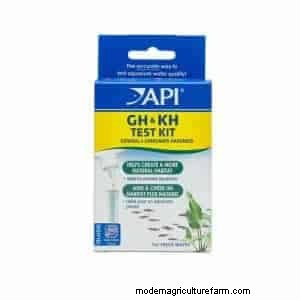 Basically, all test kits do it approximately the same way. I prefer test kits made by API (link to check the price on Amazon). This is a liquid test. The level of your PH is going to be measured by how many of these drops you put in the water.
Tip: If you have a hard time seeing the colors when testing the water, hold it against a white piece of paper.
Tip # 2: Make a list of all your measurements. You will be able to track all the changes in your tank to see if it maintaining its stability.
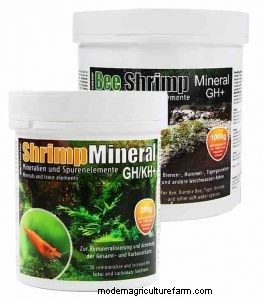 1. Shrimp minerals GH/KH+ and GH+
They contain all minerals important for shrimps. Shrimp minerals re-mineralise e.g. RO water, rainwater, desalinated water etc., raising total hardness (°dGH) and carbonate hardness (KH) at a ratio of °dGH/KH: 1.0/0.5. Shrimp from habitats with a neutral pH do very well in water prepared with this mineral salt.
Shrimp minerals GH/KH+ and GH+ (link to check the price on Amazon).
Note: There are many other types of shrimp minerals on the market (Aqua Blue Wizard, Shirakura Liquid Minerals, Shrimp King Shrimp Minerals, Shrimplab Minerals, GlasGarten products etc). They are all good products and it is up to you to pick one.
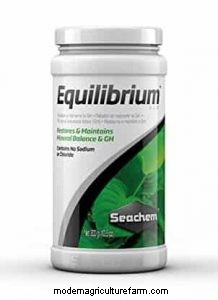 2. Seachem Equilibrium
Seachem Equilibrium will raise your GH. It is primarily calcium sulfate and magnesium sulfate.
It is a good choice if you do not want to raise the KH or pH. However, you will have to add it every time you do a water change.
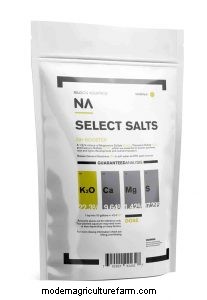 3. GH Booster
You can also use GH booster (link to check the price on Amazon) or similar products, which normally contain calcium and magnesium sulphates. Gh Booster is a 1:3:3 mixture of Magnesium Sulfate ( MgSO4), Potassium Sulfate ( K2so4) and Calcium Sulfate (CaSO4). It raises General Hardness (GH) in soft water and RO water sources.
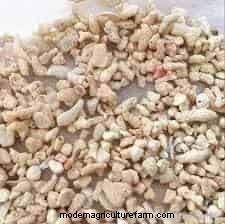 4. Crushed coral
Keep in mind that Crushed coral will raise not only your GH but also your KH. Another potential problem is that Crushed coral can raise the pH like crazy. Unlike specialized products, you do not know exactly how many you need to add. It is always guesswork and testing. The results can be very unpredictable if you are trying to work with precise numbers.
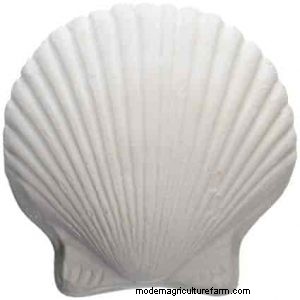 5. Wonder Shells
They contain magnesium and calcium. Therefore, when Wonder shells dissolve, they release these elements into your aquarium and raise the GH.
Another great thing about Wonder shells is that they usually do not raise KH or pH. They aid in the maintenance of these parameters by neutralizing harmful acids, which result from organic decomposition. The Wonder Shells should be placed in an area with low water flow for best results. Do not place them in filters.
Do not add too many at once.
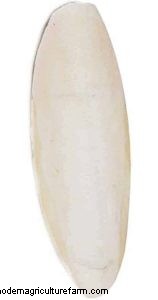 6. Cuttlebone
It is a good way to increase your GH. Cuttlebone dissolves slowly. It means that it is less likely can cause overdosing. At least, it will give you some time to react.
Note: For example, calcium blocks dissolve allot faster in the soft water potentially causing overdosing with calcium.
7. Aragonite
This mineral is available as rocks or sand. Aragonite acts the same as crushed coral. It is made up almost entirely of calcium carbonate. Therefore, it releases both calcium and carbonate into your water.
| I highly recommend to read my article “How to Supplement Shrimp and Snails with Calcium”. |
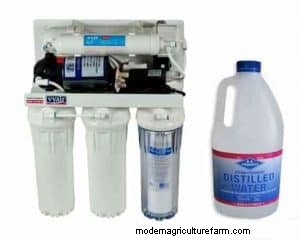 1. Reverse Osmosis or Distilled water
In order to lower GH in a shrimp tank, you will have to use RO/DI (check the price) or Distilled water. Reverse Osmosis or Distilled water is pure water. Basically, it is free from any bacteria, minerals, salts, and impurities. The TDS of this water is close to zero.
Use this water during small water changes to start lowering your GH. It would be a good idea to change a little every day or two and try to lower the GH by 2ppm.
Do not do any sudden changes! Be patient, acclimatize your shrimp or you will simply kill them.
Note: if you do not have Reverse Osmosis or Distilled water, either you can boil water or use a deionizer will lower GH. It is possible to remove bicarbonates of calcium and magnesium by simply boiling the water.
You can read more about “Best RO/DI systems for Shrimp tank” right here.
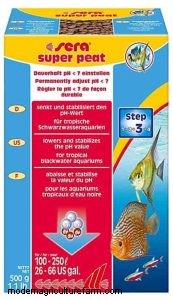 2. Peat moss
It softens water and reduces its hardness (GH). It is advisable to aerate the water for 1-2 weeks in a bucket containing peat moss. Use an air pump to aerate it and approximately in 1-2 weeks, the water will be softer and more acidic. After that, use this aged water when making partial water changes in your tank.
Water quality parameters play an important role in shrimp life. The poor water quality is the leading cause of disease, stop feeding, retardation of growth, mortality, and breed failures. The maintenance of good water quality is essential for both survival and optimum growth of the shrimp.


