
Welcome to Modern Agriculture!

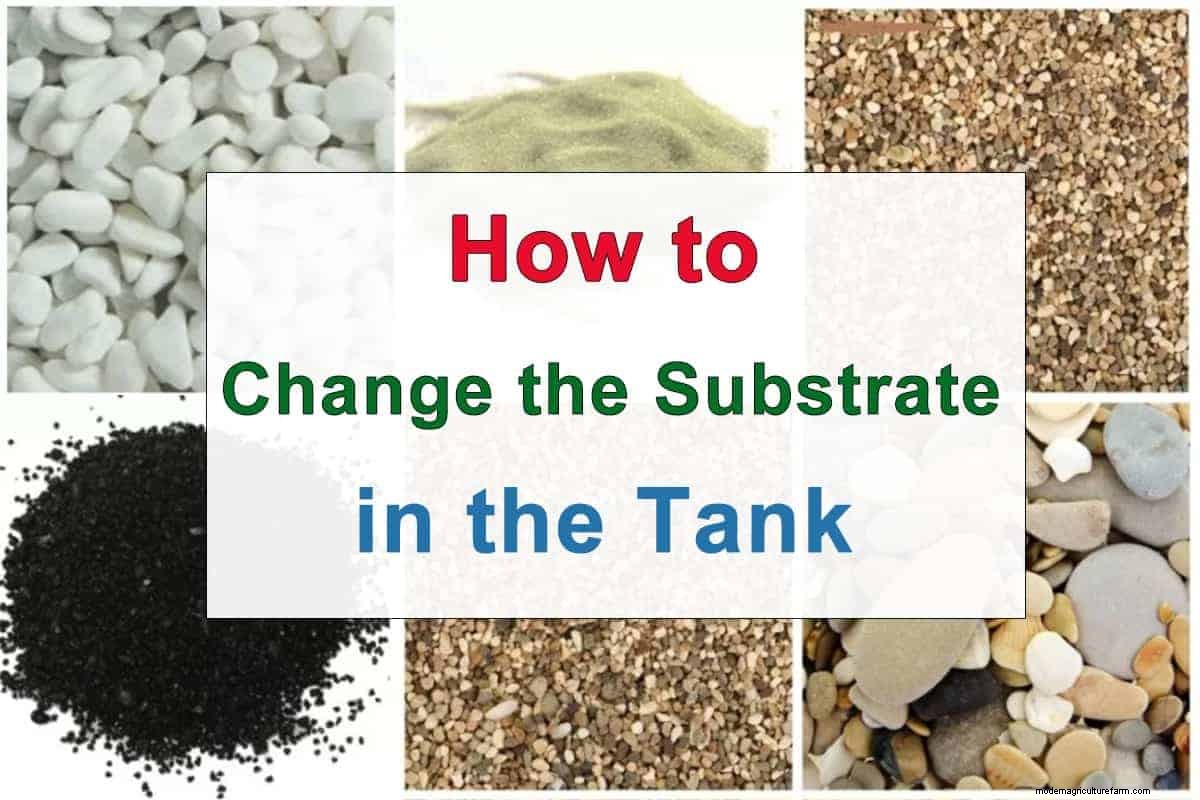
Changing the substrate in the tank is one of the most dreadful and stressful experience not only for the fish and shrimp but for the hobbyist as well. If you have had the ‘pleasure’ of doing it before, you can understand the scope of potential problems it can cause and why we often keep putting this off.
Unfortunately, lots of people do not understand that changing the substrate can disrupt the nitrogen cycle in the tank or put it through a mini-cycle as the bacterial levels build up again.
In this article, I will talk about different ways of how to change the substrate in the tank step-by-step, pros and cons, and what we can do to increase the chances of doing it successfully.
However, before we jump into discussions, I need to start off with some basic explanations regarding beneficial bacteria and ‘mini’ cycles. It can be especially helpful for those who are new to this hobby.
Ammonia is released by fish, shrimp, snails, etc. as waste products, which produce ammonia. Beneficial bacteria are used to cycle our tank because these bacteria eat ammonia and nitrites products. So, the accumulation of high concentrations of ammonia and nitrites, which is toxic to fish and other aquatic organisms, is prevented by nitrifying microorganisms (Beneficial bacteria). This is called a nitrogen cycle.
Basically, the nitrogen cycle is THE MOST important process in the aquarium. It refers to the establishment of beneficial bacterial colonies. Therefore, our goal is to keep it as stable as possible.
There are many species of beneficial bacteria but all of them can be divided into two main categories:
However, sudden and big changes in the tank can disrupt this cycle, and harm the beneficial bacteria. Depending on how badly those beneficial bacteria were hurt, we can have a so-called mini-cycle, or in the worst-case scenario, even the cycle crash.
Read more about it in my article – Everything about Beneficial Bacteria in Aquariums.
Mini-cycle (also know as New tank syndrome) is the result of an insufficient amount of beneficial bacteria compared to the existing bioload in the tank.
We can often see mini-cycles in newly set-up aquariums when they are caused during the introductory phase by adding too many fish at once.
That is why it is never recommended to fully stock the tank right after the cycling process. We have to keep in mind that the tank is not established and that the bacteria colony is not large enough yet to consume a lot of bioload.
Although in a well-established tank it is a lot harder to cause these mini-cycles to occur, it can still happen if we remove some part of nitrifying bacterial colonies from the tank.
In most cases, mini-cycles last anywhere from a few days to a few weeks. Mini-cycling is different for each tank, just like cycling.
There are two popular misconceptions regarding beneficial bacteria:
Beneficial bacteria attaches itself to any surfaces throughout the aquarium, it is on the décor, live or fake plants, driftwood, rocks, tubes, heaters, glass, substrate, and, of course, in the filter of your tank.
Every other surface you may have within your aquarium targets for bacterial growth.
Although it is true that the majority of your bacteria is living in your filtration system, it does not always mean that it can be enough to handle all the bioload in the tank by itself.
The substrate also covers a huge portion of the tank, therefore, changing the substrate in the tank can be detrimental to the aquarium’s bacterial colonization because it is going to be a big hit to the nitrogen cycle.
Changing the substrate is a very debatable topic. Even though everybody does it their own way, there are 2 main techniques of doing it:
1. Partial substrate change.
This method is often used with large tanks, or when it is not possible to relocate the livestock. Therefore, people change 1/3 or ¼ of the substrate once every week.
| PROS | CONS |
| Suitable for any tank | The process may last for weeks |
| Safer | Very messy |
| Does not require a holding tank | Very stressful for the fish |
2. One-time substrate change.
This method cannot be used in all tanks. The main advantage is that it can be done in one hour with good preparation.
| PROS | CONS |
| Suitable for small to medium sized tanks | Risky |
| Fast | Requires a holding tank |
| Less messy | Stressful for the fish |
To change the substrate, you need to have a plan and a checklist of materials you need.
Important: We can often see that the substrate is marketed as “pre-rinsed” or “pre-cleaned” by manufacturers. DO NOT trust them. Even though the substrate itself can be clean, their bags often contain dust, debris, grit, or other residues from the workshop it was packaged in. We do not want any of that in our tanks.
If you forget to rinse your sand, your tank can turn into an uninhabitable cloudy mess. It’s normal for sand to take some time to settle to the bottom of a tank. However, it will take way longer for the sand to settle if you forget to rinse it.
When I was a beginner trying out sand, I made the mistake of not rinsing my sand before adding it to the tank. My sand never settled naturally and I ended up removing it entirely to try again.
The rinsing process to clean sand is really easy.
Depending on how much sand you have, it usually takes from 15 minutes to 1 hour.
First of all, you need to do your research because some products can leach ammonia. Therefore, before changing the substrate in the tank, we have to get rid of it.
For example, if you check my article “Top 5 Substrates For Planted Aquariums” you will see that many products leach ammonia.
Once everything is ready and all preparations are done, it is time to actually change the substrate in the tank.
Check your water parameters for the next week before adding the animals. Depending on the substrate, it may leach ammonia even after it was at 0 in the bucket.
That is why it is very important that the quarantine or holding tank should be cycled as well! We never know how long we will have to keep them there. If it is not cycled, everything will die there.
In some cases, people do not have another cycled tank to keep their fish for a week or more. What can they do?
Generally, you can only hope for the best that the filter has enough beneficial bacteria to avoid mini-cycle.
The algorithm of changing the substrate remains the same. Except that all animals should be put back in the main tank right after the process is done. In addition:
People often use old water after changing the substrate. Is it reasonable?
I do not think so.
As I have already said, the water actually does not hold the beneficial bacteria so you do not need to keep it. The only reason to use it – because our animals are already acclimated to it. However, this argument is valid only for a short period of time.
This trick can be used only when we are partially changing the substrate in the established tank.
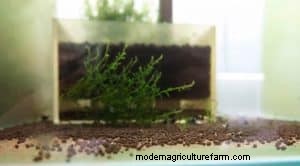
Some shrimp species (mostly Caridina species like Crystal shrimp, Blue bolt shrimp, etc.) require active substrate. Active (buffered) substrate means that the substrate alters water chemistry (pH).
The buffering capacity of the water (KH) neutralizes the acidic soil.
Depending on how much of a buffering system in the water, the active substrate may last from several months to 2 years. Nonetheless, eventually, any active substrate stops being active and becomes inert.
In order to avoid the problem of changing the substrate, or at least make it simpler, some professional shrimp breeders use a bare bottom tank (or very thin inert substrate) with a large pot filled with active substrate.
Therefore, every time they need to remove or change the substrate in the shrimp tank, they simply take out the pot and replace it with another one.
If you decide to use this trick, DO NOT forget to prepare the soil beforehand! It may leach ammonia. In addition, you need to have some beneficial bacteria as well, otherwise, you may get a mini-cycle.
Although it may not look really nice. Nonetheless, it is efficient and it works.
Changing the substrate in the tank can be a real pain, especially in large aquariums. If we do not do it the right way, the tank may take months to balance back out. It is a big job and I would not advise doing it without meticulous preparation.


