
Welcome to Modern Agriculture!

Aquascaping is quite an expansive field as it’s an integral part of aquarium keeping. A variety of elements are used in the aquascaping business, but rocks form the backbone of any reliable aquatic layout. They provide the fish with hiding areas, offer anchoring support for plants, and create a more natural-looking environment.
Among the many types of rocks available for aquascaping today, there’s one type that stands out the most – basalt rock.
Yes, basalt rocks are safe to use for fish tanks, thanks to the material being inert. In other words, it doesn’t alter the water’s chemistry or overall quality. But what is basalt to begin with? Basalt rocks are formed of molten lava and are different than your regular volcanic rock, although not by much.
The notion of volcanic rocks describes a category rather than a specific piece. This category refers to all types of volcanic rocks resulting from cooling magma, no matter their mineral content. Basalt rocks make for a specific type of volcanic rocks with a specific mineral content. They are low in silica, contain less than 20% quartz, and come with a mix of biotite, labradorite, olivine, and other exotic elements.
Unlike regular volcanic rock, basalt rocks showcase a less porous surface, as they appear fuller and harder. They’re also impressively heavy, to the point where it will impact the aquarist’s ability to perform adequate aquascaping.
Basalt rocks are considered igneous rocks (‘fiery’) and do not alter the water’s pH or overall chemistry. However, this is only true for basalt stones used in aquascaping. In reality, basalt is even used in agriculture for its, you guessed it, ability to alter the soil’s pH.
Fortunately, the devil is in the details. The type of basalt used in agriculture comes in powder form and is generally used in conjunction with fertilizers to increase soil pH and enrich the soil with various minerals. These include calcium, potassium, magnesium, and others.
In compact form, basalt doesn’t leak any minerals into the surrounding environment, so it’s safe to use for aquariums.
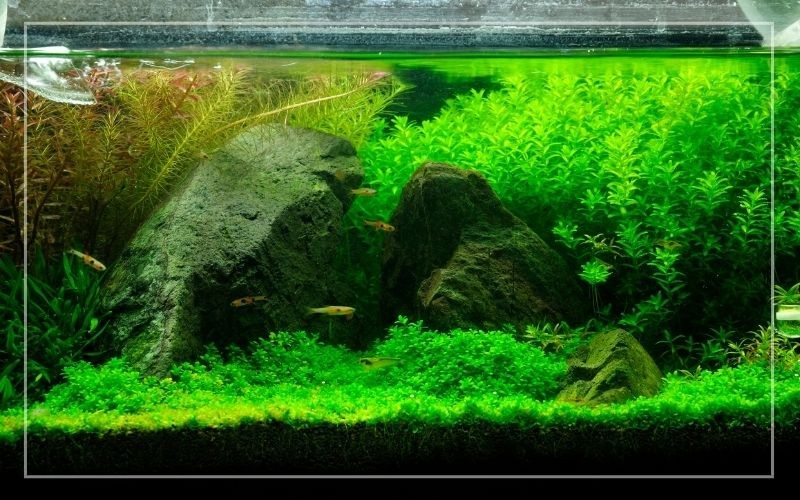
Yes, basalt rocks are great for aquascaping, so long as you can fit them within your system. It’s worth noting that basalt rocks are different from your regular aquascaping rocks for various reasons. These include:
The high density – Basalt rocks are generally smooth and dense with no visible porosity, holes, or crevices. So, plants may find it a bit more difficult to latch onto the rock’s surface at first. Porous rocks also serve as home for various cultures of bacteria inhabiting their many crevices. Basalt rocks don’t fit that category.
Other than that, basalt rocks are great options for your tank. They provide a sturdy base for your plants, offer a great visual contrast with more brightly-colored elements like fish, plants, and other decorations, and are inert.
Just make sure that your tank can hold them, and remember to pressure wash or even sterilize them before use. It’s not uncommon for basalt rocks to carry various pathogens or chemicals into the tank and poison the environment. This isn’t a problem specifically linked to basalt rocks, but any aquatic component being added to an aquarium in general.
The right answer to this question comes in 2 forms. On one hand, we have basalt rocks which are inert. In other words, they won’t leak any minerals in their surrounding environment. They are also large, hard, and unfit to use as substrate. From this perspective, no, you can’t use basalt rocks as substrate for your plants.
On the other hand, basalt is being used as a nutritious substrate in powdered form. When crushed to dust, basalt actually transfers various nutrients to its surrounding environment. It will also influence the pH of the water or soil in which it is kept. The problem is that this only applies to agriculture. I am unaware of any instances of basalt dust being used as a plant substrate in life aquariums. So, don’t even bother with it.
Instead, you should stick to normal substrates to provide your plants with adequate support. The substrate you’re choosing for your plants should:
Basalt rocks make for a great addition to any aquatic setup. They are hard, inert and create an interesting aesthetic contrast with the surrounding environment. Just be wary of the rock’s density and weight to prevent any potential accidents along the way.


![Can You Use An Edger Along A Fence [Without Causing Damage]?](https://modernagriculturefarm.com/article/uploadfiles/202211/2022111711215970_S.jpg)