
Welcome to Modern Agriculture!

The Jersey cattle originate from the island of Jersey, located on the Channel. There is no assurance as to which where the original races were. The most probable native bases of this race are the small black cattle of Great Britain and the great Colorado of Normandy. This theory is consistent with the fact that the Channel Island of Jersey, Guernsey, and Alderney was part of the Duchy of Normandy and became the domain of Great Britain.
In 1734, islanders motivated by the interest aroused by their small cows decided to preserve the characteristics of the breed and banned the introduction to the island of cattle that were not destined for slaughter. In this way and from this date onwards, the genetic purity of the breed is ensured and the name given to the crossbreed is explained.
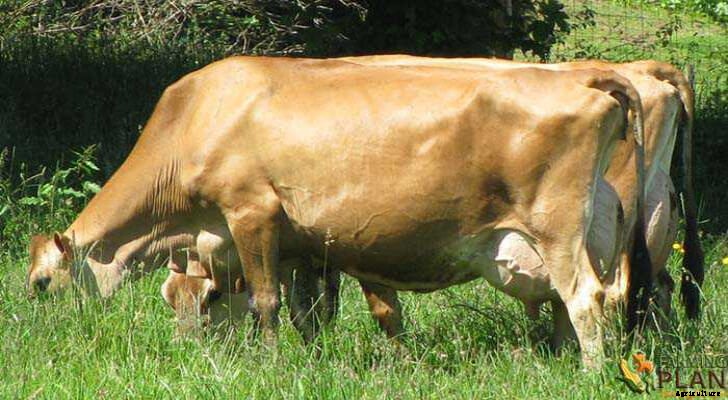
The Jersey cattle are a breed exclusively oriented towards milk production. This breed is considered the second milk breed worldwide. Jersey catches the eye because of its small size and femininity. It is the best to produce milk anywhere in the world, under special conditions including the tropics.
In addition to this, the typical concave profile, with broad forehead, short and emaciated face, prominent orbital arches, broad nose and incomparable vivacity make up its traditional head. Her femininity, her affection and meekness and the silky characteristic of her thin, loose skin distinguish her from all the dairy breeds, which indicates her high efficiency by transforming the food into milk.
The colors range from the light bay, through the brown, to the almost black, accepting the spots. The color of the udder belly and inner thighs are lighter than the rest of the body. All cows have black snouts and black eyelashes. It is an animal of small size, 1.25 m height and average weight at maturity between 350 and 430 kg.
Fine bone and excellent legs, which give it the possibility of attaching very easily to any type of topography, including the hillside area. Jersey’s calves are born with a weight of approximately 25 kg. You can also Read Cow Farming
Feeding Jersey cattle should be based on fodder that provides enough fiber.
By thermal floors, the recommended diet is:
In addition to its solids diet, the animal demands water in proportion to 6 percent of its live weight. If the cow weighs 400 kilos, requires 24 liters per day.
The Jersey cattle are a breed that is raised primarily by the production of its milk. It has a daily milk production of approximately 13 kg with a fat percentage of 5.5%. The duration of lactation is 279 days on average.
Jersey cattle are very attractive as a cross-breeding component in tropical and subtropical countries. Among all the dairy breeds in the temperate zone used to improve livestock in the tropical zone, only Jersey contributed to the creation of highly prized breeds.
This guide has been created to help you learn the history and origins of Jersey cattle. We hope that it was helpful! If there is anything else we can do for you, please let us know. Good luck with your research!
As A Reference: Wikipedia


