
Welcome to Modern Agriculture!

The Hampshire Sheep originated in the south of England. Its name owes it to the locality from where “Hampshire” was developed. This breed comes from the crossing of several species, including the Willshire Horn, Berkshire Knot, Southdown.
The Hampshire or Hampshire Down is a breed of sheep which originated around 1829 from a cross of Southdowns with the Old Hampshire breed, the Wiltshire Horn, and the Berkshire Nott, all horned, white-faced sheep. The Hampshire Downs are an area of chalk hills in southeastern England that stretches for about 20 miles from Winchester to Salisbury.
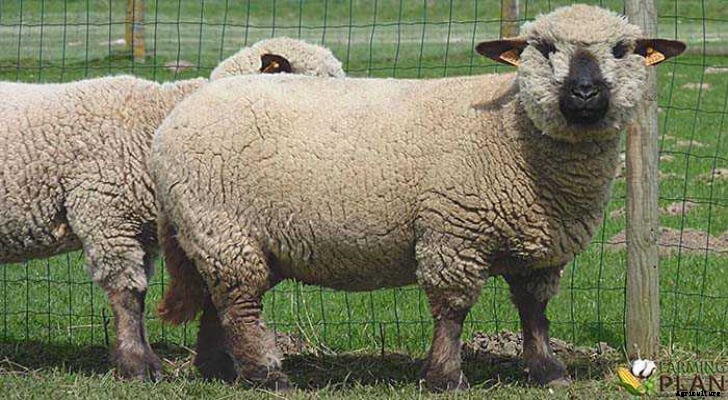
The Hampshire Sheep is a species that is great. The males arrive to weigh between 115 to 150kg while the females arrive to weigh between 80 to 115kg. The fur is white, except on the face and on the legs that do not have wool covering and is black or dark brown. The hooves are black. An additional feature of this breed’s coat is that it is shiny.
The ears are the same color as the face, without inclination, are straight, and measure up to 10 to 12cm. The male and female both of this species do not have horns. The skin of this breed is light-colored can be pink or blue and is flexible. One of its reproductive characteristics is seasonality considered as short although not as short as the Suffolk.
The months of greater reproductive activity are in the months of October, November, December and January. This breed is used for crossing with the Corriedale and Merino to obtain fattening animals. The resulting offspring can increase by 200 g. per day. In this way, you can obtain a lamb finished in 6 months, with a live weight of 35 kg, and produce lambs for slaughter.
The Hampshire Sheep feeds mainly on grass, and studies have shown that this breed assimilates herbs well as they convert the forage they consume into fiber and muscle more than any other breed, indicating that their feed conversion is efficient.
The Hampshire sheep is a dual-purpose breed. Farmers take advantage of the production of their meat, and the demand for wool produced by this species. Its meat is consumed by several countries for being of good quality, that is why the farmers are careful in their production to be able to import this race to countries like Brazil or Belgium.
They have very steep bones, covered with layers of lean meat. While wool is used for the production of knitting yarns, flannels, and socks.
The Hampshire Sheep is a breed that adapts very easily to the surrounding environment. In the year 1889 was created in the locality of Salisbury England the Association of Sheep Hampshire, where today still works. That same year the same association was created but in another continent.
In the United States, this type of sheep was not reported until World War II and began to import again this breed from the year 1865 from England to the United States. It has a very docile character, easy to handle, which makes raising small herds not difficult. Sheep grow easily, and lambs are big at birth.This breed can have quiet deliveries and without any complications.
A census conducted in New Zealand in 2008 revealed that there were at least 2,000 sheep from the Hampshire breed. Females have a high maternal instinct and are good milk producers.
The Hampshire or Hampshire Down is a breed of sheep which originated around 1829 from a cross of Southdowns with the Old Hampshire breed, the Wiltshire Horn, and the Berkshire Nott, all horned white-faced sheep. These were native to the open, untilled hilly stretch of land known as the Hampshire Downs. I hope this guide has helped you! Good luck if you’re thinking about starting your own flock!
As A Reference: Wikipedia

