
Welcome to Modern Agriculture!

Goats are a superb multiple purpose homesteading livestock. They provide meat, milk, and property maintenance. Even if you live on a small homestead, there is enough space to keep Pygmy or Nigerian dwarf goat breeds to help achieve your sustainability goals. In this guide we will go over many broad topics on goats, how to purchase goats, start up costs, bringing your goat home, feed, care, and much more.
To begin, the first thing that should come to mind is how much it will cost to keep goats. The cost to buy and keep a goat depends on a myriad of factors, many of which fluctuate greatly based upon location.
The price of goats is impacted not only by the time of year, but also by the breed, age, and sex of the animal. Heritage breed goats are often far more expensive than other breeds. A quality Billy goat can fetch a high price and may be more than well worth the money, but you should never simply believe the goat is a great breeder, healthy, and docile based upon the say-so of a seller you do not know.
Expect to pay between $85 to $250 for a quality goat that is not a rare or heritage breed.
Goats are herd animals and need to be kept with either their own kind of a similar safe companion. The best companion for a goat is another goat. But, sometimes you cannot afford to purchase or even find, two quality goats at the same time.
Choosing a safe companion for a single goat might seem like a simple proposition, but that is not necessarily so.
My Nigerian dwarf nanny goat and my female Blue Heeler were the best of friends until my Billy goat arrived. Some folks are adamant that dogs, with the possible exception of trained livestock guardian dogs, should never be allowed around goats.
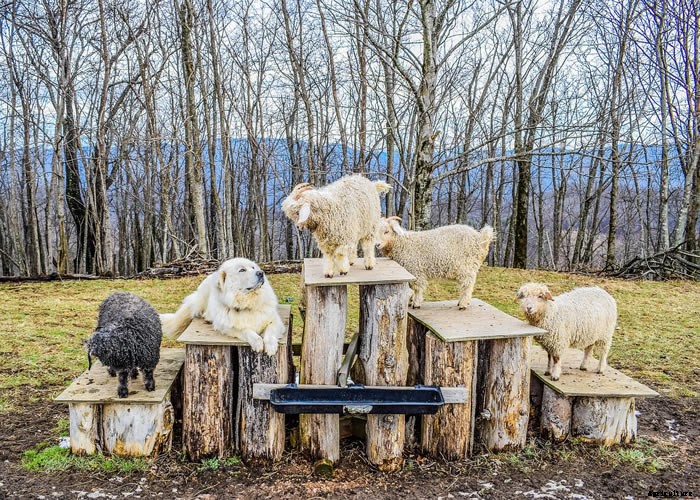
I have seen horrible results of goats being exposed to dogs, sometimes even ones that had previously gotten along. Carnage between the species has not been my personal experience, but lethal attacks by otherwise docile dogs on goats definitely do happen.
Sheep are typically considered a safe companion for a goat. But, my homesteading friend Sarah allowed her two goats to free range several hours a day with the sheep and one ewe rammed an equally large wether – castrated male goat. He later died from internal damage.
Even if you purchase more than one goat at the same time, there is no guarantee that they will get along. Novice goat keepers should never try to keep two Billy goats at the same time, at least not in the same pen or in pens where the two males can see, hear, or smell each other.
Your sweet nanny goat might not take to a new doe being introduced to the herd at first. She may horn or roll the doe, not so much in an effort to hurt the new addition but to establish herd dominance.
When adding a goat to your homestead, the best rule of thumb is to make introductions slowly. I prefer to place a new goat where it can see, hear, and smell the others but not have immediate access to them. The other goats wander over to see the new arrival and get used to each other over the course of several days before they are allowed a supervised meet and greet. Expect some posturing and fussing, but after an hour or two of watching the goats everyone should settle down and the animals can be turned out together.
Always make introductions early in the day so the animals have time to get acquainted and the new arrival fully accepted before they are penned up together at night
A standard size goat should be offered between two to four pounds of hay or natural forage to browse on a daily basis. Goats, like cattle, are ruminants and have four stomach chambers. Because of their ruminant status, a goat has an incredibly high metabolism and consume far more feed that what their size might indicate.
Hay and natural foraging items should be the primary source of food in a goat’s diet to avoid getting bloat, becoming overweight, or developing other health problems. A legume based hay is best for goats, but bales that are also comprised of alfalfa and some clover are fine as well.
But, do not purchase or cultivate hay that is too high in alfalfa or cover if the same hay is going to be fed to non-ruminant livestock, such as equine. Alfalfa hay contains a higher percentage of minerals, protein, and vitamins ruminant livestock need to consume a healthy diet. The calcium levels in alfalfa hay are also highly beneficial to nursing nanny goats.
Goats must ingest enough roughage to keep their rumen in proper functioning order. Long fiber hay is necessary for the bacteria-rich rumen in the first compartment of the stomach, to function. This large rumen chamber should feel “spongy” in texture when gently massaged through the fur.
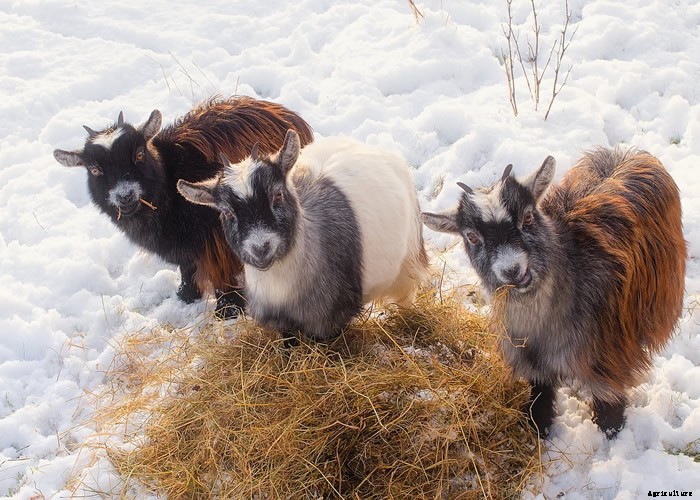
Chaffhaye also makes an excellent supplement to traditional hay and grain feed in a goat’s diet. This type of hay is garnered by an early cut of tall grass or alfalfa that is mixed with bacillus subtilis (probiotic culture) and molasses. This type of hay is not readily available at agriculture stores in my rural area, so I pour a little molasses onto the goat feed once a week – or more often if I have a pregnant or nursing nanny. Because chaffhaye is more nutrient rich than typical pasture baled hay, a 50-pound bale is equal to nearly 100 pounds of traditionally baled hay.
Grain feed, or all stock feed, should be a supplement to the hay and browsing feeding habits of a goat herd. Mixing a quality all stock grain feed with cracked corn is highly recommended instead of allowing the goats to get too used to just the sweet taste of the grain feed. The cracked corn will infuse more nutrients into the diet of the herd that the all stock or sweet mix grain feed alone.
Typically, only a tiny bit of grain is given as a treat or small dietary supplement during warm weather months – unless you do not have enough land for the goats to browse in addition to hay bales being fed.
During the cold weather months, livestock are given increased rations of grain feed to infuse more minerals, protein, vitamins, and other nutrients into their diet. During the summer I give my small stature goat breeds 1 cup of grain daily. A standard size goat could be safely given up to 2 cups. But, this is merely a treat for my spoiled herd and not a true need dietary need because they have free fun of nearly 56 acres for browsing.
Grain feed should be regulated carefully to avoid overfeeding that can not only cause potentially deadly bloat, but also colic – which could be equally lethal.
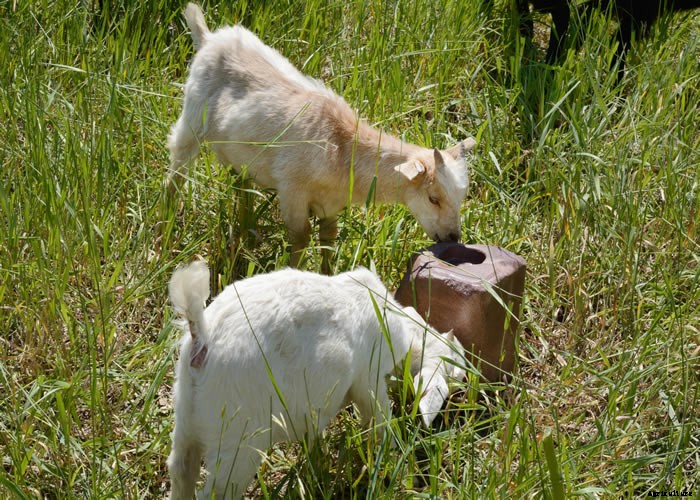
Goats should have access to mineral blocks on a year round basis and a salt block at least during warm weather months. These all livestock mineral blocks are available at agricultural stores like Rural King and Tractor Supply for $2 to $5, on average.
I also highly recommend keeping baking soda in a feed bowl in the goat pen as a free choice treat. The baking soda helps stave off bloat and treat it naturally if a goat contracts it. Many goat keepers also sprinkle a little bit of baking soda on top of the daily grain rations to help thwart the development of bloat.
The cost of a 50 pound bag of grain feed will vary depending upon the brand purchased and your location. In my rural area, such nutrient-rich feed ranges in price from $8 to $12 a bag.
Most goats are kept on a farm for milk, meat, or brush clearing. But, there is another avenue of goat farming that can also be fulfilling and lucrative … fiber goats. While sheep are the primary fiber animal in the United States, fiber goat farming is increasing in popularity and earning many small herd keepers a substantial amount of extra income.
Locating a fiber goat to start a herd is likely going to be more difficult than finding a top quality meat, dairy, or miniature goat breed – depending upon the region where you live and homestead.
If you goat farming operation is going to include fiber goats, learning how to shear them yourself will not only make the homestead more self-reliant but save you money in the process.
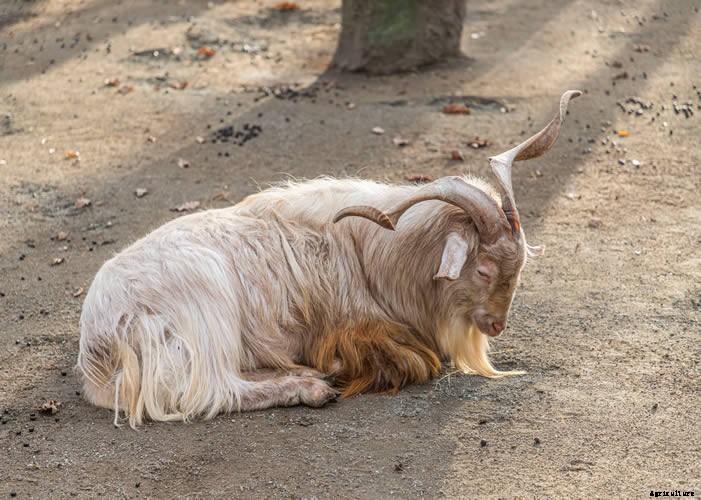
Goats, like sheep, are sheared twice a year. The traditional shearing times are in the spring and early fall. It is best not to shear goats too early in the spring or in the late fall because they will be too cold without their hair – even if you place them inside a goat coat to protect them from the elements.
If you live in a climate where the weather stays warm nearly year round, it is likely safe to deviate from the recommended shearing times to avoid the goats from becoming too hold and their mohair and cashmere from growing so long it becomes matted or tangled.
Always do a thorough inspection of each goat’s whole body to find any abrasions created during the shearing process. Even small cuts should be cleaned and have a triple antibiotic ointment applied or spray the area with Blu-Kote to protect the wound from infection. An untreated wound that is exposed to livestock manure and other dangerous debris can lead to potentially deadly infection in a short amount of time.
Many fiber goat farmers and dairy goat farmers use the time when the animals are tethered to a stand to conduct full health inspections, de-worm, and give vaccinations to the herd.
A goat hobby farm is an agricultural activity where the animals are raised for personal use – be it for meat, milk, fiber, or brush clearing or a small degree of supplemental income. Unless you make the minimum amount of money required to report the income to the state and federal government, you are not mandated to complete any type of business related filing or USDA inspections for the meat and milk you produce for on the farm – family use.
Hobby farms are not permitted to deduct livestock and agricultural related expenses on their income taxes. Even if your goat farming operation is nothing more than a hobby, that does not mean you will necessarily be absolutely free from government rules, regulations, and permit reviews. Odds are if you live in a rural area you can simply go out and buy as many goats as you want and erect a fence using any materials you desire – in any spot you want.
But, if you live in a suburban or urban area, or even a small town in a rural county, there may be limits to the number and type of goats you can purchase. If you live in a “right to farm” state the rules governing keeping livestock are often less stringent than it states that have not passed a mandate related to small scale farming by residents.
In addition to limits being placed on breed and number of goats being kept inside a municipal area, a permit to keep the animals, rules governing pen materials and placement, as well as an inspection of the grounds, may be required. Always check local and state laws related to keeping goats and other types of livestock before purchasing animals or materials. If found in violation of local and state laws penalties can include not just steep fines, but jail time.
Selling farm related items that were grown or raised on your land from a roadside stand on the same property typically does not involve any type of permit or government inspection – but there may be exceptions to this general rule of thumb depending upon where you live.
Herd sharing activities often occur on both goat and cattle hobby farms and farm businesses. Engaging in herd sharing agreements is the primary way keepers of milking animals can earn an income from the raw milk they produce without running afoul of the law.
Regulations against the selling of raw milk or products made from raw milk exist in the vast majority of states. Even in states where it is wholly illegal to sell raw milk or raw milk products it is often legal to sell a share in an animal. The shareholder is entitled to milk the animal and consume or use the raw milk in food stuffs – in most states.
As with all farming activities and livestock purchases, check local and state laws pertaining to herd shares before selling stock in an animal and allowing raw milk to be removed from your farm or homestead.
When starting a livestock for profit operation of any type you need to maintain in-depth and quality records of all purchases and expenses for tax purposes. Securing the services of an accountant that has experience with agricultural businesses is also highly recommended.
Even if you new goat herd business venture is only a part-time gig that does not make a dime that first year, you may still be able to claim typical farming expenses on your income tax return.
This is just a brief overview of some of the farming business related expenses of which I am familiar. I am not a tax professional of any type – but highly advise you work with one when setting up the homesteading business. He or she can guide you through the necessary record keeping process you should engage in to provide proof of expenses as well as other key tips that can help you properly document the fiber goat homesteading business – and hopefully help you save money in the process.
Joining a goat association, fiber artists organization, or homesteading can help you learn more about industry trends, supply and demand and to connect with potential buyers.
Oftentimes, belonging to such groups offers more than knowledge sharing for newbies and marketing opportunities. Being a member of a goat or fiber arts club – that meets either virtually or in person, can foster a sense of community that can help bolster your spirits and celebrate your victories as you journey towards creating a successful homesteading based business.
Curtail your excitement when shopping for goats long enough to develop a strong and financially feasible plan to purchase and raise just a small to medium herd to maturity. Remember to factor in the cost of vaccines and veterinary reviews if you are going to be selling live goats or products from the goats as a commercial farm – even if your farm business is small and little more than a part-time endeavor. Planning out the new goat farm business to the smallest detail will help your create a realistic budget of both your time and your money.
After you have considered these factors, I will always encourage you to dive right in and enjoy this great adventure of raising goats.
Disclosure: We may earn affiliate commissions at no cost to you from the links on this page. This did not affect our assessment of products. Find full disclosure here.
