
Welcome to Modern Agriculture!


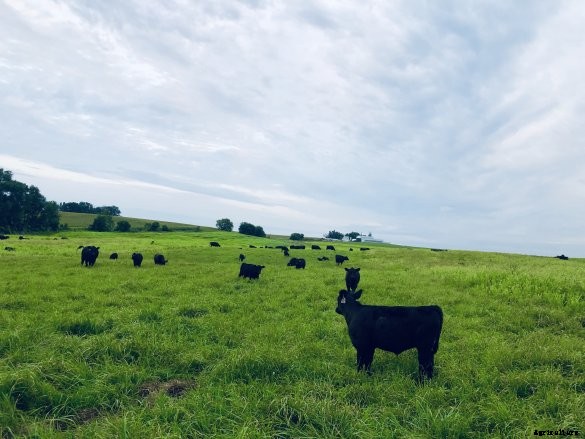
Bruce and LeeAnn Waugh are family farm descendants who branched out on their own to become first-generation ranchers. They began building their legacy decades ago on 80 acres of land near Goodhue, Minnesota. Now, Cannon Valley Ranch (CVR) boasts more than 300 acres, a herd of about 100 registered Angus, and their son Taylor as co-owner.
Bruce, LeeAnn, and Taylor run the business and also work off the farm. Bruce works for WinField United, LeeAnn is a beef nutritionist for their local cooperative, and Taylor is a trained agronomist and meat cutter. The primary income for the ranch comes from their beef cattle operation.
Over the years, they made decisions to grow and adapt their cattle business to create a sustainable future for their family. Their latest venture — direct-to-consumer sales of premium beef including wagyu — is aimed at diversification.
“We have to play the cards we’re dealt,” Bruce says. “We live in a fairly densely populated area of Minnesota, 45 minutes from downtown St. Paul and 30 from Rochester. There are a lot of hungry mouths to feed, and in this past year with the pandemic, it made sense for us to branch out and start a meat business to supply to our community.”
The Waughs’ son Aaron works in the restaurant industry in Rochester and, as the marketing arm of the ranch, has opened doors for CVR beef to be sold in restaurants locally.
With this new cash flow and Bruce and LeeAnn’s support, Taylor was able to purchase a neighbor’s 100 acres that border their own and help scale the ranch.
“It’s my land and I have my own cows, but we use those acres to feed and pasture cattle, managing them all together under the umbrella of CVR, and we split the income,” Taylor explains.
Taylor also leads the genetics program on the ranch. After being approached by a lab manager of an affiliate to ABS Global, the Waughs seized the opportunity to accelerate the genetic progress of their herd and breed high-quality cattle with balanced traits through ABS in vitro fertilization. This is how they could add the purebred Akaushi (wagyu) to their ranch and do so more quickly than a traditional breeding program. They are now a satellite collection facility for ABS Global.
The Waughs have hosted beef breeders at their farm for IVF collection. They’ve also worked with multiple dairy breeders who have won supreme champion at the World Dairy Expo.
By collecting a fee for their IVF services on a per-head basis, the Waughs are building the bottom line.
Through LeeAnn’s work as a beef nutritionist, she helps local farmers feed their cattle, some of which are the offspring of CVR bulls. There is also potential for the cattle to return to the ranch for direct beef sales.
“It’s the combination of all the little things that help cash flow and sustain our ranch,” Taylor says. “A huge problem with the beef industry is that ranchers may only get paid once a year. For us, we’ve had fall female sales and a spring bull sale, but the opportunities in between are the hat tricks that keep us working.”
Bruce says they aren’t afraid to take risks on the ranch, but it is calculated when they do.
“Not everything we try works out, but we don’t risk the financial viability of the farm,” he says. “And if there’s one industry that requires resilience, it’s agriculture.”
Continuing to work off the farm is one of the strategies they’ve employed to keep the farm going. Taylor’s ultimate goal is to ranch full-time and keep providing value to their customers.
“If we can keep growing and become more sustainable, that will help us get on the farm full-time,” Taylor says. “We could work toward buying our customers’ calves, or through our customers, retain ownership and market the cattle through a branded beef program. This approach would help them get more money for their cattle so that they can be sustainable as well.”
Working together as a family has taught the Waughs many lessons.
“One thing we’ve gotten a lot better at is communicating,” Bruce says. “I jokingly say we have our board of directors — well, that’s me, my wife, and Taylor — and often we need a board of directors meeting to keep the communication going.”
In a family operation, learning how to communicate and doing it well is a journey, not a destination, Bruce adds. They’ve learned there is always room for improvement and the work they put into it strengthens their own relationships.
“We were weaning calves this year and because of our grass situation we had calves in early, but we weren’t set up well. Calves weren’t cooperating, and it seemed like nothing went right,” Bruce says. “After we finished we said, ‘Let’s talk about why this didn’t go well.’ It was nothing personal, only an opportunity to figure out how to make it better next time. It’s never about blame or quitting.”
Family is their priority and also the foundation on which they can support each other, says Bruce. Sometimes you have to know when to give each other a break or when to shut off the mom or dad switch to instead be a coworker or a boss.
For Taylor, the biggest lesson he’s learned from his dad is patience.
“It truly is a grind of doing the little things right day in and day out,” Taylor says. “We have to sit back and kind of analyze the business as a whole and be able to adapt quickly when needed. That’s one advantage to being a smaller ranch — we’ve been able to pivot a lot faster than others to take advantage of opportunities, and truly be adaptable.”
A true family operation, Cannon Valley Ranch reaches beyond home base in Minnesota. Bruce and LeeAnn’s daughter, Lindsay, and her husband operate a ranch in North Dakota. They have used CVR breeding stock for their herd and have sent cattle back for the meat business. Bruce and LeeAnn’s son Aaron helped CVR to supply premium Angus beef to Forager Brewery in Rochester, Minnesota, and The Bleu Dog Cafe in Welch, Minnesota.


