
Welcome to Modern Agriculture!

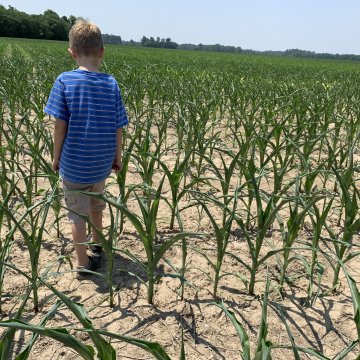
According to the August 12 U.S. Drought Monitor, dry conditions are spreading throughout the western and northern Corn Belt. Corn crop conditions also are slipping, with good to excellent ratings falling 4% in the August 15 Crop Progress Report compared to the week before.
While drought-stressed crops may not make grain, they could be used as livestock feed. However, growers must watch for high levels of nitrate in the lower leaves and stalks, according to Dorivar Ruiz-Diaz, crop nutrition specialist at Kansas State University (KSU).
“The accumulation is because the plant assimilation of these nitrates into amino acids is slowed because of the lack of water, a crucial component to numerous plant processes,” Ruiz-Diaz says in the Aug. 12 Agronomy E-Newsletter from KSU. “Nitrate toxicity in livestock is because of its absorption into the bloodstream and binding to hemoglobin, rendering it unable to carry oxygen throughout the body. The result is eventual asphyxiation and death.”
The specialist urges producers to test drought-stricken forage prior to harvest. Most land-grant universities have testing capability, as do private laboratories.
Here’s how to do it:
“If a harvested forage is high in nitrate, blend the feed with another forage such as prairie hay or brome,” Ruiz-Diaz advises. “That will dilute the total nitrates in the animal’s diet and could potentially reduce the risk of poisoning.”
He adds that high-nitrate forages chopped for silate and properly ensiled are a safer option for livestock feeding. Microbes will metabolize about 50% of the nitrate during the ensile process, decreasing the risk of nitrate poisoning.
“It is still not a bad idea to leave 6 inches of stubble in the field. That is the portion of the stem with the highest concentration of nitrates,” he says.
Safe to feed
4400-8800 ppm Limit to 50% of total dry ration for pregnant animals 8800-15,000 ppm Limit to 25% of total dry ration. Avoid feeding to pregnant animals 15,000 ppm or more Toxic. Do not feed Source: University of FloridaGrazing high-nitrate forages can be a dangerous practice. Although animals tend to consume the leaves and the top portions of the plant, which contain less nitrates, the risk of consuming a high-nitrate portion of the plant still exists. In addition, the longer the animal is left on a field and the more that animal is forced to eat the remaining forage at the lower portions of the plant, the greater risk of nitrate poisoning.
If grazing is the only option, follow these four suggestions from the University of Nebraska-Lincoln:


