The damage done by vermin can be categorized into 2 major groups:
direct damage to the environment, feed, food, equipment, and/or infrastructure and
disease carriers and disease multipliers.
Mice and rats
The most common mouse, Mus musculus, has a territorial range of less than 50 meters. The life span of the mouse is 9 to 12 months and sexually matures in 6 weeks. Each mouse has about 3 to 6 offspring per cycle with a maximum of 10 cycles per year. The Norway rat can produce up to 100 offspring per year, while the roof rat can produce around 90 per year. Both have a territorial range of less than 100 meters. Mice and rats primarily cause environmental damage but can carry and transmit pathogens including Salmonella and Pasteurella multocida (fowl cholera).
While mice are very curious, rats are very suspicious. This is something to keep in mind for control strategies. Both rats and mice are mainly active during the dark hours. If seen during the daytime, there is most likely an infestation of mice or rats.
Rodent control program
Rodent control is part of any biosecurity system. Rodents can be carried in boxes, feed, bedding, and other materials that are brought onto the farm from suppliers. Therefore, it is not just the poultry farms but also feed plants, hatcheries, storage facilities, and processing plants that must have a rodent control program in place.
Three methods are involved in rodent control: mechanical, biological, and chemical.
Mechanical control
This should start with the design and construction of the farm. There should be a perimeter fence with a metal sheet on the bottom that is at least 40 centimeters vertical and has a 20-centimeter horizontal lip on top.
The foundation of the building should be 50 centimeters in the ground (rodents are very good at digging!) and 1 unit with the floor.
A concrete apron outside the house of at least 20 centimeters is recommended.
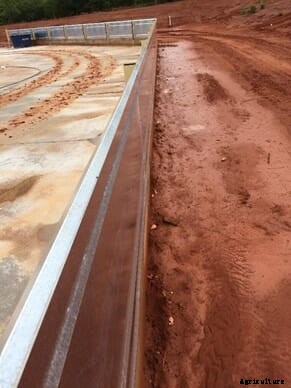
A vegetation-free perimeter ( 3 to 10 meters) around the farm buildings and a vegetation-free perimeter (3 to 10 meters) around the complex fence (see photo).
A 3-meter gravel area around the poultry houses is recommended. Broken roof tiles are often used since they are sharp and rodents do not like to walk on them.
If feed is bagged, store the bags on top of pallets. If stored in silos, control and remove any spillage under and around the silo.
Remove and prevent any standing and open water sources.
Remove dead flocks immediately, store in rodent-proof containers, and incinerate daily if possible.
Repair and fill holes during the house clean-out.
Prevent any piling of debris within the farm perimeter. This includes accumulation of old equipment, old nests, construction materials, and any trash that can serve as rodent breeding sites.
Biological control
Traps with bait and glue traps can be used and must be checked daily and refilled as needed.
Rodents will stay close to walls while traveling, so place traps against walls and in dark areas.
Chemical control
Most products work on an anticoagulation principle using a poison inside a bait. The benefit is that it takes some time before the poison becomes active. Thus, the rodent does not die immediately after consuming the poison. This is an important factor in rat control.
Create and use a baiting plan that shows the location, box numbers, and traps to conduct an accurate evaluation of bait consumption or catches in your logbook.
Under normal conditions, bait stations are placed every 25 meters around a building and should be checked 4 times per week. If infested, increase the number of stations to every 5 meters and increase the number of times stations are checked.
Indoor bait stations depend a bit on the house construction but must be present in the attic and feed room.
Rats are clever and suspicious. Therefore, in stations with bait consumption, discard any bait and replace it with fresh new bait.
Rotate baiting products every 6 months.
Anticonception products are relatively new but can work very well. First, determine where there is bait consumption and then replace those stations with the anticonception product.
During the clean-out period, maintain the chemical pest control.
Beetle
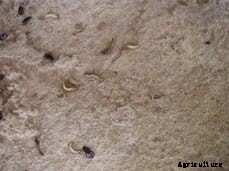
The main beetle in the poultry houses is the lesser mealworm, also named litter beetle or darkling beetle. An adult beetle is about 6 millimeters long, brownish black, and oval with 6 legs with a tough chitin exoskeleton. It prefers warm, humid environments. An adult can produce up to 2,000 eggs in its life cycle (about 1 year). Eggs turn into larvae within 4 to 11 days under optimal conditions (humidity and temperature). The total cycle length is dependent on the ambient temperature: 26 days at 31 °C (88 °F) increasing to 90 days at 22 °C (72 °F).
In the chicken house, larvae can be found under the pan feeders, drinking lines, and the outer wall. The outer row feeders are especially popular. Beetles feed on spilled feed, manure, dead flocks, and cracked eggs. They can cause structural damage by chewing into insulation. This damage can be increased by flocks attempting to reach the insects. Adults can be found all over the house, but those in the litter have an opportunity to disperse when the house is emptied. They may escape either to the roof or into the soil. Furthermore, beetles left in litter when it is piled outside can fly and find new houses to infest.
Beetles cause damage by infesting feed and destroying infrastructure. Beetles can carry and transmit viruses, fungi, bacteria, and parasites among the flock and between flocks. Disease agents transmitted by the beetle include Salmonella, spondylolisthesis (kinky back), Pasteurella, pathogenic E. coli strains, and even avian leukosis virus. Gumboro disease is well known to persist between flocks through beetles. Beetles can infect flocks through contact of surfaces and direct consumption of the insects.
Three methods are involved in beetle control: mechanical, biological, and chemical.
Mechanical
Chemical treatments are not very effective at the infestation level. Beetles are known to be resistant to many pesticides. Therefore, good management practices along with a prevention program are the most effective ways to control beetles.
Remove the litter after the flock has been depleted. If litter is left outside to dry and has beetles, those beetles can fly back into the house or other places on the farm. Cover or treat the litter to keep the beetles contained until it can be removed from the farm.
Ensure that the house drains well and is ventilated properly to prevent wet litter. Check for and repair any water leaks immediately. Beetles need water to thrive, so it is important to keep the house environment dry.
Repair any structural damage as these areas can be used as burrows for beetles.
Allow at least 2 weeks of downtime between flocks. This will eliminate the food and water source for the beetle and allow time for insecticides to work.
Biological
Boric acid can be applied as a pellet to the house. This pesticide damages the skin of the larvae but should only be applied between flocks because it can also injure animals.
Products are being developed that use specific strains of fungi to infect and kill larvae and adults.
Chemical
Carbaryl-based products block the nervous system by inhibiting the enzyme acetylcholineesterase.
Pyrethrin-based products are safe to use while flocks are in the house. These chemicals cause temporary paralysis, but the beetles can produce enzymes that detoxify the chemical. Using pyrethrins synergistically with other insecticides can be more effective.
Insect growth regulators are also available, which prevent formation of chitin so that the larvae cannot turn into an adult beetle.
Professional pest control companies have experts who can readily evaluate your situation and help you develop a good pest management program. Once your program is established, good record keeping is a valuable tool to identify and mitigate vermin issues before they become an infestation problem.