
Welcome to Modern Agriculture!

During the COVID-19 pandemic, Aviagen continues to support customers with a series of informative webinars. One recent webinar focused exclusively on strengthening bird welfare. Entitled “Animal welfare: current and future perspectives,” the online meeting was led by Anne-Marie Neeteson, Global Vice President of Welfare & Compliance at Aviagen® Group.
Neeteson empasized that the sustainability of poultry production depends on the well-being of birds, which is a main priority for Aviagen. In line with the internationally accepted “Five Freedoms” as the ideal state to strive for, their birds are provided with fresh water, quality feed, proper handing, health care, and an environment that is appropriate to their species needs and use.
Neeteson also referenced the “Three Essentials of Stockmanship”: knowledge of and skills in animal husbandry and personal qualities like responsible care. For skillful flock management, adequate training is crucial for all who work with the birds. “Among the more than 50 traits that Aviagen selects for in their breeding program, over one third of a fast growing bird’s focus is on animal welfare,” she explained.
Since 1970, Aviagen has made simultaneous improvements in bird performance, feed efficiency and welfare through its balanced breeding program., This balanced breeding approach will ensure sustainability for the global poultry industry.
Poultry is developed within the three pillars of sustainability: Environment, Economic, and Social. The meat poultry industry through the International Poultry Council (IPC) has prioritized where they can make a difference in these pillars and aligned these with the UN Sustainable Development Goals – this has officially been signed between FAO and the IPC in the Declaration of São Paulo. The environment is protected with sustainable management and efficient use of natural resources. At the same time, poultry production promotes sustained and inclusive economic growth. And, sustainable animal production assures food security, along with human and animal health.
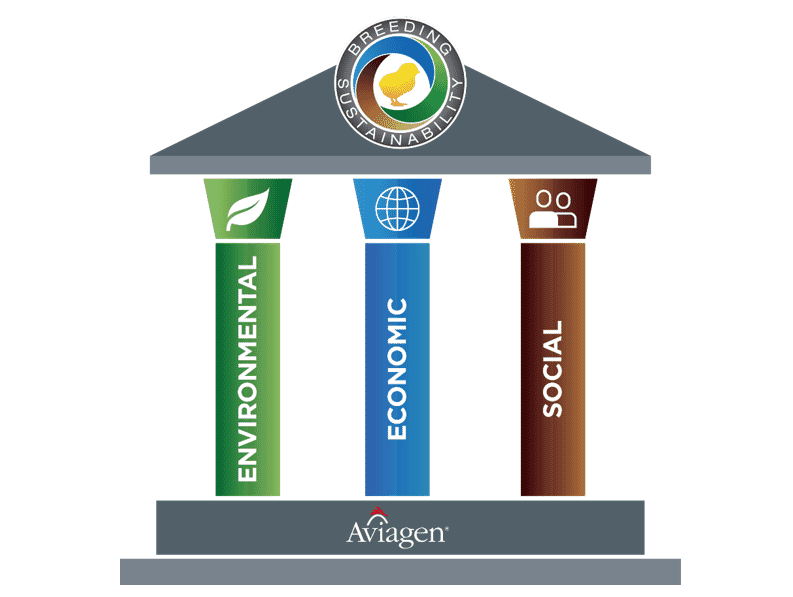
Modern chickens have proven to be more biologically efficient than ever before - each kilogram of live weight now requires less feed and provides a higher meat yield – translating to economic advantages for growers and gains for our planet. Reduced feed requirements mean less land usage and lower transportation costs. Aviagen has calculated that 15 years of genetic progress from 2003 to 2018 serves to lower the energy consumption of broiler production by 16 percent, while decreasing global warming potential with 15 percent less greenhouse gas emissions.
These economic and environmental milestones are achieved while also increasing poultry health and well-being through balanced selection.
Neeteson stressed that it is the industry's responsibility to provide safe and healthy poultry to help feed a growing population, reducing hunger and improving the health, prosperity and well-being of people around the world. Everyone in the food supply chain must commit to global food security by supporting initiatives such as compartmentalization, strong veterinary systems, biosecurity audits and responsible use of antibiotics.
Another major element to keep global supply opens is a sustainable supply of breeding stock from parallel breeding programs, with a large, diverse genetic pool. Gene diversity contributes to economic sustainability by giving producers a range of products to choose from, enabling them to offer the right bird for the right market.
"The right bird for the different global markets results in a sustainable source of protein for everyone, helping to eliminate hunger in local communities around the world," remarked Anne-Marie.
Neeteson ended the webinar with a valuable takeaway: “In poultry farming, the greatest success is through knowledge sharing. It’s urgent that we engage in ongoing, active and transparent communication with stakeholders. We must maintain close collaboration with customers, associations and society as a whole. When we keep close relationships throughout the food chain, continually operating with transparency, education of future professionals, strategic alliances, and vigorous research and development, we’re rewarded with the satisfaction of knowing we’re helping to sustain the industry for today and the future to come.”

