
Welcome to Modern Agriculture!

Today, let us talk about Gir Cow Cost, Gir Cow Milk Per Day and other facts of Gir cattle breed profile.
Gir cow is one of the humped category cattle breeds in India. This is considered as unique in characteristics when compared to other breeds. The cow is originated in Gujarat. It is very healthy & the milk is known as A2 milk. The breed is found in Gir hills and forests of Kathiawar including Junagadh, Bhavnagar, Rajkot and Amreli districts of Gujarat. This breed is also known as Bhodali, Desan, Gujarati, Kathiawari, Sorthi and Surti in different parts of the breeding tract. These Gir animals are famous for their tolerance to stress conditions and resistance to various tropical diseases.
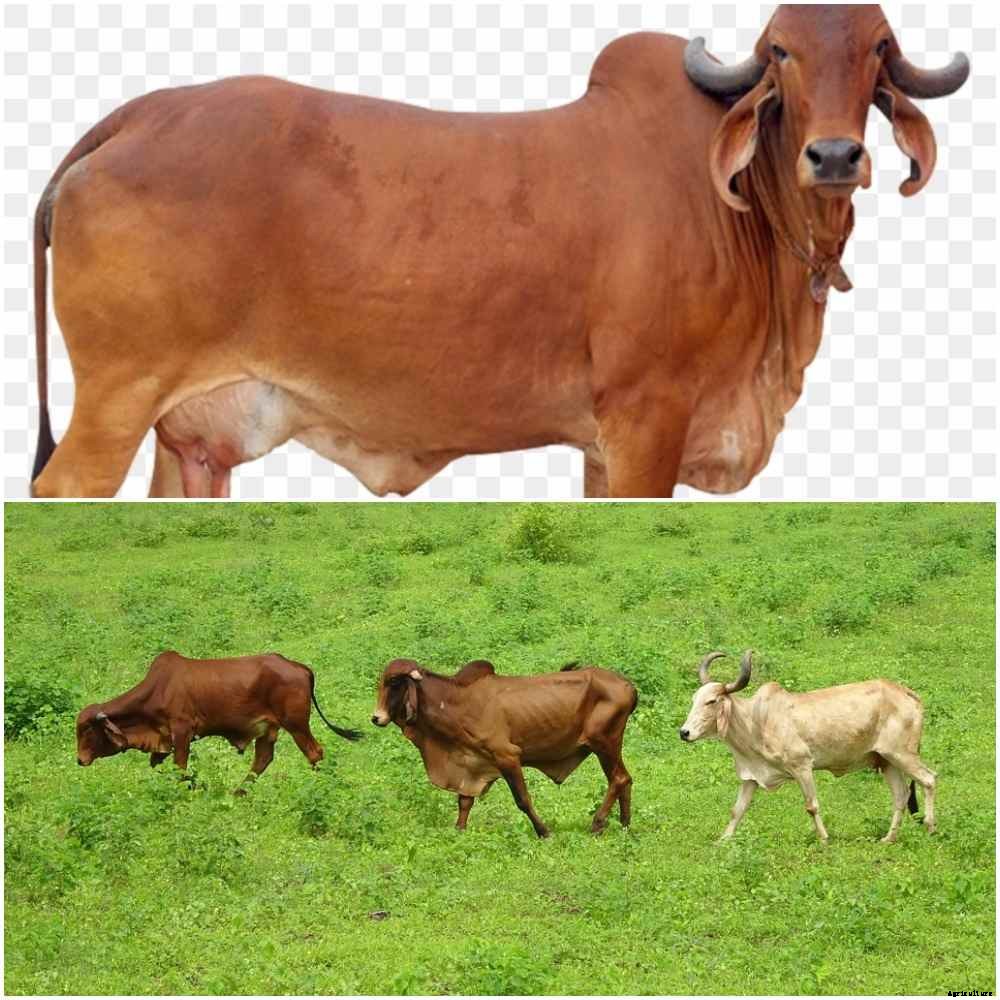
This breed is used to drag heavy loads on all kinds of soil. Other countries like Brazil, Mexico, USA and Venezuela have imported these animals where they are being bred successfully. Most of the Milk Production in Gujarat State is contributed by this breed, Gir holds a promising place among 39 phenotypically characterized Indian cattle breeds (NBAGR, 2015). Other promising cattle breed in Gujarat is Kankrej. Both Gir and Kankrej have been evolved through centuries of breeding efforts of farming and mostly pastoral, migratory communities of Gujarat viz. the Rabari, Bharwad, Maldhari and Charan.
The breeding tract of Gir lies between 20.5˚-22.6˚ latitude and 70.0˚-72.0˚ longitude and is at an average of 400 m from sea level. The soil is medium black, temperature ranges from 7 ˚C to 45 ˚C, humidity varies from 20% to 80%, and annual rainfall ranges from 500-1500 mm with a maximum during the months of July-August. The major cereal crops grown in the area include Bajra, jowar and wheat and the major pulses are grams and pigeon peas. Other crops grown in the area include groundnut, castor, cotton, onion, sugar-cane and garlic. The important trees prevailing in the area are: banyan, rain-tree, neem and acacia.
Read: Jersey Cow Dairy Project Report.
Physical characteristics:
Sr. No. Feature Male Female 1 Height (Avg. Cm) 159.84 130.79 2 Body length (avg. cm) 137.51 131.40 3 Heart girth (avg. cm) 201.41 166.47 4 Weight (avg. kg) 544.00 310.00 5 Birth weight (avg. kg) 20.77 20.77Color:
Red color is predominant, about 80% of the animals have red body color. Yellowish light to dark red color is common in Junagadh/Gir-Somnath district and its adjoining regions. More number of Gir cows in Bhavnagar and Surendranagar districts and to some extent in Rajkot district is red in color with white spots over the body. Animals with completely white coat color and red spots over the body are found near Surendranagar district. Completely white, completely black and yellowish red colors are extremely rare in Gir. Males are darker shades as compared to female cows.
Horns:
The horns of the cattle start at the base and take a sideways downward and backward curve and again incline a little upward and forward taking a spiral inward sweep. Based on the shape of horns, several local terminologies are used for describing Gir animals such as Machiya, Muthiya, Bhila, Patti, Kundha, Boda and etc.
Ears:
Ears are folded like a leaf, hang all the time and their inside face forward. The lengths of ears are longest amongst all cattle breeds (around 30 cm). At the end of the ear, a notch is visible, which is also a characteristic feature of the Gir breed. Based on the shape of ears, different local terminologies are used for description such as Bhungadiya, Fafada, etc. (Maradiya, 2016).
Head, face, eyes and nostrils:
The head is capacious, heavy, convex, like an inverted clay pot, which becomes very narrow below the eyes. The face of the Gir is typically long. However, some livestock owners prefer a short face. These Gir cows eyes are almond shaped. The more distance between the eyes is desirable. The yellow eyes as well as white eyelashes are not desirable. Black nostril is another characteristic feature of Gir.
Brisket, skin and tail:
The brisket is large, but with thin skin. It is very soft and swinging in appearance. It plays a key role in thermoregulation. The skin is loose, smooth and shining in appearance. The switch of the tail is clustered and color is black. A few animals have tails long which touch the ground level.
Hump:
A vertical imaginary line through the midpoint of the hoof should meet the middle portion of hump above. Hump not bending. As the eyelids cover almost a half of the eye and the animals have a sleepy appearance. The hump of Gir cow is the largest amongst all indigenous cattle breeds.
Usually, Gir cow costs from 1 lakh to 2 lakhs rupees depending milk production, age, lactation status and pregnancy status. Generally, Pregnant Gir cow costs more than dry ones. Healthy and young Gir bull also costs in the similar range of Gir cow.
Gir cows can yield more than 12 liters of milk per day.
Read: Dairy Shed Design and Construction Plan.
GIR has been crossed with exotic breeds in All India Coordinated Research Project (Cattle) for the genetic improvement. The major objective of this mega project was to develop a crossbreed strain suitable for the existing environmental conditions. The Animal Husbandry Department initiated a genetic improvement programme for these animals. Young Gir bulls are being progeny tested under this programme.
The Indian Council of Agricultural Research (ICAR) started two projects on Gir cattle, one is executed by the (NBAGR) National Bureau of Animal Genetic Resources for the conservation of the breed and another by the (PDC) Project Directorate on Cattle for genetic improvement.
Gir cattle are exported to Brazil for the global supply of improved breeds of cows for mass production of milk and meat. CROSS BRED cattle yield higher milk, but are not easy to maintain because they are prone to diseases, cannot be used as draught animals and their lactation reduces with each generation.
On the other hand, indigenous breeds are fully modified to Indian conditions, yield milk of a higher fat content and the bulls can be used as draught animals.
JASDAN: Given that the Gir is indigenous to Gujarat, local business should have been milking it to earn foreign exchange. But it seems far away Brazil is doing an improved of this. The South American country today has around 50 lakh heads of this unique breed known for high milk production.
Read: Quail Bird Farming.


