
Welcome to Modern Agriculture!

Home is where the quail are.
With modern farming, there are many ways to raise an animal. There isn’t a right or wrong way, rather, we all learn what works for our space and needs through trial and error. Environment plays a significant role in how we choose to house our animals. What works in one part of the country may not work well in another. This applies to quail too.
Quail are amazing birds, and in previous articles, I’ve written about hatching and brooding Coturnix quail (Coturnix japonica), also known as Japanese quail, and Chinese blue-breasted or button quail (Excalfactoria chinensis), and some other species of quail as well. In this article, I’ll cover the special housing needs of adult quail for their well-being and your success.
As mentioned in my new book, The Quail Lady’s Guide to Raising Coturnix on the Homestead, it’s best to prepare pens for all stages of growth before obtaining the birds or hatching eggs. Both button quail and Coturnix grow fast, and in the blink of an eye, they’ll be ready to be moved. Coturnix chicks will need to be moved to a grow-out cage by three weeks old. The grow-out cage can be an individual pen or the brooder pen. They are the fastest growing of most quail species. Button quail and New World quail species, such as bobwhites and exotic species of quail, can be moved to grow-out cages later in growth, as they’re slower growing and more delicate.
Quail, especially Coturnix quail, are becoming quite popular to raise because they don’t take up much space. The rule of thumb for housing space is 1 square foot per bird. You can add more birds per square foot as you feel comfortable. In the commercial setting, I’ve seen people house 4 to 5 birds per square foot; however, I prefer 1 to 2 birds per square foot as I raise larger, selectively bred Coturnix and like to give them more wiggle room. Button quail and other species can be housed in pens (either on-ground or wire-floored), above ground or on ground, and aviaries. Bobwhites are a New World quail and do well in flight pens and aviary settings. My specialty is the Coturnix quail, therefore I will discuss different housing methods for them.
You can be creative about housing adult Coturnix. They can be kept indoors, outdoors, on-ground, or above the ground. Some important things to consider are:
Again, quail can be raised in really quite small spaces. When I first started raising quail, I lived in a two-bedroom apartment before upgrading to a 5½-acre homestead in Florida.
You can raise them in garages, on your porch, or in your backyard. Quail are the perfect alternative to chickens for the urban homesteaders. I have even read that a person raised Coturnix in a makeshift coffee table in their New York apartment, and when company came over, they just put a tablecloth over it! It is amazing how these birds adapt. If you’re raising them indoors, you’ll need to clean quite often to limit the ammonia build up, as quail do defecate a lot and it can get smelly fast. Ventilation and daily maintenance is necessary to keep you and your birds healthy.
Being ground dwellers, Coturnix do just fine being raised in ground pens. There are several things to consider for ground pens:
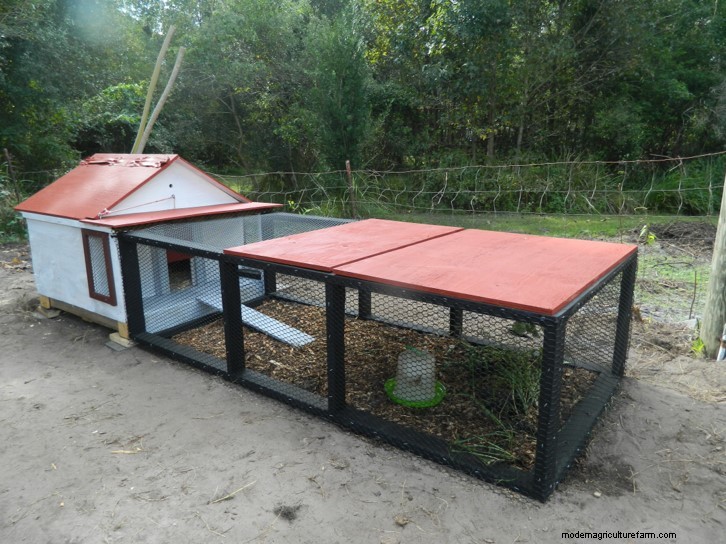
My friend Lisa’s ground coop for her quail. You can see the shavings and also some plants for hiding.
We have tried many methods of raising quail and found that in our environment, raising our quail off the ground worked best for us. There isn’t a right or wrong way to raise quail. Both housing methods are suitable.
Coturnix quail can be happy in an aboveground pen such as a rabbit hutch, guinea pig cage, or small cage made specifically for quail.
Commercial cages tend to be quite small, while other options will give your birds a bit more room. You don’t have to pack them in if space is your concern with the commercially made cages. One square foot per quail is ideal, but based on your comfort level and environment, you can add a couple more quail per square foot in a humane setting, or give them even more space. It’s your call.
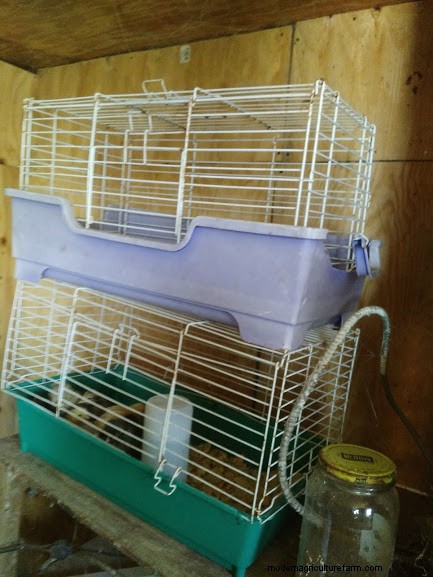
You can adapt guinea pig or hamster cages for quail.
From my experience, there are benefits in raising Coturnix quail in off-ground cages. Quail who live on wire-bottomed cages defecate through the wire and onto the ground below, making it easier to clean their cages. They’re also less likely to get mites or other parasites by living above the ground. Being on wire also gives you cleaner eggs.
You can keep your birds entertained and healthy by providing dust baths in a shallow dish or small kitty litter box, which are easy to clean. Use a combination of ashes, sand, dirt, and some grit. By adding a little oyster shell to the dust bath, the birds can keep themselves clean and also ingest some calcium. The grit will help them digest their food as well as annoy any potential mites.
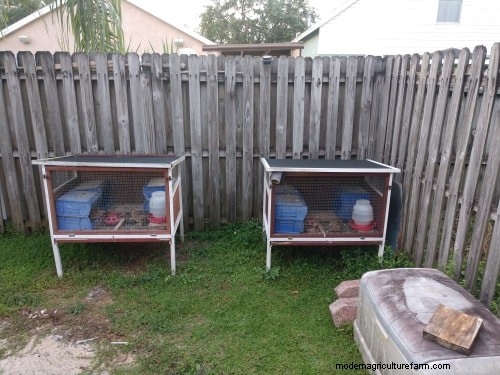
Hutches in the backyard. The roof helps protect them from being spotted by flying predators.
Wire pens can be used indoors (with a tray underneath to collect droppings) or outdoors. Always make sure to protect the birds from the elements. They should be kept out of the wind and rain.
If you house the wire cages indoors, make sure you can commit to daily maintenance to avoid ammonia build up, which can be harmful for you and the quail.
Whether you house quail indoors or outdoors, on-ground, or on wire off the ground, quail raising is an enjoyable experience. Quail are a wonderful alternative to chickens, require minimal space, and can be housed efficiency with their well-being in mind. I hope that these housing method tips give you an idea of what you need for your quail. Remember, there really isn’t a right or wrong answer on how to house quail. It merely is trial and error and what works for you.
If you are a beginner and interested in Coturnix quail, my new book, The Quail Lady’s Guide to Raising Coturnix on the Homestead, is out; it’s a prequel to Coturnix Revolution and highly recommended for all stages of quail raising.
Alexandra Douglas was born in Chicago, Illinois. At age nine, she began raising psittacines (parrots). When she moved to Oregon for college in 2005, she majored in Animal Sciences at Oregon State University with an emphasis in pre-veterinarian medicine and poultry. Alexandra was hooked on quail as soon as she was handed a day-old pharaoh Coturnix. Currently, she owns Stellar Game Birds, Poultry, Waterfowl LLC, a poultry farm that sells chicks, hatching eggs, eating eggs and meat. She has been featured in Aviculture Europe and honored by the Heritage Poultry Breeder Association of America for her research on quail. Her book on Japanese quail, Coturnix Revolution, is a comprehensive guide to raising and understanding these domesticated fowl. Visit her website or follow her on Facebook.


