Welcome to Modern Agriculture!

What is chicken molting? How to tell if my chickens are molting? How long do they molt? What can we do to help chickens get through molting? In this guide, we will answer those questions.
Molting is when the chickens shed their old feathers and grow new ones. They do mainly during late summer or early autumn: cooler temperatures and shorter days.
The important thing to note is that chickens stopped laying eggs during molting. So, understanding how to tell chickens molting from “normal” ones” is very important. This is mostly true if you are raising backyard chickens for chicken productions. Molting chickens=fewer eggs.
Chickens molt in an entirely predictable pattern: the molting starts from the head and neck. Then, it will progress down the back, wings, breast, and finally the tail.
Molting is, in typical cases, a regular activity for chickens. However, it can also occur in an unpredictable manner due to various factors. These factors can include a lack of drinking water and changes in lighting.
Also, brooding chickens tend to molt after their eggs have hatched.
Is it possible to accurately notice when your chickens are molting? In most cases, yes, but it will vary from chicken to chicken.
Sometimes, it’s not very obvious that a chicken is actually molting since they molt so slowly.
On the other hand, molting can cause some chickens to lose weight and even catch diseases. During molting, the chicken’s body neglects the immune system since it’s going to use all energy into feather production.
This is why knowing that your chicken is molting is very important so that you can provide them with enough care.
When you see these signs, most likely, they are molting, and you can take the recommended actions we’ll discuss further below.
For many of us, molting chickens simply means they stopped laying eggs. However, molting has its own purpose and benefits behind it.
Molting is a necessary natural process in a chicken’s lifetime. Chickens are very active animals, and so by the end of the year, their feathers are no longer in good condition.
So, molting is a natural process to replace these old and breaking feathers with warm new ones in preparation for the winter. This is why molting naturally happens in early autumn or very late summer.
However, it’s important to note that chickens are by nature, instinctual animals.
That is, they will molt when they instinctively perceive the condition to be autumn. And, not when they know that it’s actually autumn. They might recognize shorter days due to different lighting conditions. Or, they might perceive it’s autumn due to cooler temperatures, and so they molt.
In baby chicks, you should expect at least four cycles of regular molting:
Then, when they have grown into adult hens and roosters, they will molt twice a year:
Besides their regular molting cycle, chickens might also molt due to stress.
Various causes might cause stress molts. They might get stressed when you add new chickens to the coop. They might get stressed due to food or water shortages. Also, they might also get stressed due to severe weather or directly after brooding for hens.
Obviously, they will also get stressed when they are sick. So, give your chickens enough supplements that can help maintain a normal appetite during stress.
The first molting for adult chickens occurs when they are roughly 18 months old. Before that, however, the baby chicks have already gone through smaller molts, as discussed above.
The adult chicken’s first molt shed its chick feathers, and then the chicken will gain its adult feathers. The chicken might need several small molts before they get a full set of adult feathers. This typically happens until the chicken is around five months of age.
It used to be a common practice (and in some cases, still a common practice) to force a molt. Commercial egg-laying factories might force a molt of its chickens because it can allow enhanced egg production. This is typically done by withholding any feed to stress the chickens for 7 to 14 days. It is now an illegal practice in many locations.
It’s important to note that your chickens have individual personalities. So, they will go through the molting in unique ways as well.
In general, however, the entire process can last from three to sixteen weeks. Some of them might just lose a few feathers and grow them back in only three or four weeks. Other chickens might lose more feathers and can take more than 12 weeks to grow them again.
If you have a sizable flock, you will likely have both of them. In our experience, older chickens tend to take longer to replace their feathers.
It’s also important to differentiate between hard molt and soft molt. A hard molt is when the chicken loses most of its feathers within a short period of time. On the other hand, a soft molt is where the chicken loses its feathers gradually over time.
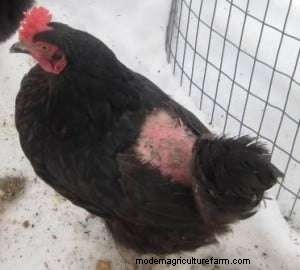
If you see any bald spots, it is most likely a hard molt, and in general, chickens with hard molt will regrow its feathers faster than those with soft molts.
In general, here are some best practices to follow when your hens are molting:
Don’t panic when your chicken is molting and stops laying eggs. Molting is, in most cases, a natural and necessary process that all chickens must go through.
Molting can last between 3 weeks to 16 weeks. Yet, you can help your chickens go through molt by not adding more stress: give them adequate water, feed a high-quality and protein-rich layer feed, and separate them from other chickens when necessary.
Below is a Pinterest friendly photo…. so you can pin it to your Chicken Board!!