
Welcome to Modern Agriculture!


The results of a 3-year study were released last March and they show that the health and well-being for cage-free hens and the people who care for them is actually worse than the conventional caged system. This comes at a time when visibility for how our eggs are produced is on the rise. Recently, actor Ryan Gosling wrote an open letter to Costco requesting that they begin selling eggs raised by cage-free chickens. A few weeks later, Brad Pitt and comedian Bill Maher, and the New York Times Op-Ed page joined him in a call to “Free the Chickens.” The study shows why cage-free eggs probably isn’t giving them what they want.
The Coalition for Sustainable Egg Supply, which conducted the research includes the American Humane Association, McDonald’s, Tyson Foods and many other large scale egg producers and consumers. The study compared the three most used methods for egg production: Conventional Cage (which provides 95% of the eggs in the United States), Enriched Colony, and Cage Free Aviary. Overall, the cage-free system compared poorly to the other two methods in its impacts on hen health and well-being, worker health and safety, food affordability, and the environment.
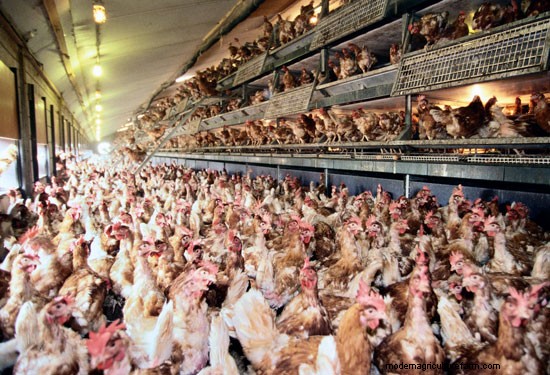
If that surprises you, it might help to take a look at what “cage-free” actually means. Up to 50,000 birds live in one “house” divided into aviary sections of 1,660 hens with open floor space for dust-bathing and roaming, and upper levels with nesting areas, water and feed.
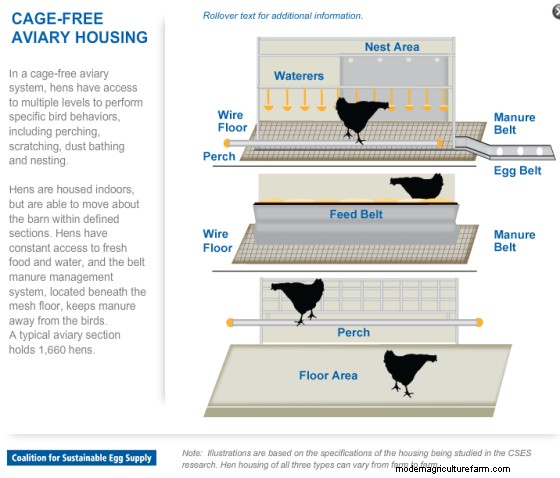
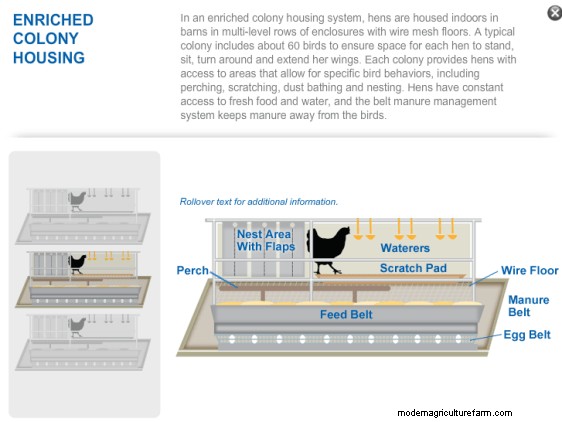
This compares to 100,000 birds in a conventional caged house, kept in stacked cages, and to Enriched Colonies, where 50,000 birds live in stacked cages in a house but have more space per bird as well as areas for dust-bathing and scratching.
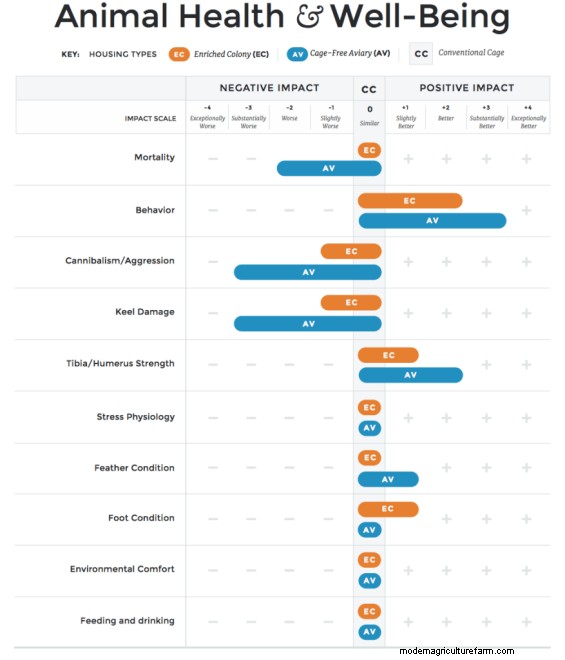
What researchers found was that the leg bones of the cage-free birds were stronger, and they definitely exhibited more of a chicken’s natural behavior. But mortality rates were worse and cannibalism and damage to the hens’ keels from hitting perches were both substantially worse than hens in conventional caged systems. The people taking care of them had substantially worse exposure to particulate matter and endotoxins, probably because of the manure and bedding material on the open floors. Gathering eggs was also more difficult since workers sometimes had to crawl on the floor to collect those that hadn’t been laid in nesting boxes.
Food Safety
There was little difference in food safety, though cage-free eggs had higher levels of Campylobacter, spp (a bacteria that can cause food poisoning) especially when hens laid their eggs on the floor.
 Environment
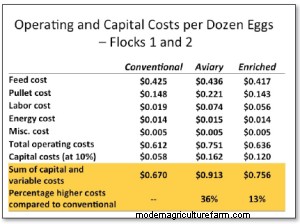
Cage-free eggs have a slightly larger carbon footprint and greater natural resource use than Conventional Cage raised eggs. This is because a cage-free system houses about half the number of birds.
Food Cost
Cage-free eggs are more expensive because of higher rearing costs, hen mortality and lower production per hen.
You can check out more results here.
If consumers want to have more humanely raised eggs, this study demonstrates that we haven’t yet found the method for doing that at a factory scale. On the other hand, the results of the research, along with the visibility about the issue provided by interested celebrities may provide opportunities for those of you raising pasture-based eggs to grow your businesses.
If you’re raising eggs at a smaller scale, your customers might appreciate knowing the difference between cage-free eggs and pasture-raised eggs as they make their purchasing decisions. Most folks probably imagine that the picture on the Costco egg carton depicts the lives of cage free hens. Sharing the difference between what they imagine and what is actually happening is a conversation of a thousand words that you can have by simply sharing pictures.

This research, combined with what people say they want, how much they’re willing or able to pay for that, and how today’s food supply chain works are all part of a larger discussion producers and consumers can have about how we feed our communities and what it takes to make a living doing that. Are there ways of providing large quantities of eggs outside a factory setting that we have yet to explore? Are we willing to pay the cost of humanely raised eggs? What changes do we need to make to our lives, and our laws and regulations to achieve the results we’re hoping for?
Save


