
Welcome to Modern Agriculture!


How did we get to the cattle we have today? Where should we go from here? These are some of the questions Dr. Harlan Ritchie worked to provide answers to in his long and distinguished career at Michigan State University. In Part 1 he looked at the change from the era of large cattle that were work animals first, to animals that were managed for meat production. In Part 2 of this series he shows what happened in the 1900s. We hope it gives you some food for thought as you consider what you want out of the cattle you raise.
During the first third of the twentieth century, the trend to earlier-maturing, smaller-framed, earlier-fattening cattle continued at a gradual but steadily increasing rate.
Here is “Advance.” He was the Grand Champion steer at the first International Livestock Exposition in Chicago in 1900. He was 25 months old and weighed 1430 lb. The International began in 1900 and ended in 1975. The steer and breeding cattle winners were very influential in setting type standards for beef cattle throughout this 76-year period.
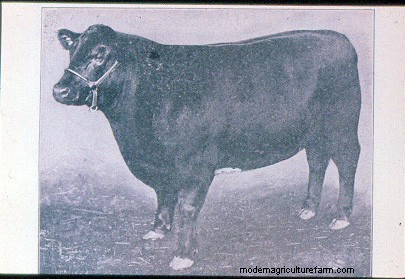
As noted last week, some of the champions of the 1890’s would be acceptable today. The same is true for the photos you are about to see of some of the leading champions of the early 20th century breeding cattle shows. However, the steers were still extremely large.
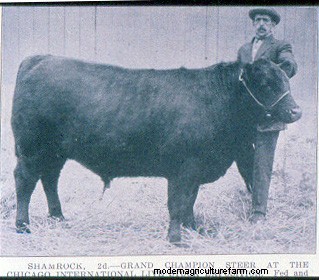
“Shamrock” was the Grand Champion steer at the 3rd International. Shown by Iowa State College, he weighed 1805 pounds at just over 3 years old. [Kathy’s note: One of our readers mentioned that people are taller now than they used to be. So I checked, and sure enough the average man in 1900 was 5’6″ and today is 5’10”. So factor that in as you’re looking at these pictures.]
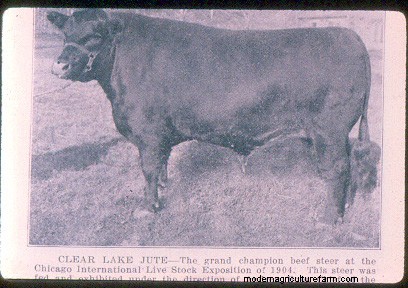
“Clear Lake Jute.” In 1902, this Angus steer weighed 1050 lb at 14 months and won his class. In 1903, he was Reserve Champion at 26 months of age and weighed 1624 lbs. He came back in 1904 to be the Grand Champion steer, weighing 1895 lbs at just over 3 years of age. He was the heaviest International Grand Champion steer. He was exhibited by the Univ. of Minnesota. For a big steer, he appeared to hold his shape quite well.
Now let’s check out some of the cows of the era.
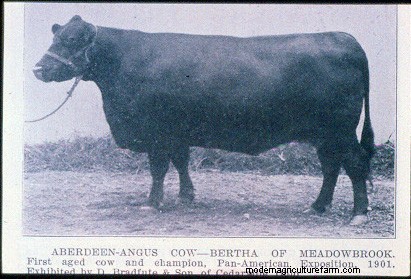
Bertha of Meadowbrook was 1st Aged Cow and Champion Angus Female at the 1901 Pan American Exposition.
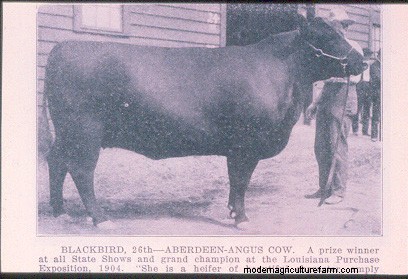
This is “Blackbird 26th,” the Grand Champion Angus Female at the 1904 Louisiana Purchase Exposition.
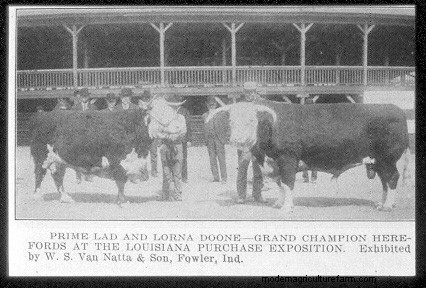
Here are Lorna Doone and Prime Lad, Champion Female and Hereford Bull, respectively, at the 1904 Louisiana Purchase Exposition.
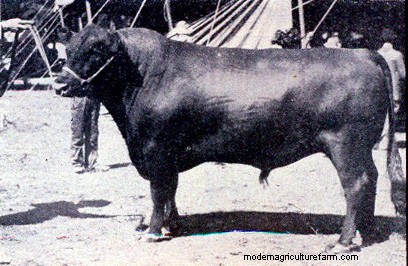
“Peter Sterling.” First prize 2-yr-old Angus bull, 1905 American Royal, Kansas City. A trim, muscular-appearing bull.
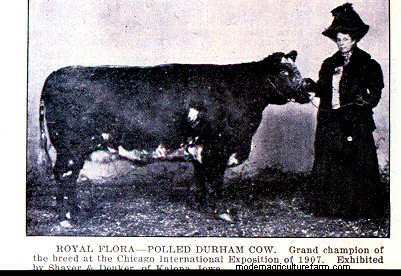
“Royal Flora” was Grand Champion Polled Durham Female at the 1907 International. If this cow was not exceptional, the clothes worn by the exhibitor certainly were!
This is Ringmaster the Grand Champion Shorthorn Bull at the 1911 International as a 3-yr-old. He was also, Grand Champion in 1910 and 1913, but was not shown in 1912.
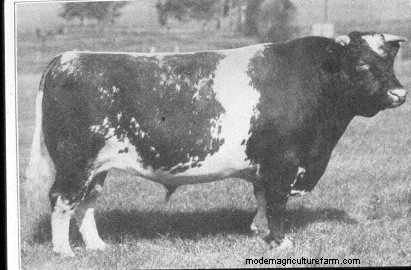
“Nebraska” is the only male winning as a bull and again later as a steer. In 1915, this Angus bull was Champion at Smithfield. He was then castrated and came back to win the Smithfield steer show in 1916. Note that they were starting to put some straw underneath the cattle when they took the photos to make them appear smaller-framed than they really were.
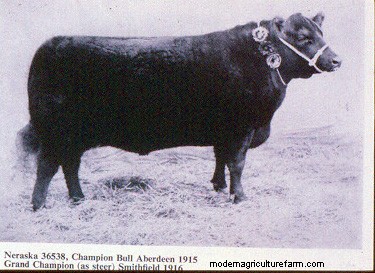
With or without the straw, this 1916 International Grand Champion Hereford bull is very short. Named Bocaldo, this bull was a very influential sire in the Hereford breed.
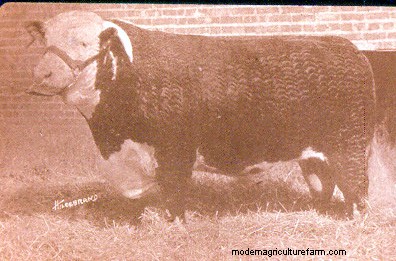
Quality Marshal was 3 years old and weighed 2500 pounds in this picture from 1925. He went on to become a great sire though some of the leading breeders of the day felt that he was too large.
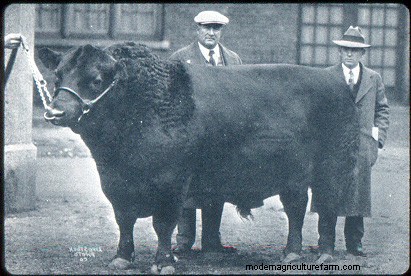
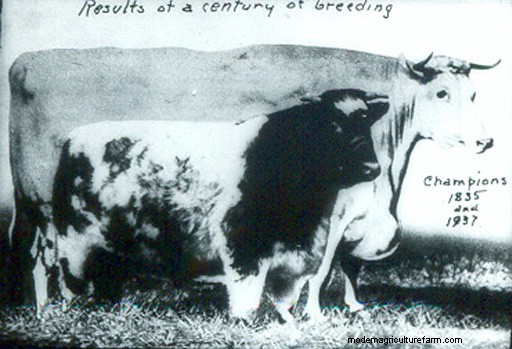
In case you’re having a hard time seeing the difference between these cattle and the 1800s cattle, here is an early example of a photo-shopped photo from 1937.The Shorthorn steer in the foreground was International Champion for Oklahoma A&M College in 1937, weighing 1100 lbs at 21 months of age. The shorthorn steer in the background weighed exactly twice as much (2200 lbs) when he was Champion at Smithfield in 1835 at 3-4 years of age
From the mid–1930’s to the mid–1950’s, there was intense selection pressure for earlier maturing, smaller framed cattle. The terms “baby beef,” “compact,” and “comprest” came into use. Dwarfism erupted in the early 1950’s and was a devastated the purebred industry.
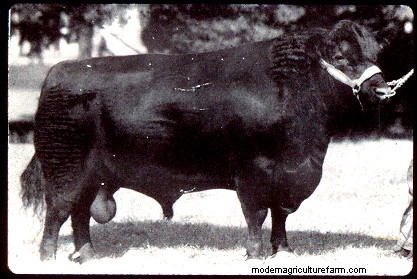
The photo of this 1931 International Champion bull, “Revelation 100,”was taken in 1938. He was long-bodied but relatively short-legged.
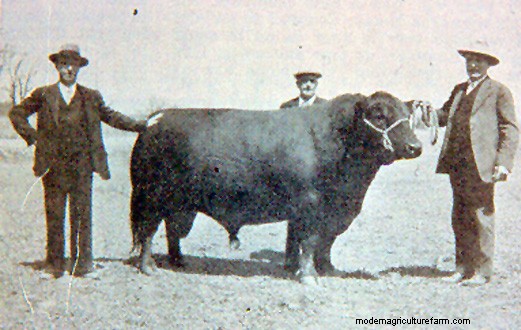
“Bandolier of Anoka 6th” Grand Champion Angus Bull, 1937 International. He was the smallest-framed, shortest-legged, most compact bull up to that time.
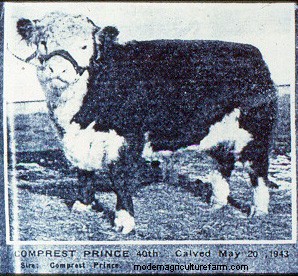
In the 1940s and early ’50s cattle bred by the Comprest Hereford Ranch and the TO Ranch out of Raton, New Mexico became very popular. Both blood lines were extremely small-framed and early maturing. Below are “Comprest Prince 40th” in 1943 and “TO Model” the Grand Champion Steer at the National Western in 1945, weighing in at 965 pounds.
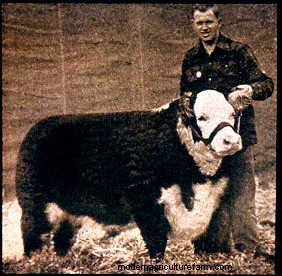
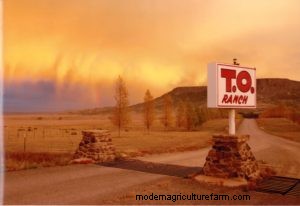
[Kathy here – From here, the cattle get shorter and shorter and fatter and fatter until they look like large pigs. I’m sharing all of Harlan’s photos of this because it seems so strange to have done this to cattle. What is especially odd to me about this is that the most influential breeders were in the west where rangeland forage is sparse and it would seem that a good pair of legs is important for covering ground to find food. I’m not sure why farmers and ranchers of the time thought this was a good idea, but I will look for answers so we can compare that to what we’re thinking now and make sure we’re not headed down our own strange road.]
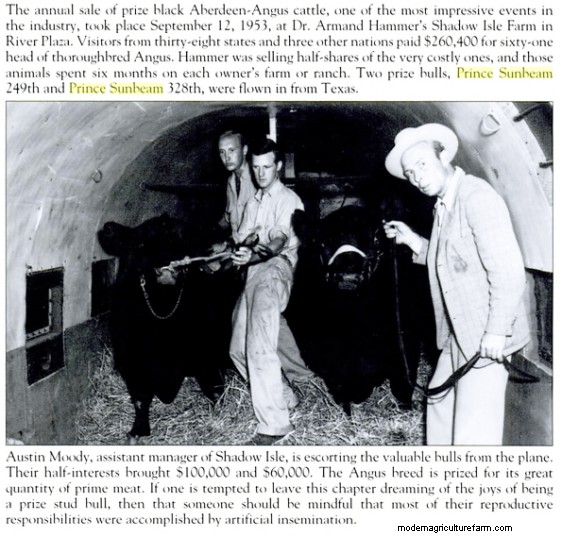
Here’s a newspaper clipping showing Prince Sunbeam 249th and 328th coming off an airplane. Check out what a half interest in them cost: $100,000 and $60,000 respectively. That’s $1 million in today’s dollars. These two bulls were so short that their sheath hair nearly touched the grass.
Meet “Ernie” the Grand Champion Steer, at the National Western Stock Show in Denver in 1948. Note where his topline hits the showman’s beltline. He weighed 895 lbs.
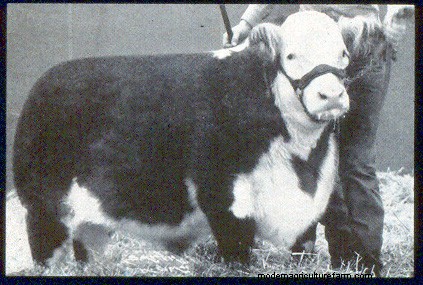
“Big Spring Special.” Grand Champion Steer, International, 1950. Weighing 1025 lbs, he was very fat.
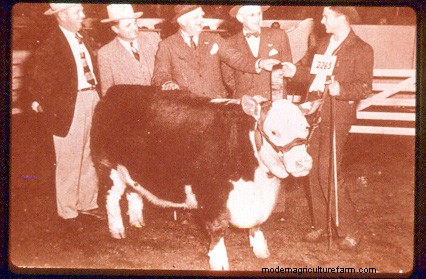
“Lone Star.” Grand Champion Steer, International, 1953. He weighed 1005 lbs. Winning steers in this era were extremely fat, as this photo would indicate.
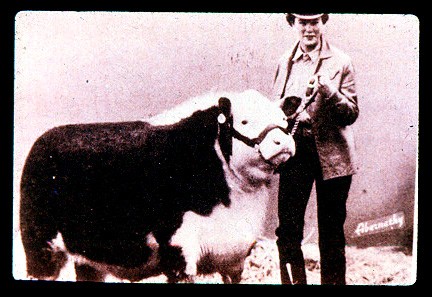
“Hillcrest Larry 62” as a 2-yr-old show bull at the International.
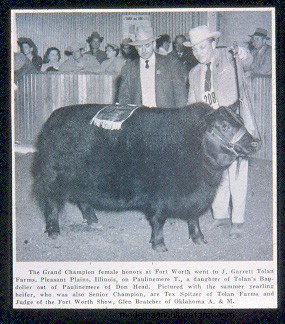
“Paulinemere T.” Grand Champion Angus Female, Fort Worth, 1955.
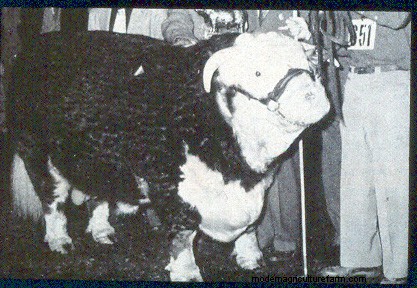
“O Bardoliermere.” Grand Champion Angus Bull, 1953 International.
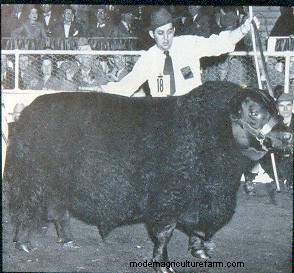
“Black Peer of West Woodlawn.” Junior Champion Bull, All-American Angus Futurity.
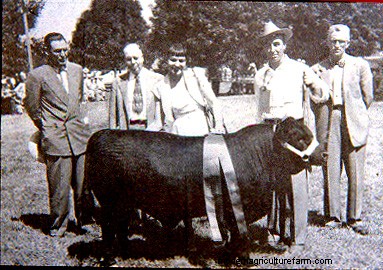
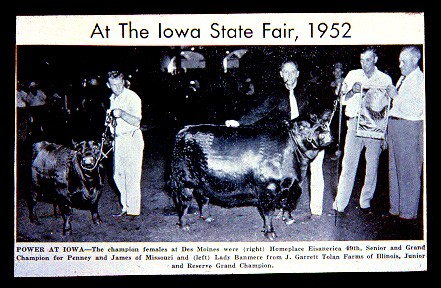
Angus Show, Iowa State Fair. Grand Champion female on the right was a 2-yr-old; reserve on the left was a yearling. The 2-year-old is a good example of the very fat, belt-buckle cattle preferred at the time.
The point of this ad was the improvement that had been made in 20 years, from the “big, plain” bull of 1933 (top) to the “typey” bull of 1953.

An early ’50’s advertisement that superimposed a measuring stick in the picture of this bull who was nick-named “Short Snorter.” Based upon his height and age, he was less than a frame score 1. The choice of a nick-name in this instance was unfortunate because “snorter” dwarfism would soon devastate the purebred beef industry.
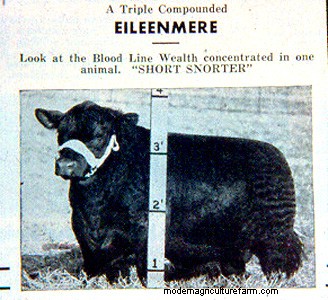
During the 1940s and 1950s dwarfism became a bigger and bigger problem among breeders of Hereford and Angus cattle. “Snorters” were so-called because IF they survived at birth, and many did not, they were very small, slow growing, and their short, dish-shaped heads and large tongues made it difficult to breath so they sounded like they were snorting. Studies at the time established that this was a heritable trait. But no one knew which cows and bulls carried the gene that caused this, and there were no reliable methods for determining carriers at the time. As a result, huge numbers of breeding stock were culled. Animals that would have sold for a great deal of money were suddenly worth only their slaughter value.
In the next in the series we look at how the industry got itself out of this mess and what the next challenge was. Stay tuned!
Save
Save
Save
Save
Save
Save
