
Welcome to Modern Agriculture!

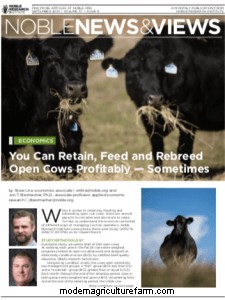
Cull cows – every operation has them. They’re the cows that are not pregnant at weaning time. The typical strategy for many spring-calving cow-calf operations is to cull and sell these cows immediately in the fall. The problem is that they’re generally in poor condition and are head to market at a time of year when their price is at a seasonal low.
Since the sale of cull cows can represent as much as 1/3 of a herd’s revenue, Dr. Jon Beirmacher and researchers at the Noble Research Institute wondered if it was possible to increase the value of these cows to improve operation profitability overall. So from 2015 to 2018 they ran an experiment to see if improved body condition and increased pregnancy rates could make a difference in the value of the cull cows.
The study used a total of 244 open cows. Each fall, the open cows were sorted into two groups – “thins” with a Body Condition Score (BCS) of less than 5.5 and “moderates” with a BCS greater than or equal to 5.5. To track their progress they weighed the cows every month from the mid-October to the end of March/beginning of April.
 Each group was fed a ration developed to help them reach a target BCS of 6. The thin group was fed a mixture of ground hay (60% alfalfa and 40% grass at 20 pounds per head per day), plus 9.5 pounds of corn per head per day. The moderate group got the same hay mixture plus 1.5 pounds each of 32% protein cubes 1.5 pounds fed three days a week. Two rested breeding bulls were also added to each group.
Here are the BCS and breeding statistics for the project:
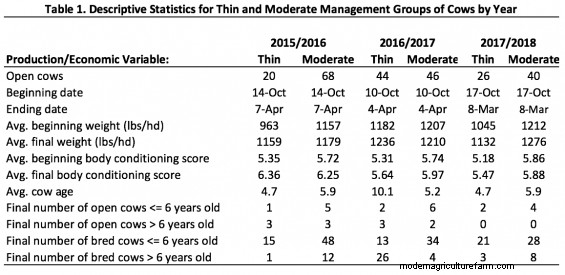
The average BCS among all cows, years and management groups moved from 5.53 to 5.93, and 85% of open cows were rebred successfully each year. But, as report authors Lira and Biermacher note, “The real question is whether or not the final value of the animals outweighed the expenses associated with keeping them through the winter.”
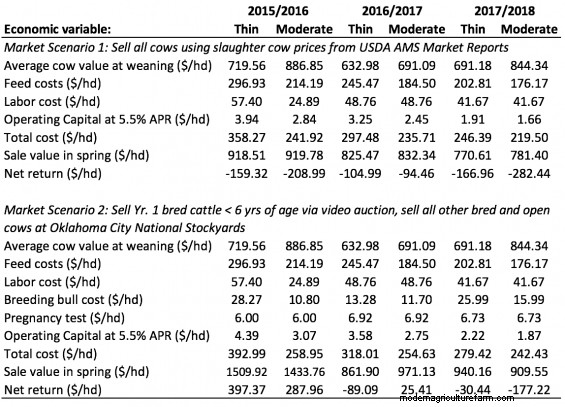
The answer depends on where you sell your animals and how well the market is doing. In this case, they looked at three different pricing scenarios:
1. USDA-AMS market prices for slaughter cows (useful to producers who do not have access to rested breeding bulls for a rebreeding program)
2. Video Auction for bred cows less than 6 years of age
3. Oklahoma City National Stockyards for bred cattle over 6 years old and all remaining open cows.
For the first scenario, they found that retaining, feeding and marketing thin and moderate open cows would not result in a profit. Profits were mixed for scenarios 2 and 3. In the first year, when cattle prices were higher, they made an average profit of $500 per head for 63 bred cows less than 6 years of age sold in the video auction. In year 2, there were more older bred cows that were discounted compared to the younger animals, pulling down the overall returns for the thin group. Cattle prices had also dropped compared to the record prices of 2014 which also affected results.
Making a profit by retaining, feeding and breeding open cows is dependent on a number of factors:
• Can you score an animal’s condition and sort open cows into thin and moderate groups?
• Can you provide low-cost feed and hay, labor and rested bulls to animals that are in thinner and poorer condition?
• Do you have enough cows to make up truckload lots to keep transportation costs per animal low?
• Finally, are your animals older or younger? Younger animals will be more profitable than the older ones in this program.
Here’s what the study authors recommend:
Thanks to the Noble Research Institute and Steve Lira, Economics Associate and Jon Biermacher, Ph.D., Associate Professor for their fine work and for sharing the results with the On Pasture community! You can subscribe to the Noble Research Institute’s publications and information here.
