Welcome to Modern Agriculture!


This article comes to us from the Beef Cattle Research Council of Canada. We’ll be including future articles in this series that include newborn calf management practices and intervention strategies to help producers create positive calving outcomes. For those of you raising small ruminants, check out these resuscitation tips and then check the link for Bill Fosher’s excellent article on saving hypothermic lambs.
Calving is a natural process and most cows give birth to a healthy calf and everything goes as planned. However, there are times when things go wrong. Perhaps there is a malpresentation, such as a backwards arrival, or the calf’s foot is back. In some cases, perhaps calves do not take their first breath after a difficult labor.
In this video, you’ll see Dr. Claire Windeyer demonstrate these tips for getting a calf up and going as soon as possible (Spoiler: do not hang them upside down):
Position the calf in the with both front legs tucked underneath their chest or out in front of them and back legs on each side of the body, pulled towards its head. This allows the calf’s lungs to expand with the least amount of pressure making it easier for the calf to breathe.
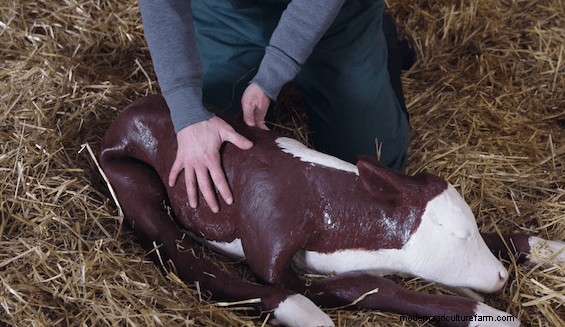
Hanging a calf upside down causes its stomach and intestines to press down on the diaphragm and compress the lungs, making it harder for the calf to breathe. Although fluid will come out, this fluid is from the stomach, not the lungs.
Use a towel or your hands which can often help the calf ‘wake up’ and start breathing.
This may cause the calf to gasp and take a deep breath in, and initiate the breathing process.
This can often cause them to gasp and start breathing. Be careful not to fill the ear with water as this could cause an ear infection.
Recent work at the University of Calgary showed slight statistical improvements in weight gain during the first week of life. Furthermore, without being told which calves had received the pain control product, producers were able to identify calves that had received the pain control product. They noted that these calves appeared brighter, mothered up faster, and were let out of the barn sooner.
When newborn calves don’t get off to a healthy start, it can be stressful. However, these techniques will help you respond quickly and provide timely care and attention to newborn calves that need resuscitation. For more information visit the BCRC Calving and Calf Management webpage.