
Welcome to Modern Agriculture!

We’re often asked here at The Happy Chicken Coop: “how long will my hen lay eggs for”?
Like so many ‘simple’ questions there is no straightforward answer, there are many variables – within each breed and each individual hen. A bit like people, no two hens are the same…
However with that said, we have put together some information and guidelines for you so that you can accurately assess how long your hens should lay eggs for.
We are also going to give you a brief ‘bio’ on a few heritage and production hens so you can compare and further research to find a suitable breed for you.
A small word of advice – if you get your chicks from a feed store, don’t rely on the staff to know about the chicks. Many of the folks working there don’t know any more about chicks than beginners, so be prepared.
The biggest factor which determines how long your hen will lay eggs for is the breed.
When you choose your breed, you need to ask yourself a couple of questions – do I want a hen that is a prolific layer for a couple of years, or do I want hens that produce a little less over the short run but lasts longer?
Many modern industrial production birds are explicitly bred to be excellent producers for the first eighteen months to two years. After this, production drops off dramatically.
In a production setting, these hens would be considered ‘spent’ and sent for slaughter even though they will still produce some eggs. Keeping them is just not profitable if your bottom line is money.
On the other hand, so called ‘heritage’ breeds have been around for years and although shunned by the big egg producers, they are a great type of hen for small scale poultry keepers such as ourselves.
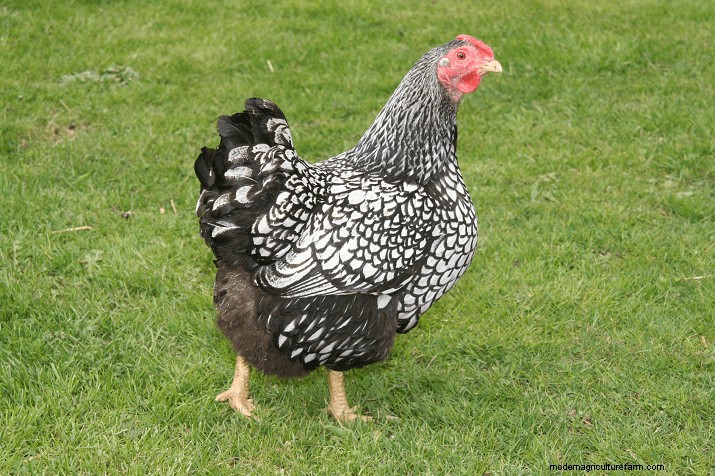 A Silver Laced Wyandotte
Although they may not ‘bury’ you in eggs in the first couple of years, they will keep up a steady production for many years longer.
Let’s now compare heritage and Industrial breeds.
If you live in an urban setting and want hens that will supply you with eggs for a long time, heritage breeds may be the way to go.
With heritage breeds laying for a more extended period of time, for me, they are the better choice if you want decent egg production over an extended period.
I have a variety of heritage breeds in my flock and some lay better than others – it’s very much an individual thing. Ms Crabby, a seven year old Welsummer laid an egg just the other week! Of course, it was probably her ‘egg of the year’, but nevertheless she laid one.
So, how long will heritage birds lay for? Again, it varies from breed to breed, but most of my girls laid consistently for 3-4 years before I noticed a drop in production.
Production hens will lay well for a couple of years and then will decline in egg laying noticeably.
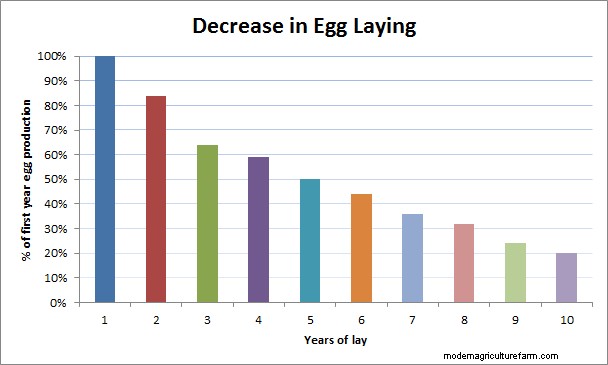
If you are interested in production hens, you need to think: ‘What will I do with them after a couple of years?’
If you live in a city with livestock ordinances, you are likely restricted to the number of hens you can keep.
When your hens are done laying, what are you going to do with them?
Many animal shelters are finding themselves the recipients of hens that have been given up or abandoned and are overwhelmed with chickens.
Which heritage breed you choose will depend on what you want from your hen.
Do you simply want eggs or do you want to have a bird that can provide both eggs and a decent amount of meat once her laying life is done?
The original purpose of ‘dual purpose’ heritage hens was to produce eggs and when done with that, supply a good chicken stew.
Good egg producers are Rhode Island Reds, Sussex, Barnevelder, Fayoumi, Minorcas and White Leghorns.
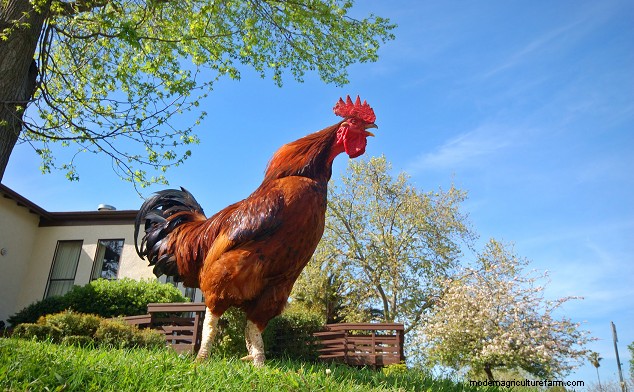 A Rhode Island Red Rooster
Many other breeds out there produce a good amount of eggs per week.
In general, the Fayoumi, Leghorn, and Minorcas’ are known to be ‘flighty’.
They don’t care too much for being handled and can lay their eggs anywhere and everywhere, so they are actually better kept confined.
As for ease of handling and care, it’s better to stick with the more steady breeds such as the Rhode Island Reds or Barnevelders.
In general, you can expect these heritage hens’ to lay consistently for 3-4 years, with some slowing up towards the end of that time.
Most of these girls will live to around seven years on average – if they are protected from predators and treated royally, they can last much longer!
Most, if not all, of the industrial production hens are ‘proprietary’ brands.
These birds have been genetically manipulated (not genetically altered) and refined for increased egg production and feed efficiency: the bottom line is minimum input and maximum output. I found it interesting that birds were labeled as ‘products’ rather than livestock.
Today’s broiler chicken is four times larger than in the 1950s and matures in six to nine weeks.
There is a downside to this fast maturity – with Cornish Crosses, they are generally unable to bear their own weight at 9 weeks and may suffer from heart failure.
The egg layers mature quickly also and should be laying by 18 weeks – some earlier.
There are several varieties out there that are suitable for your backyard being docile and friendly for the most part.
A few of the more well-known varieties are Lohmann Browns, Black Star, Golden Comets, and Freedom Rangers.
A laying hen uses a great deal of calcium, protein, and calories putting out those eggs for you, so it’s important to feed her well.
Layer ration for the laying period should be 16%, pellets or crumbles, whichever they prefer.
If you have a small flock you may want to ferment their feed, it releases more nutrition and stretches the feed further also.
Don’t forget to give them extra calcium – separate from the feed – as with most things, too much is also bad.
Giving them the correct nutrition is extremely important for maintaining their health and vitality, it’s essential if you want them to keep on producing.
A lack of calcium and other essential vitamins and minerals may lead to thin-shelled eggs, no-shell eggs, or other egg-laying issues.
As we noted earlier, not all hens are the same.
Some heritage breeds will start laying at sixteen weeks some will start later. Industrial hens can be counted on to begin laying at sixteen weeks.
Occasionally you will get a hen that just doesn’t seem to lay well at all right from the start.
This is usually resolved once the ‘egg machinery’ gets into top gear, but there may be one or two that never seem to produce well.
This is usually a genetic ‘oops’, and little can be done to resolve the issue.
If the hen is laying internally, she will likely get egg yolk peritonitis and succumb to the infection.
Hybrid hens tend towards reproductive problems a little more than heritage hens.
This is understandable since the reproductive cycle is almost continuous in these birds. Heritage birds do suffer from reproductive issues, but it’s unclear if it’s because hens are now living to be much older than before.
Health problems associated with ‘old age’ in chickens have not been well studied since it’s only fairly recently that chickens have become so popular.
In general, healthy chickens never completely stop laying eggs.
While heritage vs. industrial breed plays a vital role in the speed and quantity a hen lays eggs, it’s not a matter of how long the chicken will lay because they can lay eggs up until the day they die, even if it’s old.
For example, I have a 9-year-old Orpington hen that lays eggs, gets broody, and even hatches out chicks. It’s incredible that she’s still kicking, let alone raising her chicks.
She’s a beast!
If you’re ok with the slowing egg production, and money isn’t the driving force behind the reason for your flock, you can keep your favorite hens around and still expect to receive lovely eggs for the rest of their lives…just not as frequently as before.
As we promised – no easy, quick-fit answer, but we hope this has helped show you what to expect from the heritage and production hen.
The first two years will be full of lots of lovely eggs, whichever type you choose; beyond that will depend on the variety you chose and the breed itself.
Regardless of which you choose, always try to do some research beforehand.
I know how tempting baby chicks are, but if you buy the wrong breed for your expectations, you will be very disappointed.
On the subject of baby chicks, if you want eggs, buy sexed chicks – otherwise, you may end up with a bunch of roosters who definitely won’t give you any eggs!
Do you have a preference: heritage or production? Let us know in the comments section below, we’d love to hear your thoughts.
Read How Long Do Chickens Live: 6 Factors That Impact Life Expectancy


