
Welcome to Modern Agriculture!

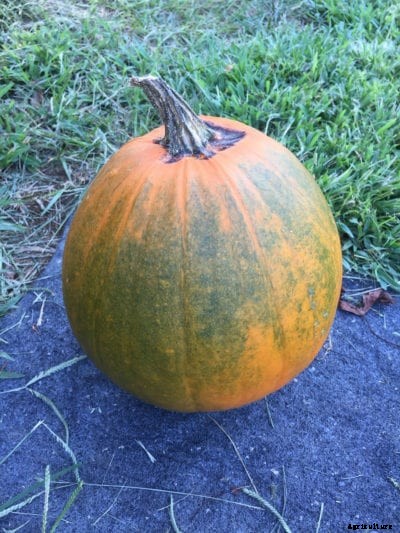
You didn’t intentionally plant a variety of the so-called “ugly” pumpkins. Yet, your traditional pumpkin crop is covered with weird bumps, indentations, or odd coloration. At first you might think this is the result of a seed mix-up. Then you notice your yields are down and no new pumpkins are developing. What you may be seeing are pumpkins with mosaic virus.
Several different types of pathogens are responsible for causing mosaic virus in pumpkin plants. Generally, these viruses are named for the first species in which they were identified. So even though zucchini yellow mosaic virus (ZYMV) was first isolated in zucchini plants, it doesn’t necessarily mean only zucchini can be infected by ZYMV.
In fact, zucchini plants may not even be ZYMV’s primary host. Often, mosaic viruses can infect a wide range of plants, including weeds. There is only one way to accurately determine which pumpkin mosaic virus is affecting your future jack-o-lantern crop and that’s to send a sample of infected plant tissue to a laboratory for testing.
Fortunately, that’s not necessary or even helpful, as there are no current means of curing viral infections in plants. Instead, gardeners are advised to focus on identifying, preventing, and eliminating sources of mosaic virus in pumpkin crops.
Most pumpkins with mosaic virus were infected through vector transmission from aphids. Controlling aphid populations seems the logical solution for stopping the spread of pumpkin yellow mosaic virus. However, transmission of the virus occurs rapidly once the infected aphid begins feeding.
By the time aphids are detected, it’s usually too late to spray. Instead, try these methods for controlling the spread of pumpkin mosaic virus:


