
Welcome to Modern Agriculture!

Introduction to Growing Mushrooms:- Mushroom is a edible fruiting body of a fungus plant that appears above the ground and consists of spores. This edible portion of fungus plant is reproduced by dispersing spores in the similar kind that other plants disperse seeds. Usually these fungi plants are sustained by “mycelium” (network of fine, microscopic threads) instead of drawing nutrients through the root system. This fungi network can extend to implant into rotting wood, soil, or other medium sources. Commercial cultivation of mushroom can fetch good profits under ideal conditions of plant management . Technically mushroom is a part of plant kingdom. However, it does not have any root system. Mushrooms have to depend on organic material such as dead wood, animal tissues, and dung for their nutrition. Mushrooms have great economic importance as they are good source of proteins and being used as healthy food. The white button mushroom is popular type grown across the globe. Button mushroom is type to start with for learning and harvesting process. Based on this experience, you can start with other types as well. Some mushrooms are poisonous and care should be taken while growing edible mushrooms. If you are not sure about the mushroom that you are planning for growing, you can find out from horticulture professionals about poisonous mushrooms.
Scientific Name or Botanical Name of Mushrooms:- The scientific name of the most commonly grown mushroom is “Agaricus bisporus”.
Genus of Mushrooms:- Agaricus.
Common Names of Mushroom or Other Country Names:-
Mushrooms in Indian Languages:-
World Top 10 Production Countries in Growing Mushrooms:-
Health Benefits of Mushroom:- The following are some of the health benefits of Mushroom.
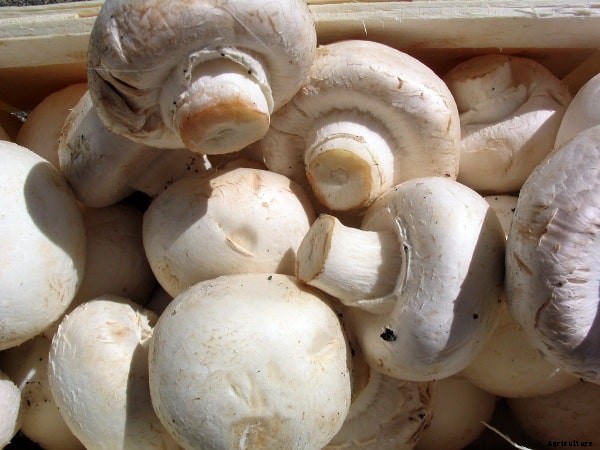
Varieties / Types (Cultivars) of Mushrooms:- There are many types of mushrooms grown across the globe. However, in these types, there are varieties of both edible and non-edible. The following list is about edible mushroom categories. There are many improved , commercial, hybrid varieties grown in the world. However, you should select suitable high yielding cultivar for your region . You can find out this information from your local department of horticulture.
Terminology Used in Growing Mushrooms:-
Agro-Climatic Conditions in Growing Mushrooms:- In some Asia countries, mushrooms are cultivated seasonally. However, currently innovative agro-technology allows farmers to grow them throughout the year in controlled environments such as polyhouse and greenhouse even in hydroponic farming system. Mushroom crop requires 20°C to 28°C for its growth(spawn run) and 12°C to 18°C for reproductive growth. Apart from this, this crop requires relative humidity of 80 to 90% with good ventilation during its growth period.
Cultivation Technology in Growing Mushrooms:-
The whole process of growing mushroom are divided into the following categories (steps):
Let us discuss the each step in-detail.
Spawn Production in Growing Mushrooms:- Well, spawn is usually produced from fruiting culture / stocks of selected strains of mushrooms under sterile conditions. You can obtain stock culture from genuine sources or it can be produced in lab. You must consider the spawn with good quality in terms of flavour, texture and size. Other points to consider higher yields, longer shelf life and commercial value.
Compost preparation in Growing Mushrooms:- The substrate on which mushroom grows is mainly prepared from a mixture of plant wastes, water ,salts and supplements. For producing 1 kg of mushroom, it requires 220 to 230 grams of dry substrate materials. It is recommended to have 6.7 kg of nitrogen, 2.0 kg of phosphate and 5.0 kg of potassium (N:P:K-33:10:25) in 1 ton compost. This would be converted into 1.98% of N, 0.62% of P and 1.5% of K on a dry weight basis. There are 2 types of compost preparation methods.
Spawning in Growing Mushrooms:- The below methods are followed for spawning process.
The spawn should be mixed through the whole mass of compost @ 500 to 750 grams/ 100 kg of compost (which is about 0.5 to 0.75%).
Spawn Running in Growing Mushrooms:- After the completion of spawning process, the compost should be filled in polythene bags of 90 cm x 90 cm size and 150 gauge thickness and with a capacity of 20 to 25 kg/bag / trays(like wooden trays of 1 meter x 1/2 meter accommodating 20 to 30 kg of compost / shelves. These should be covered with a newspaper or polythene. The fungal bodies should grow out from the spawn and take about 2 weeks to colonise. The temperature maintained in cropping room should ne 23 to 25°C. Avoid high temperatures as it can be detrimental for growth of the spawn and any temperature below specified may result in slower spawn run. Maintain the relative humidity around 90% and a higher than normal CO2 concentration should be beneficial in this process.
Casing in Growing Mushrooms:- The compost beds (after complete spawn run) should be covered with a soil about 3 to 4 cm (casing) to induce fruiting. The casing material should have high porosity, good water holding capacity and the pH should range between 7.0 to 7.5. Peat moss is the best casing material used. Apart from this, decomposed cow dung and loam soil (1:1), garden loam soil and sand (4:1) sand and lime may be used as casing material.
The casing soil should be either steam sterilized or pasteurized at 66°C to 70°C for 8 hours, treated with formaldehyde (2%), and bavistin of 75 ppm. This treatment should be done at least 2 weeks before the material is ready for casing. Once the casing is done, the temperature of the room should be again maintained at 23°C to 28°C and 90% of relative humidity for another 9-10 days. Usually, low ‘CO2’ concentration is favorable for reproductive growth at this stage.
Fruiting in Growing Mushrooms:- Under ideal growing conditions, the fruit body initials which appear in the form of pin heads start growing and gradually develop into matured button stage in case of button mushrooms.
Pests and Diseases in Growing Mushrooms:- The insect pests mostly observed in growing mushroom are mites, nematodes, and springtails.
The common diseases found in growing mushroom are Dry Bubble (brown spot), Wet Bubble (White Mould), Cobweb, Green Mould, False truffle disease, Olive green mould, Brown plaster mould and Bacterial blotch. For the symptoms and control measures of these pests and diseases, you must seek profession help from your department of horticulture. Never experiment with any kind of pesticides or fertilizers without contacting the local professionals.
Harvesting in Growing Mushroom:- Harvesting should be done button or matured stage where in caps measuring 2.5 cm – 4 cm across and closed. The first mushroom crop appears about 3 weeks after casing. Mushrooms should be harvested by light twisting without disturbing the casing soil. After completion of harvesting, the gaps in the beds should be filled with fresh sterilized casing material and then water the beds.
Yield in Growing Mushroom:- Yield of mushrooms depends on many factors such as variety, compost preparation method, horticulture practices.
On an average, one can obtain about 12 to 15 kg of fresh mushrooms/100 kg of fresh compost in 2 months crop. You can obtain higher yields of 15 to 20 kg/ 100 kg of fresh compost using short method for compost preparation.
Bottom Line in Growing Mushrooms:- If proper care is taken, you can get excellent profits. For better understanding, you can get training in any horticulture department or department of agriculture. You can also watch YouTube videos for gaining some knowledge in growing mushrooms. In some markets you can buy mushroom growing kits, which can be very useful for beginners.


