The dramatic elephant ear plant, commonly known as taro, is a dramatic tropical foliage plant with magnificent heart-shaped or arrow-shaped leaves. Here's how to grow elephant ear in your garden!
About Elephant Ears
Elephant ear belongs to the genus Colocasia, which are tuberous, frost-tender perennials from tropical Asia. So, these plants are accustomed to wet areas with the filtered sun of a tropical forest. Therefore, they prefer moist soils and also partial shade. They are a good choice for wet areas along creeks, rain gardens, or low-lying areas.
If you grow elephant ears in a garden bed, that's perfectly fine as long as they receive regular moisture and don't dry out (especially in hot summers)! Elephant ears also look great in a container with other summer bulbs and/or annuals.
In USDA Hardiness Zones 7 to 11, elephant ears can be left outside year-round and are treated as perennials. In colder climates, they are typically treated as annuals and discarded at the end of the growing season. However, you could also dig up the tubers after the first fall frost, store the tubers indoors, and replant them next year after the last spring frost.
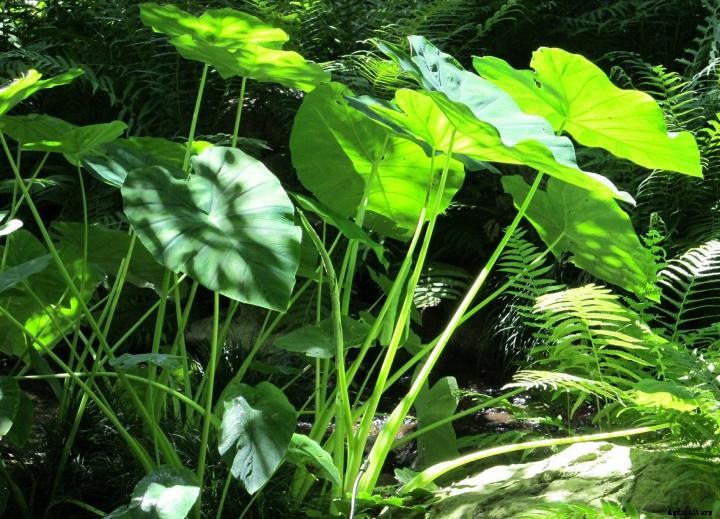
Elephant ear leaves can reach lengths of 3 feet on top of 3- to 7-foot stems. The leaves usually have prominent veins and their colors range from lime green to almost black.
Planting
How to Plant Elephant Ears
- Find a spot with medium to wet soil in part shade or filtered sun. Elephant ear will struggle in full sun and dry soil.
- Pick a location protected from strong winds. The large leaves can be damaged by heavy gusts.
- Add aged manure or compost to the soil before planting.
- Dig a hole 2 to 4 times larger than the tuber.
- Plant the tuber so it sits 1 to 2 inches below the soil.
- Elephant ears grow best when they’re planted close to the surface.
- The plant can also be grown in a pond with up to 6" of standing water.
Care
How to Care for Elephant Ears
- Don’t let the soil dry out.
- Water the plants in the morning and water from below to keep water off the leaves.
- Apply a slow-release fertilizer once a month.
- Cut off faded or browning leaves as needed. Make the cut as close to the tuber as possible.
- Tubers may be left in the ground year-round in Zones 7 to 11. In late fall, add a layer of mulch around the plants to protect from frost.
- In cooler regions, tubers should be planted in the ground in mid-spring and dug up in fall after the first frost.
- Cut back foliage and allow the tubers to dry for a few days.
- Overwinter in an open container (paper bags work well) with peat moss or dry potting soil in a cool dry location (above 45°F).
- The plant may be divided in winter or early spring.
Pests/Diseases
Aphids, whiteflies, and spider mites may become a problem.
Also look out for corm and root rots, bacterial blight, and mosaic viruses.
Recommended Varieties
- ‘Jack’s Giant’ has rich blue-green leaves with chartreuse edges. It grows to 7 feet tall.
- ‘Diamond Head’ has 2 ½-feet long rippled, heart-shaped, purple to black leaves.
- ‘Pink China’ has green leaves on pinkish stems. It is one of the hardiest elephant ears and may survive in Zone 5 to 6.
- ‘Fontanesii’ is a tall hybrid with dark green leaves on purple stems.
- ‘Elena’ has chartreuse leaves with cream-colored petioles that change to purple where they join the leaf to the stalk.
Wit and Wisdom
- You can grow the upright elephant ears (Alocasia) indoors as a houseplants in bright, indirect light. Grow in a 5-gallon container with rich, moist soil.
- Elephant ear is grown as a food crop in Hawaii (and in southeast Asia) and poi is made from the tubers. However, note that all parts of the plant are poisonous, unless cooked first!


