
Welcome to Modern Agriculture!

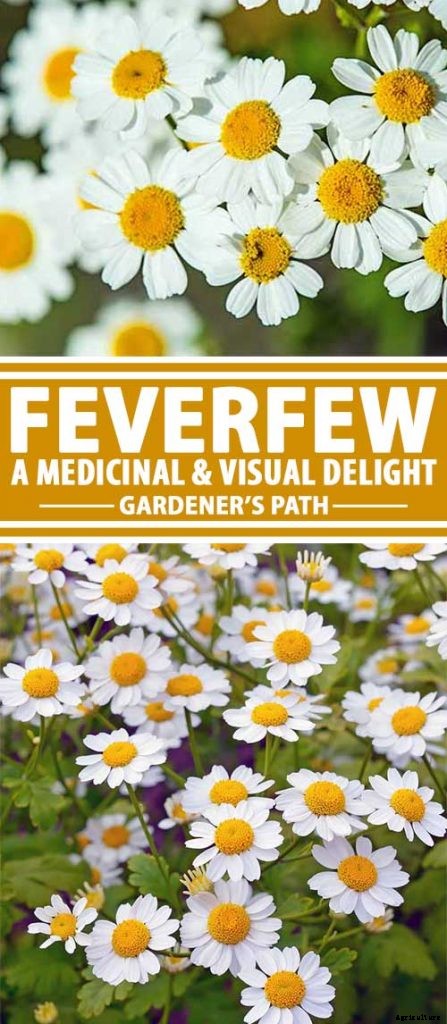
To many in the herbal medicine community, feverfew (Tanacetum parthenium) is known as a natural headache remedy.
But in the gardening community, this shrubby herb is appreciated as an attractive landscape plant.
Continue on to learn all about growing feverfew in your garden. Here’s what I’ll cover:
Let’s learn more!
Masses of one-inch, white, daisy-like flowers with large yellow centers rise on spindly stems above parsley-like leaves.
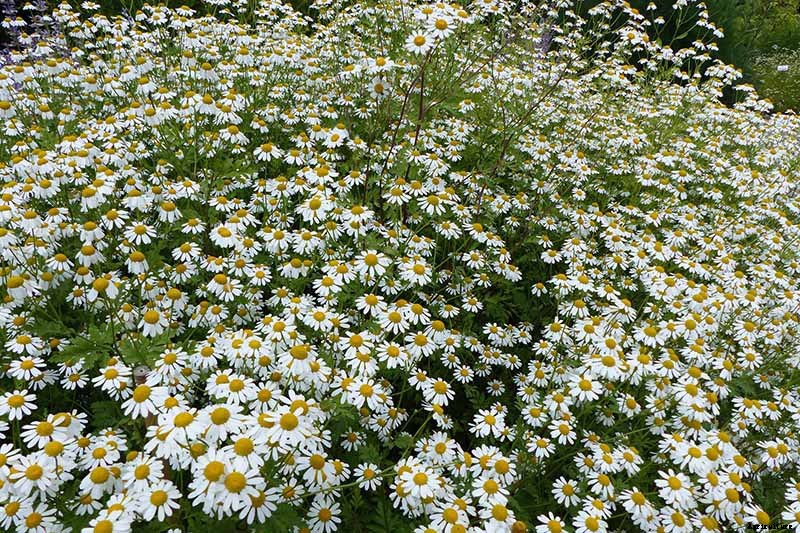
Feverfew, which you might also see referred to as Matricaria parthenoides, Chrysanthemum parthenium, featherfew, febrifuge plant, featherfoil, midsummer daisy, flirtwort, or wild chamomile, grows anywhere from eight to 24 inches tall, with a width of about the same range.
This member of the aster family behaves like an annual in cooler zones, a perennial in some areas, and it can be evergreen in warmer southern climates.
Though it looks similar, it’s not to be confused with true chamomile, which you can read more about here.
While native to southeastern Europe, T. parthenium is now widespread throughout Europe, Australia, and North America, where it grows in USDA Hardiness Zones 5-10.
Used for many centuries in herbal medicine, it became popular in the 18th century after botanist and author John Hill referred to it in “The Family Herbal” as the most useful remedy for treating headaches.
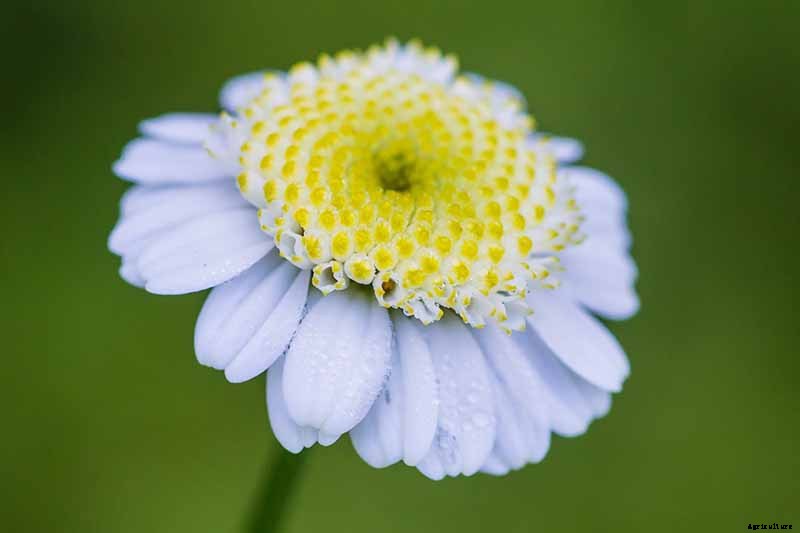
Though its name may suggest an ability to lower body temperature, feverfew is instead mainly relied upon medicinally to treat and prevent headaches. It has also been used to relieve the symptoms of arthritis and digestive problems.
All parts of the plant that grow above ground may be used in medicines, but most commercial products use the leaves.
Numerous studies assessing the effectiveness of feverfew as a headache treatment have been conducted, and in 2005 a German study from H.C. Diener et. al. found that incidents of migraine headaches were reduced in patients who ingested feverfew extract.
Scientists are still working to identify the substance in the plant that offers the beneficial effects.
You can start seeds indoors in late winter, or direct sow in your garden after all danger of frost has passed.
You can also transplant seedlings from a garden center or divide existing plants.
Direct sow seeds after the last frost, barely covering them with quarter of an inch of soil. You can plant in rows a few inches apart and thin to a foot apart once plants are a few inches high. Keep the soil moist until germination.
To get an early start, you can also sow seeds indoors in spring, about five to seven weeks before the last frost.
Scatter seeds in flats filled with a well draining seed starting mix and tamp them down lightly, barely covering them as light aids germination.
Cover with a dome lid and set in a bright location, keeping it evenly moist until seedlings emerge. Expect germination to take 10 to 14 days.
Transplants can be planted out in the garden after last frost, once at least two true leaves have emerged. Plant in holes as deep as the root ball, spacing plants about a foot apart.
Any garden soil is fine as feverfew is tolerant of poor soils. Water thoroughly after planting.
Feverfew roots consist of a deep taproot with many branching rhizomes.
To divide a mature plant, dig a circle about a foot deep and a few inches wider than the plant and lift it from the ground in spring or fall, using a shovel to cut the crown into three or four chunks.
Replant divisions 18 inches apart at the same depth as the roots were growing before and water well.
Plant it in full sun, or in an area that receives a bit of light shade.
Well-drained sandy or loamy soil with a pH of 6.0 to 6.7 is perfect for these plants.
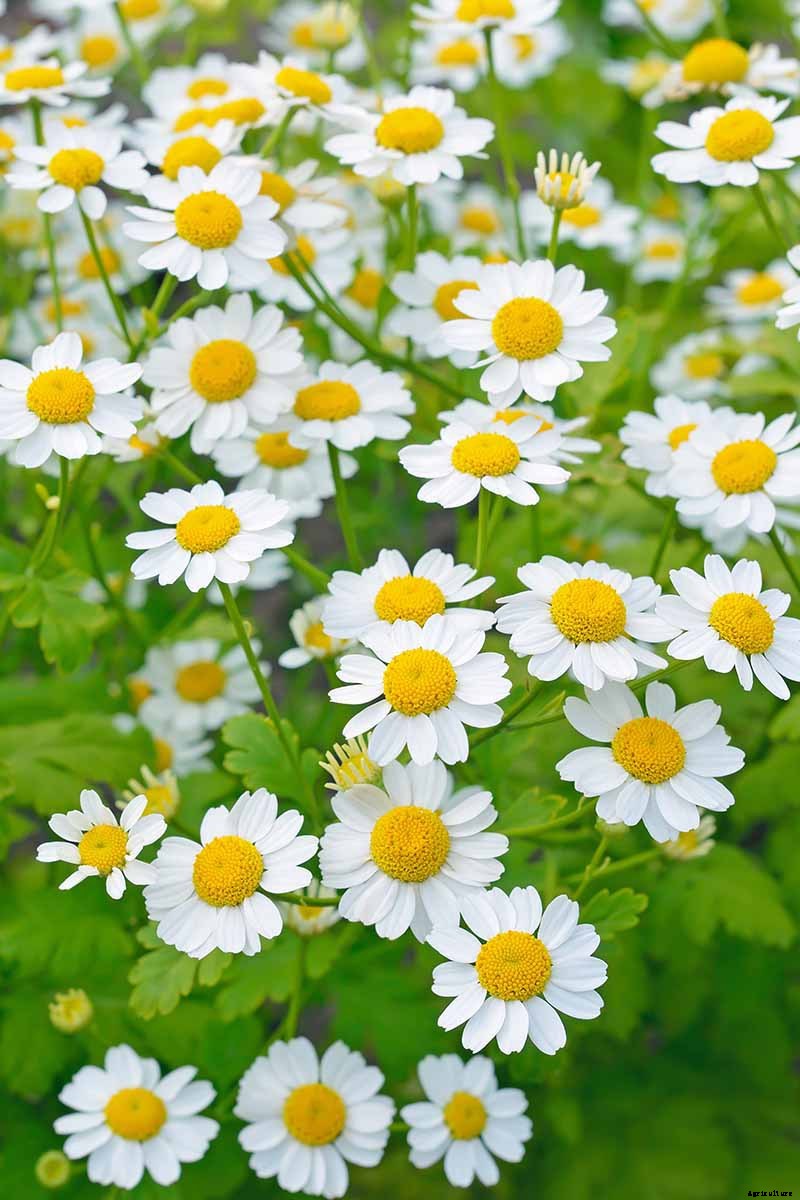
Plants should be watered a couple of times a week in the absence of rain to keep roots moist throughout the year. Feverfew won’t tolerate dry conditions and prefers to grow in slightly damp soil, so you should provide adequate water for the soil to remain moist, though not soggy.
If the soil is fertile, there is no need to fertilize.
If you are growing in poor soils, you can apply a light, balanced fertilizer each spring, such as this all-purpose organic fertilizer from Down to Earth, available from Arbico Organics.

Down to Earth Fertilizer
Interestingly, this plant has a strong citrus-like aroma that repels bees, so don’t place T. parthenium near plants that rely on bees for pollination. Feverfew can self-pollinate and doesn’t require help from pollinators.
Feverfew reseeds quite liberally and can even be considered invasive, so keep an eye out for an abundance of emerging volunteer seedlings, and remove them as necessary.
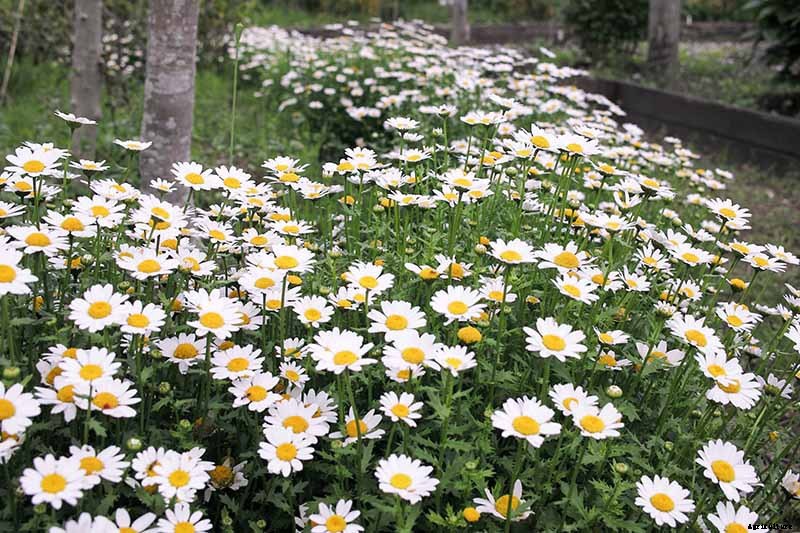
Deadhead spent blossoms or cut still-vibrant flowers for arrangements to keep up production of blooms. Deadheading also helps to prevent excessive self-seeding.
You can also cut back leggy stems, though you should never remove more than a third of the plant at once.
In areas where it is growing as a perennial, you can cut down the foliage to ground level in the fall, and mulch heavily to protect the roots during cold winters.
T. parthenium, the species plant, is readily available from your local plant nursery or online.
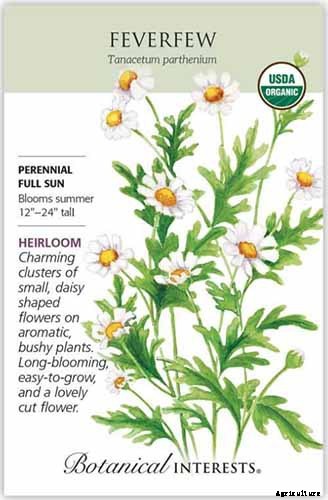
T. parthenium
You can purchase organic heirloom seeds from Botanical Interests.
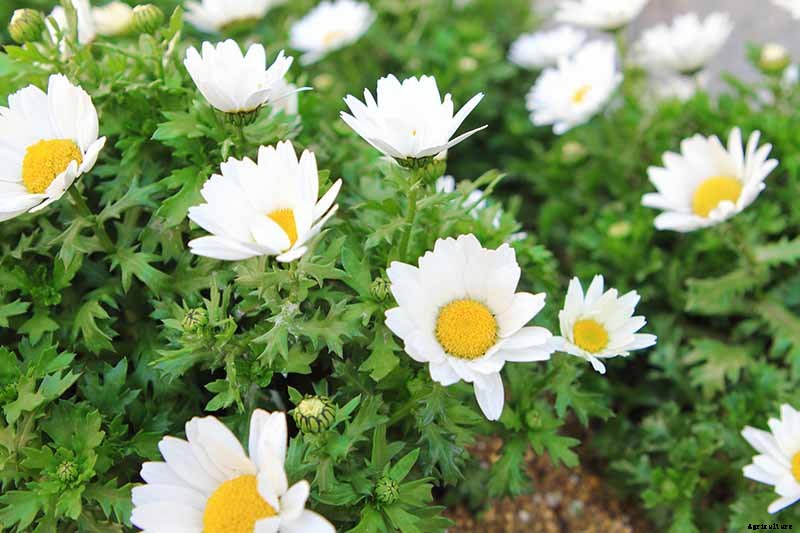
‘Double White’ features fully double, creamy white flowers with yellow centers.
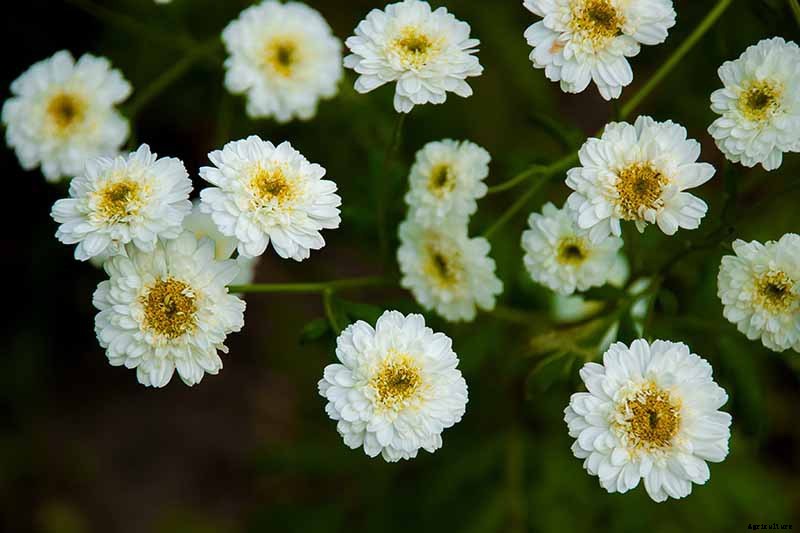
Plants grow to a mature height of 24 inches tall.
‘White Bonnet’ is a double-flowered cultivar with frilly white petals surrounding a yellow center.
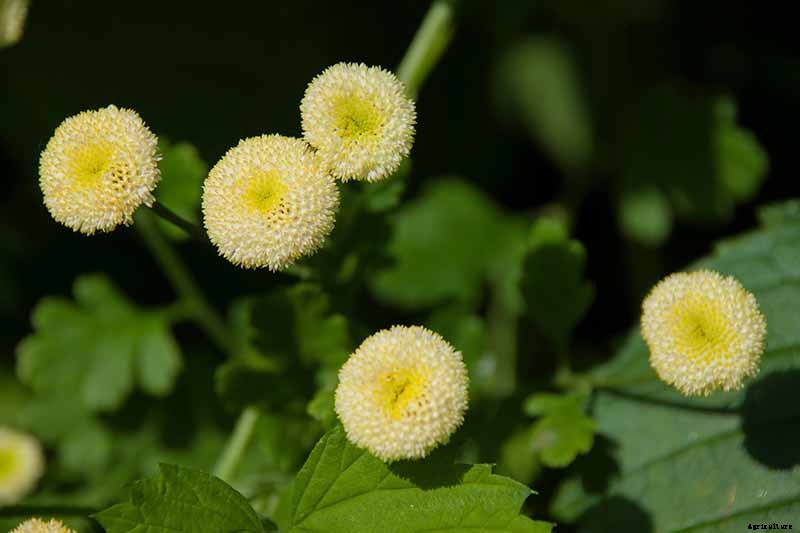
Ideal for cottage gardens or container growing, expect a mature height of 18 inches.
This white and yellow beauty is relatively disease free, but you should still keep an eye out for the occasional problem.
Aphids can occasionally plague feverfew. If they become an issue, spraying off plants with a hard stream of water from the hose often does the trick.
For severe infestations, you can try a homemade insecticidal soap by mixing one tablespoon of pure liquid soap and two teaspoons of cooking oil into a quart of water to spray on foliage whenever you notice signs of aphids.
Slugs can also make holes in the leaves. You may notice wilted foliage and a slimy residue where slugs have been. You can remove them easily by handpicking at dusk or after rain.
Diatomaceous earth or coffee grounds sprinkled around the base of plants will also help to deter slugs.
Aster yellows disease can also be a problem. The only cure for aster yellows is prevention. Use diatomaceous earth or insecticidal soap to kill the bugs that spread this bacterial disease. Infected plants must be pulled up and discarded.
Finally, feverfew is sometimes susceptible to powdery mildew if planted in a shady area, but this can be easily avoided by selecting a location that receives full sun.
Leaves can be harvested any time during the season, and flowers can be harvested as soon as they start blooming. The essential oils in the plant are highest just as flowering is beginning.
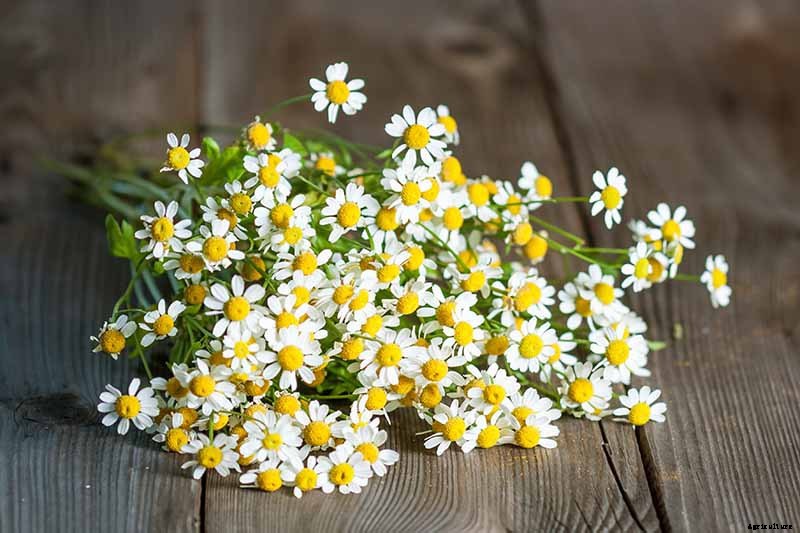
Pick flowers in mid-morning after the dew has dried. When harvesting the leaves, never pick more than a third of the plant at once.
You can also harvest the seeds to save for future plantings. Once the plant is done flowering and seed heads have dried, cut the stems and hang them upside down in a paper bag for a few days in a dark, dry location.
You can learn more about how to harvest feverfew in our guide.
You can use the flowers fresh in tea or dry them for later use.
If you have a dehydrator you can dry the leaves and flowers on a low setting. Otherwise you can hang the stems in bundles and hang them upside down in a dark, dry location for several days.
Remove the dried flowers and leaves from the stems and store in a tightly sealed jar in a dark cupboard.
You can make a tincture of the fresh or dried leaves and flowers by infusing them in a jar of alcohol. Store the jar in a dark location for several weeks, shaking it daily. After about six weeks, you can strain out the plant material.
Feverfew tincture can be used as a remedy for headaches. Always talk to a health care professional before using herbal products.
Whether you have a headache or just want to fill an empty spot in your landscape, cheerful feverfew is a plant worth considering.
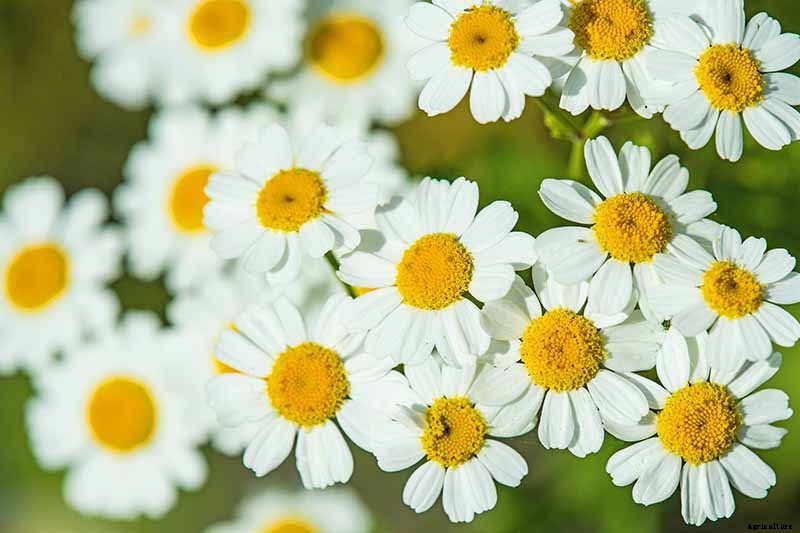
Remember its bee-repelling properties, though, when you plant it! You don’t want to rob neighboring plants of their much-needed pollinators.
Have you grown this plant? Are you now considering it? Tell us all about it in the comments section below.
Check out these articles next to discover more easy to grow beautiful and medicinal flowering herbs:


