
Welcome to Modern Agriculture!

The following information is about Types of Mulching and Its advantages.
‘Mulch’ originally means something that is soft and is beginning to decay. Materials that can be used on the soil surface mainly to prevent loss of water by evaporation, to cut down weed growth, to reduce temperature fluctuations, and to promote soil productivity are all designated as Mulch. Mulching is referred to as a mixture of wet straw, leaves, and loose earth evenly spread on the ground to protect the newly planted trees, shrubs, and their roots. Tropical areas, sometimes use crop residues as Mulch material such as sugar cane trash, banana leaves or elephant grass, etc. Areas under the wet tropics having uniform rainfall distribution use cover crops instead of Mulch materials. Mulch is of extreme use in the dry season, especially during the cultivation of certain crops like sugar cane and coffee. Straw and stalks from cereal crops and fodder crops can be treated as Mulch material and can be either left on the soil surface or can be incorporated partially into the soil surface. Mulching is considered to be one of the most beneficial practices a farmer can do to keep his farm healthy. Basically, Mulching creates a micro-climate for the plant to grow and perform better in an area that has regulated moisture content, suitable temperature, humidity, carbon dioxide, and proper microbial activity within the soil.
Mulching is generally applied in the following area of lands:
Mulch material can be classified into two major categories: organic and inorganic. Mulches derived from plant sources like compost, grass clippings, etc. is termed organic and the ones derived from plastic or other equivalent resources are termed inorganic.
Organic Mulch materials
Grass clippings
Grass from mowed lawns can be used as an inexpensive Mulch material. A thin layer of these grass clippings can be spread over emerging seedlings and later a thicker dry layer of grass is applied in the crop area. It is important to note that grass clippings treated with pesticides should not be used as Mulch. When grass decomposes it supplies nitrogen to the soil.
Straw and hay
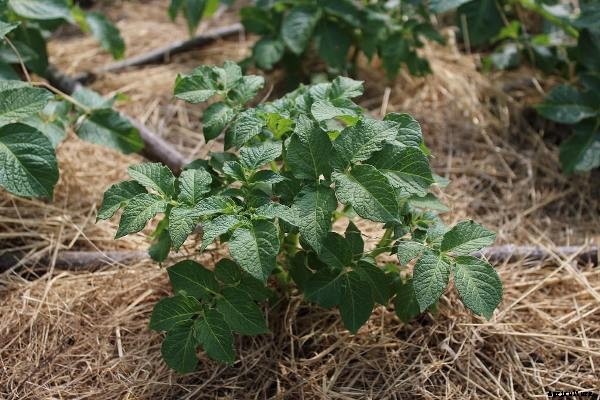
This is the most commonly used Mulch material in agriculture fields because it has a long life when compared to other materials and they make the soil extremely fertile upon decomposition. Straw and hay reflect light from the surface of the soil and keep it cool. Sometimes there could be a risk of weed growth, but a thick layer of straw can prevent it. It is recommended that nitrogen fertilizer is applied to the soil before straw Mulching because straw is high in carbon content and steals the nitrogen from the soil.
Leaves
The drop of foliage from deciduous trees is natural Mulch occurring in nature. It is a great insulator and is useful during root crops like carrots and parsnips.
Peat moss
This Mulch is long-lasting in nature and is considered to lower the pH of the soil, so generally, it is used on the land with plants requiring acidic soil conditions.
Some limitations of organic Mulch are:
Inorganic Mulch materials
The unavailability of organic Mulch at all times has resulted in the use of plastic materials as Mulch. These plastic films are available in different colours and sizes depending on one’s need. The types of inorganic Mulches are:
Black Mulch
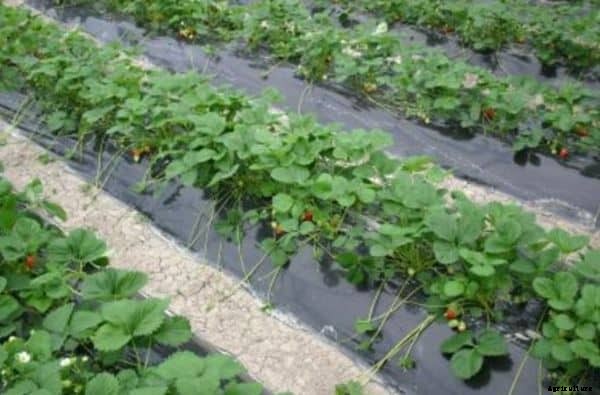
It stops the sunlight from penetrating into the soil, thereby stopping the photosynthesis activity below the black film. This helps in the control of weed growth but may increase the soil temperature.
Transparent Mulch
This film allows light to pass through and aids in weed growth, but applying herbicide on the inner surface of the film can check the weed growth. Mostly it is used while soil solarisation is being done in nurseries so as to obtain 100% seed germination and a disease-free nursery. It is useful in hilly areas for increasing the temperature of soil during the winter season.
Double coloured Mulch
These types of Mulches are wavelength selective and are designed to absorb certain wavelengths from the sun’s radiation. These changes in the light can be effective on plant growth and development. It is considered that these films help in controlling different plant properties like fruit size, color, root development, height, etc. the colored Mulches re-emit less heat, therefore, maintains lower leaf temperatures. Some varieties are:
Degradable Mulch
There are again two types of degradable Mulches the photo-degradable and bio-degradable Mulch. The photo-degradable Mulch as the name suggests getting disintegrated under the sun over a certain period of time. Similarly, bio-degradable Mulch gets disintegrated under natural environmental conditions after a certain duration of time.
Improper Mulching can be a cause of concern if done improperly. Too much is harmful to the plants. The general recommendation of Mulching depth is around 2 to 4 inches. Moderate Mulch can be beneficial while Mulching can be dangerous. It is known that organic Mulch needs to be replenished over time, but if decomposition is slower than reapplication then there could be a possibility of Mulch build-up in the farm area which is not advantageous for the plants. Deep Mulch should be used only to suppress the weed and cut down maintenance, but some potential problems associated with it are:
The Mulch that is selected for the farm should have certain properties for delivering maximum benefits. Organic Mulch cannot be altered in its characteristics, but inorganic or artificial Mulch is expected to have certain attributes. Various ecological factors may need different Mulch materials to function properly. The important aspects of Mulch material are:
Thickness – generally the thickness of the material has little or no effect on Mulching except for the solarisation technique. The thickness of the artificial Mulch film should be around 15-30 microns for vegetable crops, 100-150 microns for orchids, and 25 microns for small duration crops.
Width – the film should be selected such that it matches the inter-row spacing. The average width of the film is around 1 or 1½ m under general growing conditions.
Perforation – unperforated Mulch film should be selected for efficient water and fertilizer distribution. To prevent water stagnation around the plants, the perforated film is needed, but this may facilitate weed growth.
Color – the color of the Mulch can affect soil temperature, the air temperature around the plants, the salinity of the soil, weed growth, and the incidence of insects.
Testing the Mulch film before using it on the farm is highly important because if the film transmits light, then it is no good for the plants. The material should be durable, airproof, and thermal-proof. It should always be remembered that the Mulch material should be purchased from a reliable source.
Type of Mulch according to the need:
There are some precautions that should be taken before installing the Mulch on the fields such as:
Mulching the farmland can have many advantages apart from weed control and water conservation. The major advantages of soil Mulching are outlined here:
It is observed that after Mulching good production is obtained in vegetable crops like cabbage, cauliflower, capsicum, tomato, brinjal, chillies, okra, potatoes, etc., and some orchid crops like pomegranate, lemons, banana, papaya, guava, apricot, and grape, etc. Care should be taken to apply Mulch that is suits the crop needs.


