
Welcome to Modern Agriculture!

Introduction to Growing Star Fruit in Backyard
Here, today in this article we are going to discuss growing Star Fruit in the backyard.
Topics going to cover in this article;
Star Fruit, also referred to as Carambola, is that the fruit of Averrhoa carambola.
The Star Fruit tree is generally multi-branched, with dark green bushes. It can grow up to 20 to 30 feet in height and 20 to 25 feet wide, but to harvest them easily maintain the tree in a smaller size. It produces bell-shaped small flowers with five petals; along with the petals they have purple streaks. The season of Star Fruit is long; with harvestable fruit appear from June. When you cut the fruit in cross-sections, it appears in the form of a star. Hence, the name came as Star Fruit. A mature tree can produce 200 to 400 pounds of fruits every year. The Star Fruit is very pulpy with a grape-like texture.
The two categories of Star Fruits are; sweet, or tart. The sweet one is used in jams, desserts, and jellies and the tart one is used as a garnish.
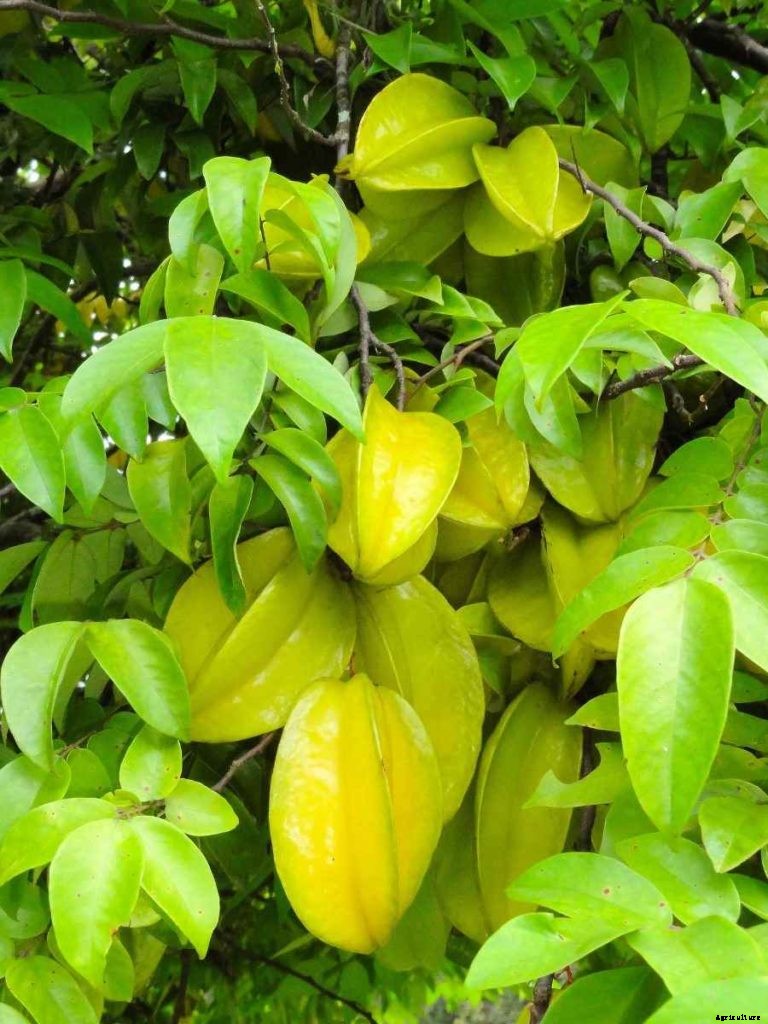
Star Fruit has many health benefits. The Star Fruit is rich in vitamin C, B9, B6, B2, and fiber. It also contains many minerals, such as zinc, phosphorus, potassium.
Planting Star Fruit in your backyard can be a lot of fun and you can even have delicious fruits.
But planting in the right way is important. So, here are some tips for growing Star Fruit in the backyard.
As it is a tropical plant, the Star Fruit tree should be planted in locations where frost isn’t likely. Having said that, it’s still knowing plant this tree within the early spring to make sure it’s time to settle in before the recent months.
If starting with a seed, they require warm soil to germinate. To ensure good germination be sure that you’re using a seedling heating mat at a temperature of 70 degrees. You need to plant in a young tree container before repotting in soil.
Full sun is important for a Star Fruit growth. Make sure your Star Fruit receives at least eight hours of sunlight per day, and it should be sheltered from cold climates, winds, or in alkaline soils. Your tree should be 20 to 30 feet away from other trees. This reduces your tree from getting too much shade. Similarly, a tree grown in containers got to be far away from other trees to enable good growth.
Once Your Plant Is Grown Roughly 2-4 Feet In Height And Has Sized Up To At Least A 3- Gallon container, it’s time to plant in the soil. Prepare your soil beforehand by loosening it up within the area where the roots will grow. Do not apply compost, fertilizer to the soil. Make sure that if there are large rocks that they have been removed, and the soil is well-drained. Plant the same depth the tree was planted in its container, but not deeper.
Each Star Fruit has a maximum of 10 to 12 seed, which are slender and light brown and ¼ to ½ inch long. First, buy a few ripe star-fruits from a grocery store nearby you. Then, carefully cut the fruit take care not to cut seeds. Remove all the seeds from it. Put some seed starter soil and in cups and wet it with warm water. Then plant them in the container.
Star Fruits do very well in a wide variety of soil textures. As long because the soil drains off excess moisture, it should be fine to plant your tree in. A well-drained, loamy, and rich in organic matter is suitable. Slightly acid liking, to grow Star Fruit you will need am acidic to neutral pH range. If there is a more alkaline pH level, they are susceptible to nutrient deficiencies. For better growth aim pH for a range between 4.5 and 7.
Star Fruit plants mostly prefer full sun conditions. It also prefers a hot and humid environment and is prone to frost damage. The temperature under 35 degrees get steadily more dangerous and temperature below 25degrees can cause tree death.
In case if you miss this: Organic Dragon Fruit Farming.
Propagating of Star Fruit can be done in three methods. They are as follows;
Star Fruit seeds lose their viability quickly. They need to be harvested from the fruit once they are plump and mature and then planted within a couple of days. Seed germination ranges from one week within the summer to two or more weeks during the winter months. Start the Star Fruit seeds in damp peat moss. Once sprouted, the seedlings are often transplanted into pots employing a sandy loam soil. Attention towards their care will help ensure their survival. Seed propagation can produce variable results. Although this is often not the well-liked method of Star Fruit propagation for commercial orchards, it is often a fun way for home gardeners to grow a tree from store-bought fruit.
For cuttings, get an existing Star Fruit tree, cut off branches that have buds. Ensure to cut the stems are at an angle, put them in a rooting hormone, and then into well-prepared polythene cover with potting soil. Be sure of watering the cuttings and roots will.
This method of vegetative propagation is best if you have already got a Star Fruit tree that you’d wish to clone. It involves wounding one among the tree branches and inspiring it to root. Air layering is often difficult because of the Star Fruit’s slow root production. Begin by choosing a branch that is a minimum of 2 feet (60 cm.) long. From the branches, the tip makes two parallel cuts around the branch between 1 to 2 feet (30 to 60 cm.). The cuts should be nearly 1 to 1 ½ inch (2.5 to 3 cm.) apart. Remove the ring of bark and cambium (the layer between the bark and therefore the wood) from the branch. If desired, a rooting hormone is often applied to the wound. Cover the entire area with a moist ball of peat moss. Use a bit of sheet plastic to wrap it tightly. Secure both ends with electrical tape. Cover the plastic with aluminum foil to retain moisture and exclude light. It can take one to 3 months for an abundance of roots to develop. When the branch of Star Fruit is well-rooted, cut it under the new two roots. Carefully remove the wrap and plant the new tree in sandy loam soil. The new tree is going to be in a vulnerable state until it’s well-rooted. During this era, keep the soil evenly moist and protect the young tree from direct sunlight and wind.
It is not a drought-tolerant species; your Star Fruit will need regular watering. Keep the soil moist, but not over-saturated, in the least times. Aim for 1-2 deep watering per week if there hasn’t been raining. Reduce watering within the winter months when it’s unnecessary. A soaker hose around the tree is often wont to do a slow, deep watering but base your placement on a hoop that’s at about the midpoint of the tree’s canopy all the way around. Your tree can tolerate flooded conditions for between 2-10 days, counting on its current health, but will begin to suffer from lack of oxygen around its roots. It’s better to avoid flooding for this species, but if it can’t be avoided, it won’t immediately suffer damage.
Humid environments are great for this species. However, await any symptoms of plant diseases that are common in humid locations. Once your tree is 1-2 years old, consistent irrigation is vital from flowering through fruiting. Confirm it’s the water it must produce much fruit


