Welcome to Modern Agriculture!

Soil structure refers to the combination of primary soil particles – sand, silt and clay – into larger units called aggregates or clods. Aggregates are commonly seen when a soil is tilled or disturbed. Organic matter is the key to creating a well-structured soil. Organic matter acts as a binding agent or the “glue” that holds soil particles together.
Structure is a desirable characteristic in soils, and is essential for good plant growth. Well-structured soils promote root growth, and have good drainage characteristics, high water holding capacities, and good aeration or gas exchange properties.
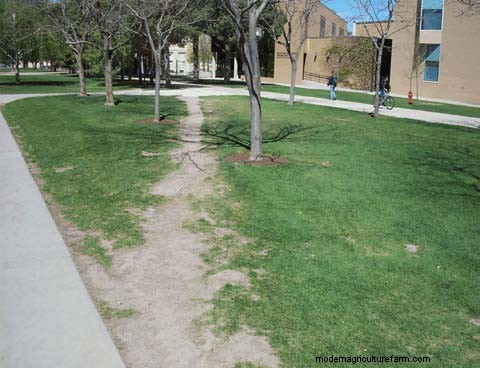
Compaction destroys soil structure and causes significant plant growth problems in Utah landscapes. It is normally caused by repeated foot or vehicle traffic over the same soil area. The traffic may be associated with construction activities, or foot or vehicle traffic in established landscapes. Moist conditions make soils more susceptible to compaction.
Compaction forces soil particles closer together, driving out pore space and reducing the volume of air and water in soil. It also seals off the soil surface and reduces the amount of air and water entering soil. Reduced gas exchange and, in particular, a low oxygen concentration in the root zone is the primary cause of plant decline in compacted soils. Increased physical resistance to rooting is also a major compaction problem.
Sparse growth or barren paths in turf areas are the most common indicators of a soil compaction problem. Water runoff and/or dry spots in turf can also be an indicator. Different growth rates among trees planted at the same time is common in park settings and can often be linked to compaction in the root zone of certain trees.
Soil compaction can also be identified by exploring an area with a soil probe, shovel or long handled screwdriver. It should be easy to push a probe into moist, uncompacted soil. Probe areas that may be compacted as well as normal areas for comparison.