
Welcome to Modern Agriculture!

A greenhouse is an invaluable thing to have for your tender plants during the winter. The best time to prepare your greenhouse for the coming winter months is to install a greenhouse heating system during fall. Heating a greenhouse is imperative when you want to maximize the potential of your plants during the cold winter season. We will show you the best greenhouse heaters in this article so that you can grow your favorite plants year-round!
You might be thinking that installing a heater in your greenhouse could be expensive. On the contrary, choosing the right heating design and equipment is affordable. For growers, the right heating equipment quickly gives them an ROI.
It goes without saying that adding heating to the design of the greenhouse is smart. However, an existing greenhouse can still be refurbished with a heater that does not have to rob the bank. As mentioned, the right heating product goes a long way in providing a comfortable greenhouse environment for you and your plants during winter.
There are a few factors that play a role in deciding for the right greenhouse heating system:
Different plants need different temperatures to survive. Some love the warm weather and some are cool-weather crops. So, deciding on the heater has a lot to do with how you want to use your greenhouse. Plants actually create heat as well. Is your greenhouse going to be filled with plants or are you going to utilize only a fraction of the growing space?
With this being said, you have to think about how you are going to manage your greenhouse in winter. Otherwise, you cannot make the right choice for heating your greenhouse.
Let’s say, you are growing only hardy plants and you are using most of your greenhouse. Then either a DIY heating system (thermal mass) or a small space heater may be sufficient. If you have a larger greenhouse, you are not fully using it during the cold season and the temperatures get very rough in your area, you might need a greenhouse heater that can keep up with these conditions.
The size of your greenhouse also plays an important role in choosing the best type of heater. Make sure that the greenhouse is properly insulated so that the heat won’t escape.
You don’t necessarily need a heater if:
Like it? Pin it!
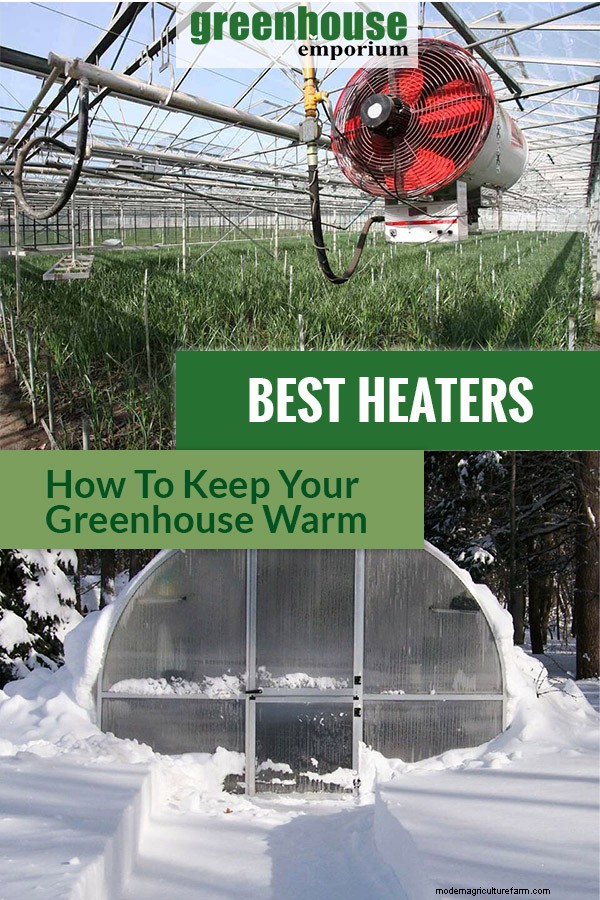
The most common heater types are electric and gas. Most gardeners prefer gas heaters because they are affordable, especially in their local area. It uses natural or bottled gas. Gas heaters have the same effects as electric heaters. You simply need to install sufficient ventilation in your greenhouse because it may emit a significant amount of fumes. Confined fumes can be bad for you and your plants’ health.
The electric heater is so popular because of its efficiency in keeping warmth at a consistent level. It does not release any dangerous fumes. This is best for those greenhouses with insufficient ventilation. It might be best, but it is also the most expensive of the three.
Paraffin is the cheapest manual heater that anyone can buy from a local market. The fuel used is also affordable although it is a bit hard to find these days. It also gives off carbon dioxide which is needed by your plants.
Ok, so this is a tricky question because – again – this depends on the greenhouse size (including height), insulation and greenhouse usage.
Theoretically speaking, 10,000 BTU is supposed to cover 400 – 450 sq.ft and 20,000 BTU around 1,000 sq.ft. However, this is for houses with insulated walls. A greenhouse does not have that much insulation. The R- or K-Value of your greenhouse model will give you an idea of how well insulated it is (not every model mentions this in the description). If you want to read more about greenhouse insulation, check out this article!
Then you also have to keep in mind the lowest temperatures in winter and what climate you want to create in your greenhouse.
Let us give you the extreme: Our biggest greenhouse is 16ft x 30ft and comes with a 30,000 BTU commercial gas heater. It is well insulated but not as good as the RIGA XL greenhouses. However, it’s enough to heat the space up in winter. This example may give you an idea of what you need for your situation.
There are several upsides to electric heaters, foremost of which is to provide a steady temperature to your greenhouse. They come in different types. Tubular electric greenhouse heaters use a heating element to distribute warmth to the entire area. The lower electric consumption by omitting the need for fans. Fan-assisted models have a fan that radiates heat to specified areas
Pros:
Cons:
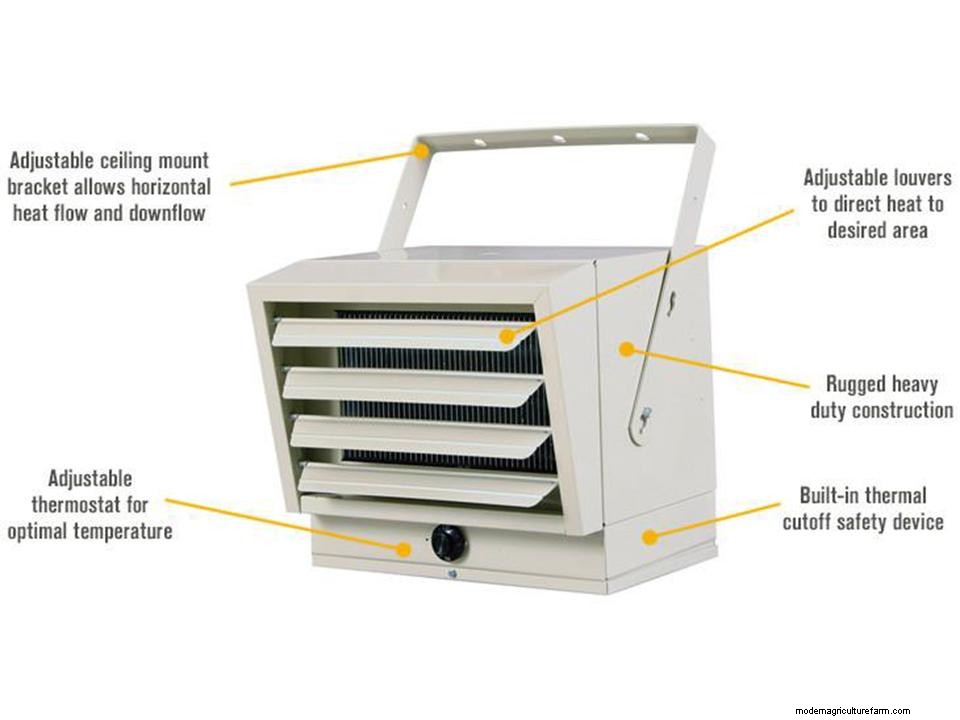
For medium to large greenhouses: RSI Greenhouse Heating System
For small to large greenhouses: AirNmore Infrared Space Heater
For small greenhouses: ISILER Ceramic Space Heater with Adjustable Thermostat
Using gas to heat your greenhouse can be practical because it doesn’t require a power source. So, you don’t need to lay a cable. The problem with using gas, propane, and butane are the toxic fumes it emits. However, the requirement of high temperatures can be quickly accessed because of their built-in thermostat control.
Pros:
Cons:
For medium to large greenhouses: Mr. Heater Corporation
For medium to large greenhouses: Dyna-Glo 18,000 BTU Cabinet Heater
Small greenhouses: Dyna-Glo Natural Gas
Greenhouse heating can cost a lot of energy consumption with the use of pumps and devices as well as maintaining the right temperature. Solar panels seem to hold the correct answer for serious gardeners who want to keep optimum plant growth and development. The use of solar panels to maintain a steady temperature throughout the year makes both plants and environment healthy and happy.
While any type of solar panels can be used for your greenhouse, the more efficient ones are the monocrystalline solar cells and the polycrystalline solar cells.
Pros:
Cons:
Pros:
Cons:


