
Welcome to Modern Agriculture!

Thimbleberries (Rubus odoratus), also known as flowering raspberries, are a delicious addition to any landscape. They look quite a bit like raspberries when the fruit is ripe, but with a much more intense taste.
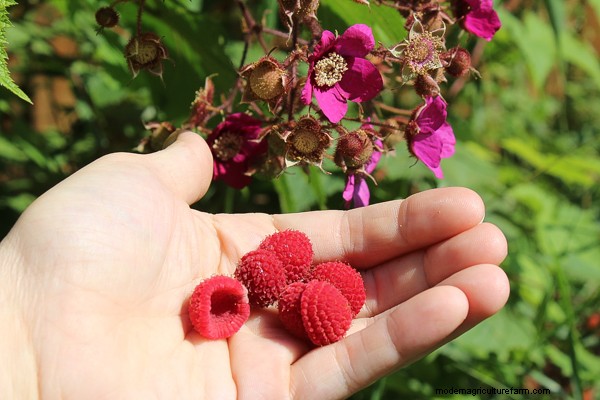
Thimbleberries are my daughter’s favorite fruit, and she eagerly waits all year for our crop to ripen. It could be that they’re sparse bearers, meaning that every berry is precious, but even I have to admit that they’re downright delicious.
These days, I get maybe one or two berries a season, and she hunts the rest down like a hawk, picking them just as they ripen.
Unlike raspberries which come in all at once in a big flush, thimbleberries ripen just a few berries at a time over the whole season. It makes it nearly impossible to pick enough for a thimbleberry jam, but also means that you get months of snacking on just a handful of fresh fruit every day.
They have a very soft texture and intense taste, and to me, they taste more like raspberries than raspberries.
The best way I can describe the taste of thimbleberries is like raspberry flavored candy. It’s like someone wanted to make something raspberry flavored, but they dumped too much raspberry extract into the batch.
The berries themselves are soft and fragile. They begin to spoil literally hours after harvest, so you won’t ever see them in the grocery store. That’s all the more reason to grow them yourselves.
There are a few different raspberry-like fruits that have the common name Thimbleberry, and I’m discussing the Eastern version (Rubus odoratus).
The plants grow along woodland edges, roadsides, and railroad tracks. I first ran across them growing in a very intentionally planted native bee garden along a stream in my backyard in Vermont. The flowers are beautiful, and they grow at head height on gigantic 6 to 8-foot tall arching canes.
They’re also called purple flowering raspberry for their showy blooms. This species of thimbleberry is native to the Eastern third of the US (Range Map).
In the pacific northwest, there’s another version of thimbleberries (Rubus parviflorus). They’re native to the western US, as well as Canada (range map).
Their growth habit is similar, but they have white flowers without fragrance. Rubus odoratus, as the name suggests, has incredibly fragrant flowers with pink petals to call all the pollinators to the yard.
I’ve never seen the western version in person or tasted it, but I’ve read that they have a similar growth habit and taste.
Though the fruit may look similar, the plants and flowers are different and need different care than traditional raspberries.
Thimbleberries will grow from seed, and they’re commonly spread in the wild by birds.
To start thimbleberry seeds, you need to mimic their natural environment and scarify and cold stratify the seeds.
Scarification mimics a bird’s digestive system and helps to slightly damage the seed coat, which will stimulate germination. You can do this by pulsing them in a blender with a bit of water. To cold stratify the seeds, place them in the freezer for a few months before planting.
Since scarification and stratification can be a bit taxing, it’s more common to start thimbleberries from cuttings or dormant rhizome divisions. They form rhizomes under the soil and can be divided every few years to establish new plantings.
Thimbleberries are large plants, growing 6 to 8 feet tall and about 3 feet wide. Allow ample space between plants. If you’re planting them in rows, leave 8 feet between rows and 3 feet between plants.
The plants will spread by rhizome and fill in the rows quickly.

A cluster of thimbleberry flowers and unripe fruit. The canes bear continuously until the first frost, so they’re always putting out new flowers as the fruit begins to ripen.
Thimbleberries like continuously moist, but not soggy soils. Mine have always grown best at the edge of drainage ditches, streams and near the dripline of my house where they get plenty of water. They would be a good choice for planting in a rain garden.
As a wild plant, they don’t really require fertilizer. Commercial fertilizers can actually damage the thimbleberry canes.
If you do add compost, be sure that it’s well decomposed. Compost that is too fresh and still decomposing can damage their roots and actually cause their roots to compost right along with the other material.
Unlike raspberries, thimbleberries do not need trellising or pruning. Let them grow wild and free for the best production.
Thimbleberries are easy to identify in the wild. The leaves are large and soft, shaped a bit like a 3 pointed maple leaf. Though the fruit may look a bit similar to raspberries, the leaves are very different.
Raspberry leaves, on the other hand, are small and come in groups on the branch.

Note the differences between a raspberry leaf and a thimbleberry leaf. The raspberry is on the left with multiple small leaves, while the large 3 pointed thimbleberry leaf is on the right.
Thimbleberries grow on tall canes without thorns. The canes have a brown “bark” that tends to fray as the canes grow, revealing a white under color.
This allows you to identify them out of season. In summer, canes themselves can be hard to see unless you get under the dense cover of leaves, but in winter they’re very distinctive.
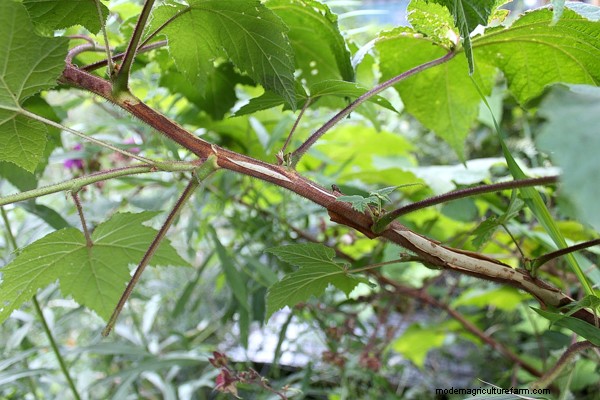
A thimbleberry cane. Note the lack of thorns, and the characteristic peeling brown bark.
The flowers are a dead giveaway.
Most people probably haven’t paid that much attention to raspberry flowers, but that’s because they’re not that noticeable. The bees find them for sure, but they’re not that impressive to humans.
Thimbleberries, on the other hand, have beautifully ornamental flowers that almost look like wild roses with bright pink petals and a fluffy pollen-filled center. It’s not uncommon to see 3 or 4 bees trashing about inside a single flower, noisily eating nectar.
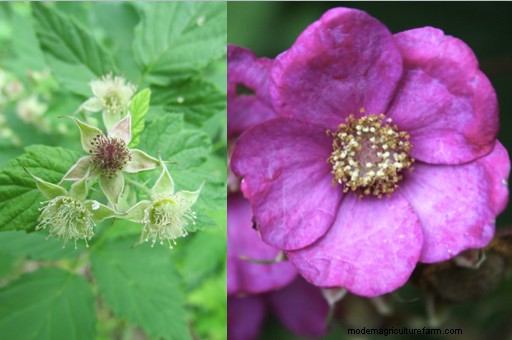
Note the differences between a raspberry flower (left) and a thimbleberry flower (right). There’s a reason they call thimbleberries flowering raspberries.
The berries themselves look like raspberries, but wider and flatter. A single thimbleberry will fit over your thumb, whereas raspberries tend to have smaller cavities and be more pinky finger sized.
Wild thimbleberries are sweet and tasty and great for eating out of hand while on a hike.
Thimbleberries are a favorite of the bees, and you can often find many bees ecstatically thrashing around within the same flower.
The plants themselves are a host nursery for a really cute honey bee mimic moth, called the yellow-banded sphinx moth. The moths are a type of hawk moth, that looks somewhat like a tiny hummingbird or bee.
You’ll be confused when you see them, and I can’t help following them around when I see them in the garden. They’re a great curiosity for both kids and adults alike.
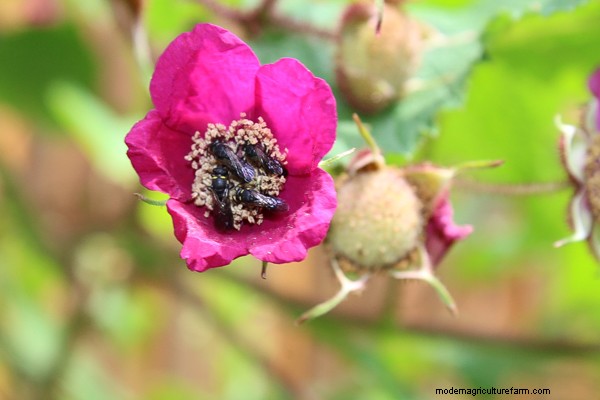
Four native bees all in the same thimbleberry flower. A common sight in mid-summer. They’re also a favorite of large bumble bees since the flowers are large and accessible.
Since the fruit is so soft, it almost always becomes bruised during harvest. The damaged fruit begins to spoil within hours.
The best way to enjoy them is fresh in the garden, popping them straight into your mouth. If you have a particularly large crop, thimbleberry jam preserves the flavor. The jam is famous in Michigan, and I recently heard a radio program (The Splendid Table) that suggested using it to glaze a baked ham.
I believe they’re using the Western thimbleberry, which may yield more impressive crops.
If you’re only harvesting the eastern version by the handful, try adding them to a vinaigrette for a tasty dressing or marinade.
Beyond the edible fruits, the fresh shoots are edible in the early spring, and the leaves can be made into a tea.
When I first spotted thimbleberries, I really had no idea what on earth I had growing in the yard. The only identification book I had at the time was a wild medicinal plants book, so I flipped through and happened to find them.
The entry was for Western species, Rubus parviflorus, so it may or may not apply to our eastern purple-flowering raspberry.
Nonetheless, the western version has been used by Native Americans for centuries. The berries are rich in vitamin C, which is true of both thimbleberry species.
A poultice of the leaves of R. parviflorus is used to treat burns and wounds, and even other smaller skin-related issues like acne. The roots are made into a tea for treating digestive ailments such as nausea, vomiting, diarrhea and dysentery.
For a more practical everyday use in the woods, the leaves make a great toilet paper. They’re large, soft and soothing to the skin.


