
Welcome to Modern Agriculture!

Nuts are an excellent source of protein and healthy fats, and most store well in the root cellar and will keep well into spring. These days, most of the nuts you can find in the grocery store are warm-climate fruits.
Almonds are grown in mass in California, and the south is known for pecans. If you’re living in a cold northern climate, you’ll have to think beyond modern grocery store varieties to find nuts suitable for your homestead.
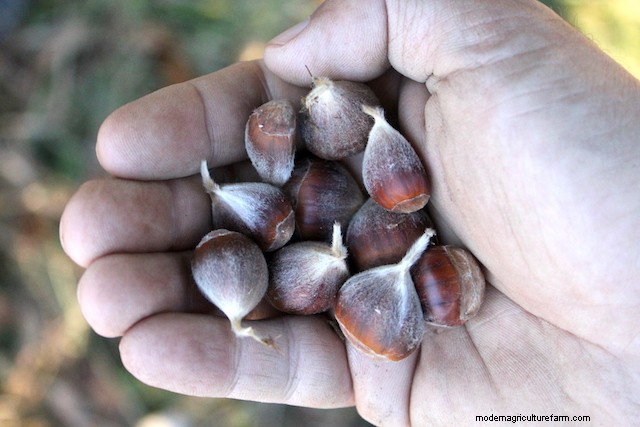
Wild chestnuts harvested in Central Vermont (Zone 4).
Native to northern climates, black walnuts are well adapted to the cold. Trees begin fruiting as early as 4 years old, though you won’t get a large crop until your tree is 20 years old or more. These days they’re mostly grown for their timber, but they do produce tasty edible nuts if you can find a way to crack them.
I’ve known people to run them over with their cars, though personally, I couldn’t get them to crack that way. Try placing them in a doubled burlap sack on an old stump and bashing the sack with a small sledgehammer.
While some people consider them too bitter, the trick to tasty black walnut is getting them out of the husk quickly. As the husk ages, it releases bitter compounds that make the nut more astringent.
Remove the outer green husk but then leave the nuts in the shell until you’re ready to eat them. Once removed from the shell, black walnuts won’t store nearly as long.
The outer husk of black walnuts is used to make natural dye and is a rich source of iodine. Just like there are few inland sources of salt, there aren’t many sources of iodine away from the coast. That makes black walnut a rarity in terms of nutritional content.
Black walnuts grow a long tap root that is easily disturbed in transplant, so it’s best to plant black walnuts from seed directly into the ground.
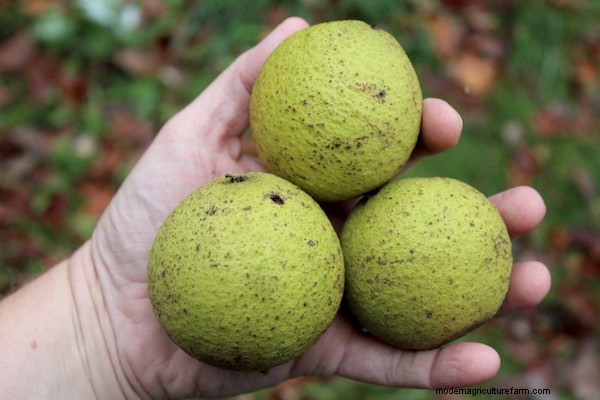
The Carpathian walnut is similar to a standard walnut, but it’s bred for increased cold hardiness. Unlike black walnuts that can be bitter and are nearly impossible to shell, Carpathian walnuts are sweet-fleshed and can be cracked with a pair of strong bare hands.
Depending on the strain, they can be hardy to zone 4. Be sure to source your tree from a company that stocks very hardy strains raised in cold climates. Fedco seeds sells zone 4 Carpathian walnuts.
As the name suggests, the Manchurian walnut is a species of walnut native to Eastern Russia, China and Korea. I honestly hadn’t heard of it until we saw a listing at our local nursery for this zone 4 hardy walnut variety. The trees are noted for their fast growth and exceptional hardiness, but the nuts are supposedly smaller than other walnuts and hard to extract from the shell.
We’re going to give them a try and hopefully, in 5-8 years I can report back on how they taste.
Native to the Northeast and Canada, butternuts thrive in cold climates. They’re sweet and with a buttery rich meat similar to a walnut.
Most wild butternuts are threatened because of a disease called butternut canker that’s causing their numbers to dwindle. Trees planted in isolation, however, in areas without butternuts present stand a good chance of reaching fruiting age without becoming infected.
Scientists are working on a selective breeding program, and are beginning to develop resistant strains. Butternuts have also been hybridized with other nut species and the hybrids are not susceptible to the canker. We have quite a few older butternuts on our land and they have a beautiful silver/grey cross-hatched bark that’s easy to pick out in the forest year-round.
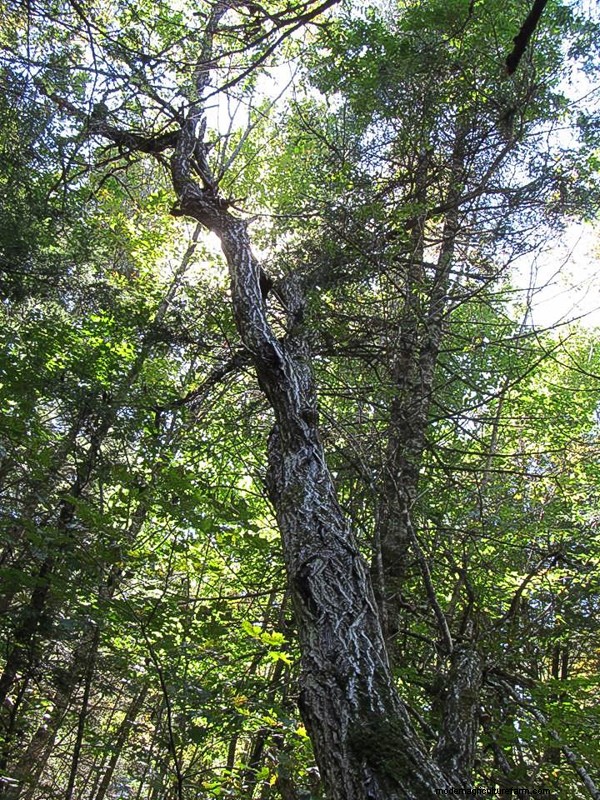
A walnut native to Japan, heartnuts are hearty to zone 4. They produce a sweet nut that’s relatively easy to crack without breaking the nut inside the shell. When you crack them directly in half, the shell opening forms the shape of a heart, thus the name.
Heartnuts are very similar to butternuts, and since they’ve been used as a landscape tree in the northeast, wild hybrids of heartnuts and butternuts are not uncommon. Thus, some plant breeders have started to produce them intentionally, leading to the Buartnut.
A hybrid of butternuts and heartnuts, this tree is often mistaken for the native butternut. Since it’s resistant to the butternut canker that’s devastating the native butternut trees this hybrid is often used to replace dying butternut trees. Hybrid vigor means that buartnut trees actually grow faster and produce more nuts than either heartnuts or butternuts, so this tree is a good productive and disease-free choice.
American chestnuts were once common wild trees providing food for humans and wildlife alike. In the early 1900’s most of the American chestnuts were killed off by a blight, and they’re very rare in the wild. Since they’re so rare, if you plant American chestnuts away from any other chestnut species there’s a good likelihood that they’ll survive in isolation.
Alternatively, a hybrid crossing the American chestnuts in with Japanese and European varieties seems to thus far be resistant to the blight. Give homegrown chestnuts a try and you’ll have something to roast over the fire this winter.
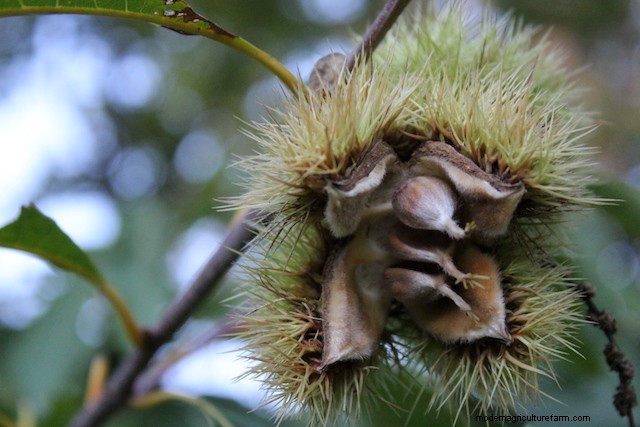
Be careful where you plant a chestnut though. The spikey outer husk around the nuts is absurdly sharp. Chestnut husks aren’t fun to step on, trust me on this one. Keep chestnut trees away from walking paths, especially if you have young children.
Hopefully, your grandparents planned ahead and planted you a shagbark hickory tree. Though they’re amazingly hardy and produce tasty nuts, hickory trees generally don’t produce until they’re around 80 years old. They produce a particularly sweet nut that’s similar to a pecan.
Though their nuts are some of the best you can get, hickory trees have never been planted commercially because they take so long to reach bearing age and crops are irregular year to year. If you want to do your grandchildren a favor, plant them a few now knowing you’ll likely never see a harvest yourself.
A hybrid of pecans and hickory nut trees, hicans occur naturally in the wild. Certain varieties have really tasty nuts and have been selected for hardiness in cold climates. The idea is that you get the hardiness of a hickory nut combined with the earlier baring of a pecan.
I’ve yet to taste one, but our local nursery writes that these are “the best nuts in existence.” That’s a pretty strong compliment.
Be careful though, as they don’t come true to seed and many of the hybrid seedlings will produce empty nuts or have other flaws. Choose a grafted tree rather than a seedling for hicans.
Though less of a tree and more of a hardy shrub, hazelnuts can be a hardy and productive addition to your northern homestead. They’re native as far north as the uppermost tips of eastern Canada.
The more commonly cultivated and commercially sold filbert species have much larger nuts, but a similar taste. These nuts have a much longer storage life than most nut varieties and can last up to 2 years without spoiling in the right conditions.
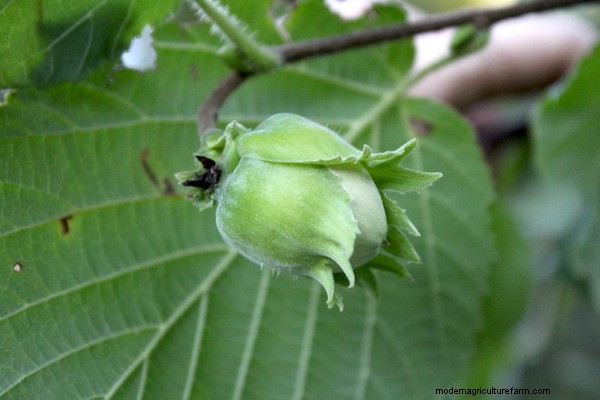
An unripe hazelnut growing on a shrub in our yard in zone 4.
Pine nuts have a sweet buttery taste without the astringency of other nuts (like walnuts). The problem is, most pine nut species aren’t particularly cold-hardy.
A strain of Korean nut pine is gaining popularity in permaculture circles and is said to grow anywhere white pines grow well. They may be hardy to zone 2 and 3 as well.
Korean nut pines grow slowly for the first 5 years but then begin to rapidly grow after that point. They’re a shade tree and require shade so that they don’t burn in full sun, especially when young.
I’ve read conflicting reports on when they begin to bear, but most sources say between 10 and 20 years old. Ours are just going in, so we’ll see.


