
Welcome to Modern Agriculture!

St. John’s wort (Hypericum spp.) refers to a genus of annuals, perennials and shrubs, typically with bright yellow, open flowers with prominent stamens. Some species develop red-brown autumn berries. Named after the feast day of St John the Baptist, around which many European species flower, the most well-known of the genus is the perforated St. John’s wort (Hypericum perforartum), which is native to Britain and Northern Europe, and much of Asia. Traditionally, Hypericum perforartum has been used as an herb to treat depression, however all plants in the genus are mildly poisonous to people and animals, and in large doses can cause sensitivity to light (leading to dermatitis). If considerable quantities are eaten they could even cause death.
While most garden varieties of St. John’s wort are compact growing and easy to manage, Hypericum perforartum spreads by creeping rhizomes and seeds. It has been introduced in many parts of the world and is considered an invasive species in parts of Australia, South Africa, and the Americas. In some regions, including the United States, Hypericum perforartum is known as klamath weed. However, there are plenty of varieties to grow, including some which do well in pots.
Grow St. John’s wort in moist but well-drained soil in full sun to partial shade. Shrubby hypericums, such as Hypericum ‘Hidcote’ can become untidy and should be pruned in spring. If they’ve out-grown their space they can be cut back hard if necessary.
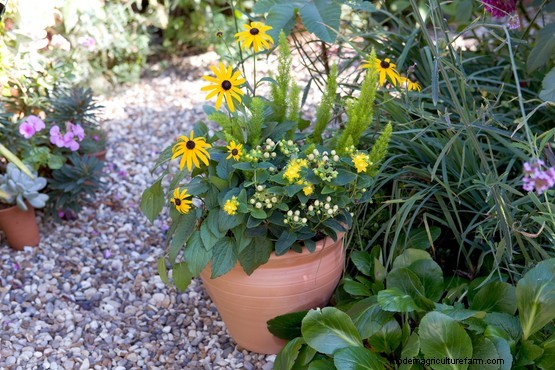
Hypericum perforartum is perfect for growing in a wildflower meadow or other wild planting scheme. Shrubby types, including Hypericum ‘Hidcote’, are ideal for ornamental borders, while low-growing St John’s wort are best used as ground cover. Some species, including Hypericum inodorium, can be grown in pots.
Plant St. John’s wort as you would any plant – dig a hole slightly wider but no deeper than the original pot, tease any restricted roots out from the base of the rootball and place it into the hole before backfilling with soil. Firm around the rootball gently with your foot and water well.
All St John’s worts are easy to grow and tolerant of a wider range of conditions, including temporary flooding. However, during prolonged periods of drought they will benefit from supplementary watering, particularly young plants. Many shrubby varieties can look untidy over the year and should be cut back in spring. If they’ve out-grown their space they can be cut back hard.
Hypericum perforartum is a prolific self-seeder so you may find you are removing seedlings rather than actively trying to propagate from it. Larger, shrubby types can be propagated from hardwood cuttings.
St John’s wort is not troubled by pests or diseases.
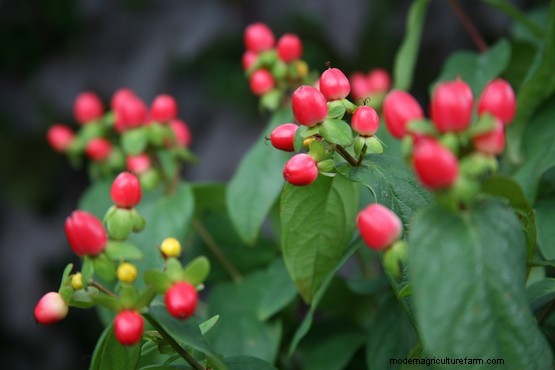
Hypericum × hidcoteense ‘Hidcote’ – one of the most popular St. John’s wort, bearing masses of yellow blooms followed by red-brown berries. Grow in sun to partial shade. Height x Spread: 1.2m x 1.5m
Hypericum × moserianum ‘Tricolor’ – a low-growing variety, perfect for using as ground cover. Needs protection from cold winds. Semi-evergreen. Grow in sun to partial shade. H x S: 30cm x 60cm
Hypericum inodorium ‘Magical white’ – Bears masses of yellow flowers, followed by white fruits. Often used in flower arranging and perfect for growing in pots or as ground cover. Grow in sun to partial shade. H x S: 50cm x 80cm
Hypericum elodes – marsh hypericum is suitable for moist soils and is perfect for edging ponds. As a herbacesou perennial, it dies down in autumn and grows again in spring. Grow in sun to partial shade. H x S: 30cm x 1m
Hypericum x dummeri ‘Peter Dummer’ – a low-growing, rounded shrub with yellow flowers and orange stamens, red-tinted fruit and lovely autumn colour. Semi-evergreen. Grow in sun to shade. H x S: 30cm x 1m
Hypericum ‘Magical Red Flame’ – compact shrub perfect for the front of a border. Bears flowers and fruit at the same time. Grow in sun to shade. H x S: 1m x 1m
Hypericum ‘Gemo’ – low-growing shrub with semi-evergreen foliage. Large yellow flowers with golden stamens are followed by red-blushed fruits. Grow in sun to shade. H x S: 90cm x 90cm


