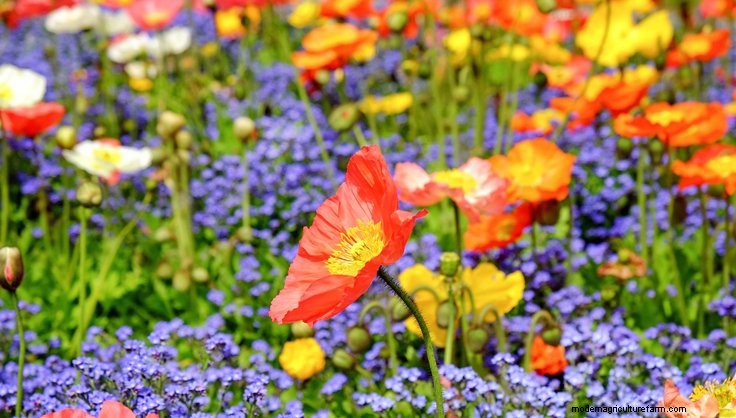
Wildflower meadows offer a very attractive alternative to traditional lawns and gardens. They only need mowing once or twice a year, and they don't require watering or fertilizing. Beneficial insects such as mason bees, butterflies and lady beetles thrive on the protection and food they provide. And many people find their casual charm is a welcome change from closely shaved grass and heavily mulched borders.
If you'd like to try your hand at growing a wildflower meadow, you need to start with good seeds. For best success, use a seed mix that's been created for your geographical location. It should contain a wide variety of species so you'll have the opportunity to see which wildflowers are happy on your site (the ones that come back and reproduce), and which ones are not (the ones that disappear entirely). You may find that lupines and daisies thrive; then again, it may be coreopsis and flax. Within a couple years after planting, it will be clear which plants are thriving.
Easy-Care Favorites
The following varieties are widely adapted, reliable performers that are not terribly fussy about soil type. All require at least a half day of sun:
Cornflower (Centaurea cyanus)
Cosmos (Cosmos bipinnatus)
Lance Leaf Coreopsis (Coreopsis lanceolata)
Plains Coreopsis (Coreopsis tinctoria)
Catchfly (Silene armeria)
Annual Baby's Breath (Gypsophilia elegans)
Sweet William (Dianthus barbatus)
Gloriosa Daisy (Rudbeckia hirta 'Gloriosa')
Black Eyed Susan (Rudbeckia hirta)
Toadflax (Linaria maroccana)
Sunflower (Helianthus annuus)
Rocket Larkspur (Delphinium ajacis)
Shasta Daisy (Chrysanthemum leucanthemum 'Maximum')
You'll find an excellent selection of wildflower seed mixes and individual varieties at: www.americanmeadows.com
The mix should include seed for both annuals and perennials. The annuals will grow quickly the first year and produce a colorful show while the perennial plants are getting established. In the second and succeeding years, you will find that your meadow has converted to perennial species, and there will be few if any annuals. If you have your heart set on cornflowers, cosmos, Shirley poppies and other annuals in your meadow, you'll need to choose a site where you can prepare the soil anew each year and plant fresh seed (or seeds that you've collected). Just spreading annual seeds over the top of an established meadow won't work, because once perennial wildflowers get established, tiny annual seedlings are unable to compete for light, moisture and nutrients. A narrow strip along a driveway or fence works well for an "annual meadow" that gets replanted each year.
Here are some additional tips about soil preparation, planting and care to help ensure your success:
- When to sow. Wildflower seed can be planted in either spring or fall. In colder climates, fall-seeded wildflowers will usually remain dormant until the following spring; in warmer areas, plants will germinate and start getting established before winter.
- Selecting the planting site. When thinking about where to locate your wildflower meadow, consider starting with a section of your lawn that has been difficult to mow or that seems poorly suited to grass. Another option is to convert an overgrown flower bed. A sunny site is usually best. Most wildflower meadow seed mixes contain sun-loving varieties that require five to eight hours of direct light each day. Well drained soil is preferred, but if you have a problem site with overly wet or extremely dry soil, you just need to select seed varieties that are particularly suited to those conditions.
- Preparing the ground. This is probably the most important step in the process. Wildflower seeds need to be sown on well-prepared soil that—as much as possible—is free of weeds. Mow existing vegetation as close to the ground as possible. Remove any woody plants. Strip off any sod, or rototill the area and then rake out the clods of grass. You can also consider applying an herbicide, such as BurnOut. Once the grass and weeds are gone, till the area to a shallow depth of 1-2 inches.
- Eliminating annual weeds. Do not plant wildflower seeds immediately after preparing the soil. Tilling the soil usually brings weed seeds to the surface, where they will germinate. Wait two weeks or so after tilling, then go over the ground again with the tiller or a hoe, to expose the roots of newly sprouted weeds. A second application herbicide is also an option at this point.
- Sowing the seed. Before seeding, mix the seed in a pail with fine-grade builder's sand, which will help ensure even coverage. Use four parts sand to one part seed. Broadcast one-half of the seed/sand mix using a handheld broadcast seeder, or by hand, using an even, sweeping motion. Then walk across the seedbed at right angles to the path you took before, sowing the other half of the seed. Sow seed rather thickly; this will help the wildflowers out-compete weeds and grasses.
- Firm in the seed. Seed that is buried too deeply will not germinate. Instead, simply walk across the seedbed, tamping it down with your foot. You can also use the head of a garden rake to ensure good contact between the seeds and the ground. Another option is to rent a lawn roller, a large cylinder that you fill with water and then push over the seedbed to firm it down.
- Water and, if needed, fertilize. Seeds require moisture to germinate. You should water for an hour or so every few days until the plants are about 1 to 2 inches tall. After that point, water only if plants look wilted or stressed. Wildflowers normally grow well in average soil and don't require fertilizer. If your soil is nutrient-poor, however, spread an all-purpose, organic fertilizer at the same time you plant seeds.
- Control weeds. If your wildflowers germinate well and grow thickly, they should choke out most weeds. When weeds do spring up in the midst of the wildflowers, pull them by hand before they have a chance to flower and disperse their seeds.
- Mow annually. A few weeks after the flowers have faded in your meadow planting, you can do a high mowing of the field (set the mower to 4 to 6 inches above the ground). This helps control unwanted weeds and grasses, and also helps disperse the mature seeds of your wildflowers.


