
Welcome to Modern Agriculture!

Rosemary (Rosmarinus officinalis)
This evergreen perennial herb is native to the Mediterranean region, where it still grows wild as well as domesticated. Its Latin generic name refers to the dew (ros) of the sea (marinus). For thousands of years, this attractive, intensely aromatic plant has captivated our senses as well as our folklore. The references about rosemary in both history and legend are abundant.
In ancient Greece, the herb was burnt to cleanse the air and to ward off evil spirits. This tradition lasted well into the middle ages, when it was burnt in areas affected by plague. It was still being burned in the 17th century in English courtrooms and French hospitals, to prevent the spread of disease. This is likely because dried rosemary leaves contain about 20% camphor, which has been prized since ancient times as both flavouring and medicine.
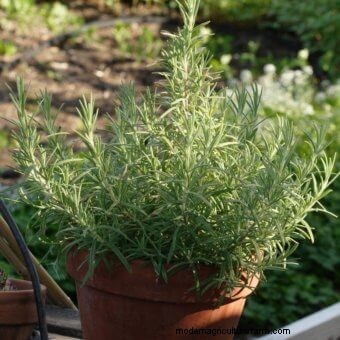
A sprig of rosemary, it was said, could be placed under the pillow to dispel nightmares. Those seeking love were to place a pot of rosemary on a windowsill to attract a mate. The herb has long been enjoyed as an insect repellent, both rubbed fresh on the skin and by placing bundles of it in chests to repel moths. In the Christian tradition, rosemary is said to never grow taller than Jesus. Another story tells that Mary, during her flight into Egypt, rested beside a rosemary bush and draped her blue robe upon it, turning the flowers from white to blue.
Rosemary was probably introduced to Britain by Roman settlers, and was likely cultivated there prior to the Norman Conquest, which began in 1066. The herb was distilled by Raymundus Lullus in 1330, and became the world’s first essential oil.
This herb is highly prized for its medicinal qualities. Culpeper, in the seventeenth century, wrote extensively of its seemingly limitless uses in the apothecary, even quoting his peers Dioscorides and Galen:
Rosemary has been used to flavour meats (and to hide the smell of rancid meat) since the middle ages. As a foodstuff, rosemary is surprisingly rich in iron, calcium, and vitamin B6, and its flavour matches well with gamey meat like lamb. Rosemary is grown on a commercial scale from Morocco and France east to Rumania. The bulk of imported, dried rosemary appears to come from France, Portugal, and Spain.
Rosemary may be prostrate or upright in habit, and mature plants in a warm climate can grow as tall as 2m (6’), but even in our area the plants can become large shrubs if they’re in a sunny, protected spot. Rosemary is very slow to grow from seed. Of all of the food plants listed in this book, it may be the slowest growing. Remember that rosemary is a woody shrub – propagation from cuttings is faster than propagation from seed.
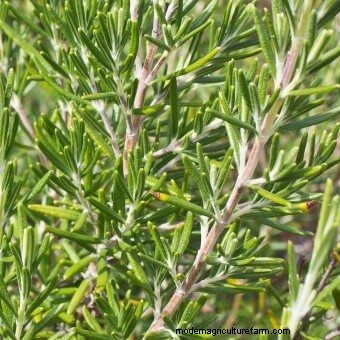
Difficulty: Easy to cultivate, but tryingly slow from seed. Rosemary is well suited to growing in larger containers. All woody herbs are slow from seed.
Timing: Seeds can be sown at any time of year – late spring outdoors is a good option, as the young seedlings will need at least 3 years before they can be harvested. Nearly every rosemary plant available at the nursery is grown from cuttings, not seed.
Sowing: Sprinkle the tiny seeds on the surface of pre-moistened, sterilized seed starting mix, and water only with a mister. Pre-chilling by storing the seed packet in the refrigerator for 2-3 weeks may improve germination.
Soil: Once seedlings are ready to pot on or transplant, choose a loose, loamy soil with excellent drainage and good fertility.
Growing: Choose a site in full sun, and leave the plants alone. They are rarely bothered by insects. In the right site, plants can become enormous.
Harvest: Rosemary dries particularly well, keeping much of its flavour. You can pinch or clip fresh leaves as needed, or cut whole branches from larger, established plants to dry in an airy, dark environment. Strip the leaves from the branch once they are dry, and store in an airtight container away from bright light.
Seed info: The CFIA standard for the germination of all herb seeds is 50%, which is very low compared to vegetable seeds. West Coast Seeds has its seed lots tested for germination, and 60-80% is the norm. Seeds should maintain their viability for several years if stored in a cool, dry environment.
Companion Planting: Rosemary – Rosemary is a good companion for beans, Brassicas, and carrots. Rosemary repels cabbage moths, Mexican bean beetles, and carrot rust flies.
More on Companion Planting.
Rosemary Lemon Vinaigrette Recipe


