
Welcome to Modern Agriculture!

Caring for your own plant nursery for the very first time is no easy task. There are a lot of things you still need to experience as a first time gardener. Starting seeds indoors and keeping those seedlings alive requires a lot of effort, skill and observation.
I’ve written about seedling mistakes before, and improper watering is by far the most frequent mistake new gardeners make. So I’ve decided to devote an entire article on watering seedlings. We’ll cover watering methods, signs your trays need watering and how often to do it for optimal seedling health.
Indoor seedlings need watering every couple of days, depending on their age, tray size and soil aspect. Check your seedlings daily and only water them when the top soil has completely dried out and the trays feel lighter. You can bottom water or spray water from above – or a combination of the two.
It’s easy to kill your indoor seedlings with love (a.k.a overwatering), but before you pick up your watering can, you need to check the signs and see if your baby plants are truly thirsty. Here’s what to look for:
Your growing environment, as well as your seedlings, will give you clues on when to water if you really know what you’re looking for:
On average, your seedlings will need watering every 48 hours. Water them daily or twice a day, and you risk getting poor germination or disease. So it’s best to err on the underwatering side.
When they’re young, seedlings need more consistency. Young, small seedlings start their life in small module trays which don’t hold on to a lot of water and tend to dry out quickly. That’s the most sensitive part about starting seedlings – finding the right sized tray so that it’s space-efficient while also providing enough water and room for roots to develop.
The smaller the module tray, the harder it is to get watering right. So check your seedling every day, even twice a day at first, and only water when you see the signs described above: dry top soil and light trays. Don’t overwater thinking you’re giving your seedlings extra moisture to last them longer, it doesn’t work that way and too much water will deprive their roots from oxygen.
Now let’s take a look at how to water older seedlings. Seedlings that need to spend longer periods indoors – like peppers and tomatoes – benefit from larger containers. We either start the seeds in larger nursery pots or move them into bigger containers once they’ve grown to a decent size.
Watering rules for larger containers are different – you can water the older seedlings grown in larger containers as little as twice per week. A good rule of thumb is to stick your finger inside the soil. The “finger dip” test is also used with house plants – if the soil is dry up to the first finger knuckle, it’s best to water your seedlings.
Just like outdoor seedlings have to withstand temperature variations, wind, rain, or drought, so do your indoor seedlings, but on a different level.
The microclimate you’ve created inside your growing room will affect how much water your seedlings will need:
You can water your seedlings in one of two ways, and each have their purpose:
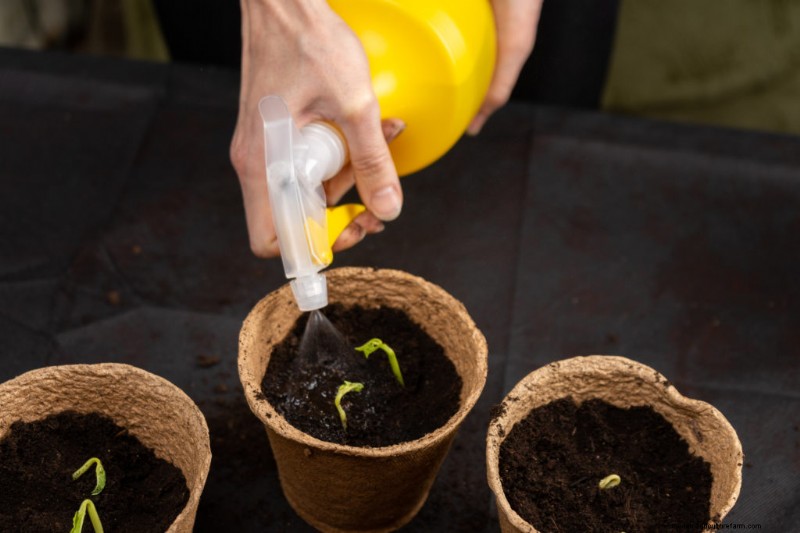
Misting is reserved for starting seeds, when your top soil needs to stay relatively damp. You can mist the surface daily or use a humidity dome – either way is fine. Once you see seedlings popping up, reduce the amount of misting – you may see some uneven germination, so keep misting from above for a couple more days until most seeds have germinated.
If it’s been more than a week and only a few of your seeds have germinated, top misting won’t help anymore. You probably have an issue with old seeds or you’ve overwatered your soil mix for too long, causing seeds to rot.
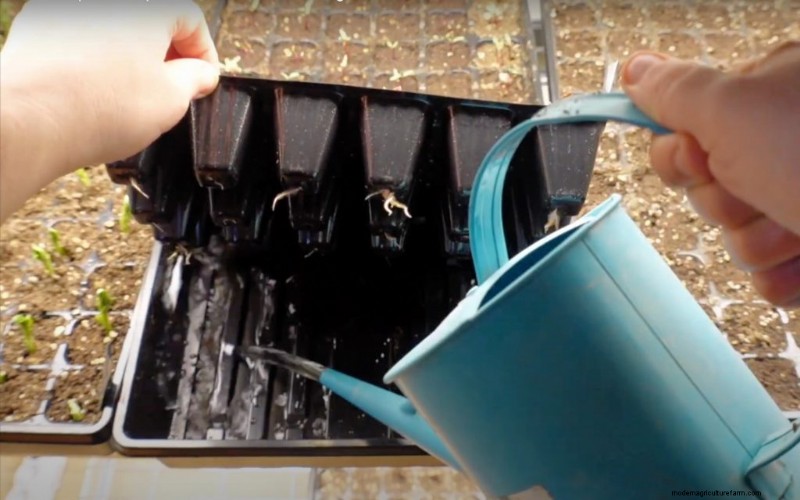
This is the preferred method of watering for indoor seedlings. For bottom watering, lift the module tray up, enough for a watering can nozzle to fit, and pour water inside the bottom tray. Fill the trays with about 1/2 inch of water. Wait for 20-30 minutes, check if all the water has gone, and either add some more or pour the excess water out.
You can also check the trays to see if they’re heavier. The top soil will be dry for a while and won’t turn wet right away, but it might do so in a couple of hours, depending on how much water you added.
Seedlings in larger containers will also benefit from bottom watering, but the key thing to mention here is that you don’t need to see your top soil turn wet. Use the finger dip test every day to see if their water levels are ok.
If you’re using peat moss as your seed starting mix, you may notice some issues when going too long in between waterings. When peat moss completely dries out, it almost looks like it’s water repellant. You pour water from above and it seems to run off the surface. You water it from the bottom and it doesn’t look like anything is happening.
This is when your peat moss mixture needs a good soaking. Fill the trays with double the amount of water you would normally add, and let the module tray filled with peat moss float inside for about 30 minutes. If it doesn’t appear soaked from above, repeat the process and also mist the soil from the top.
It’s hard to find the perfect growing medium, so I like not to exclusively use coco coir or peat moss, but also mix it with some organic matter like vermicompost for added moisture retention and nutrients.
Short answer – YES. If you catch underwatered seedlings in time, before they dry out completely, they will recover from overwatering.
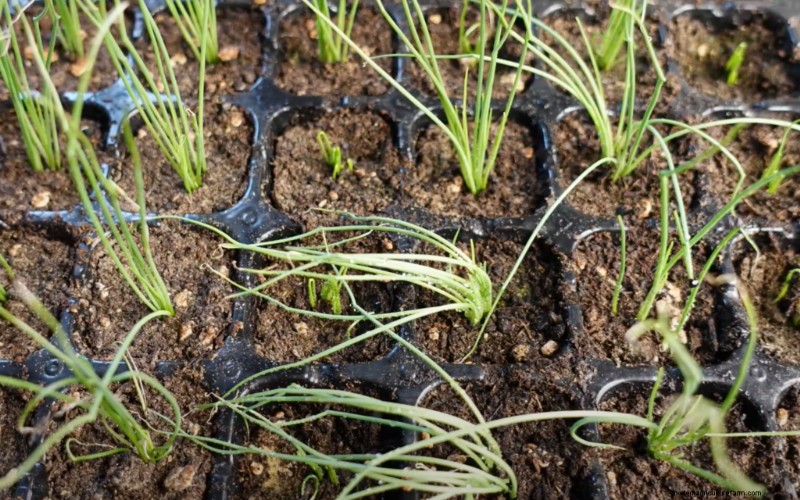
Onion seedlings and generally taller seedlings are an excellent example of this. Whenever they suffer from underwatering, they go limp and start to fall over, but spring back up as soon as they’ve had a good soak.
You might think that yellowing leaves are a sign of underwatering, but it’s quite the opposite. It’s overwatering that causes the most distress, drowns the roots and robs them of oxygen. Yellowing of the cotyledons (first bottom leaves) is perfectly normal though, and it’s just a sign that the plant is getting a little too old or too large for its tray.
If you catch overwatered seedlings in time, you might still be able to fix the problem. However, prolonged overwatering will lead to 3 major problems:
To help your seedlings recover from overwatering, drain all the trays and wait for the top soil to dry out. You can also install a ventilator or leave the windows open if it’s not too cold outside. It may take a couple of days, but the excess moisture will eventually wick out.
Watering your indoor seedlings is one of those crucial skills that you have to master through trial and error. I’ve lost countless batches of seedlings to damping off disease until I realized what I was doing wrong. But once I got my temperature and ventilation right, as well as learned to read the soil and health of my seedlings, I was off to a great start. With research and patience, you’ll get there too.


