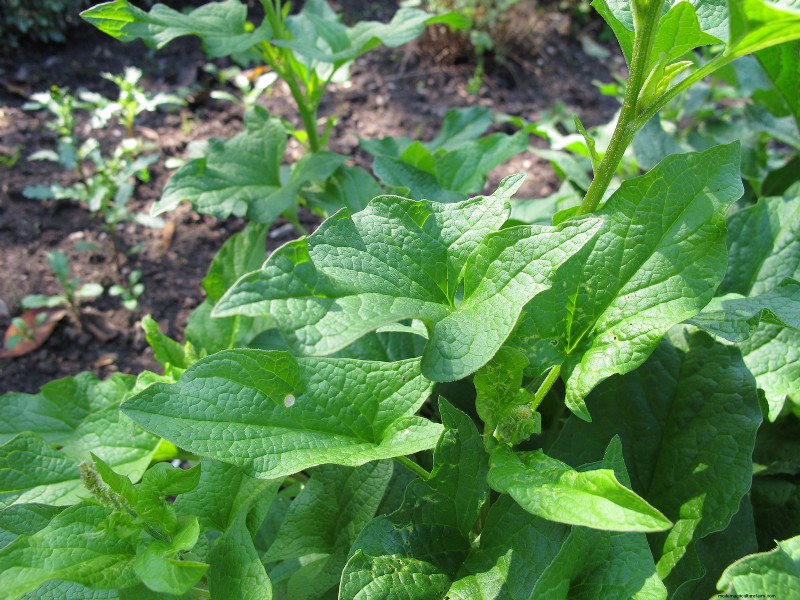
Good King Henry is a perennial green sometimes called “wild spinach” or “poor man’s asparagus.” It is grown for its juicy and flavorful arrow-shaped leaves which can be cooked and eaten like spinach and for its young shoots which can be blanched and eaten like asparagus.
Good King Henry has been grown in kitchen gardens for hundreds of years. It is native to much of central and southern Europe. Its botanical name is Blitum bonus-henricus (syn. Chenopodium bonus-henricus).
Where Good King Henry does not grow as a perennial, it can be grown as an annual. It grows best in USDA Zones 4-8 and is hardy to −25 °F (−31.7 °C). It is often grown at the edge of a vegetable garden where it can grow undisturbed. Its dense conical clusters of greenish flowers reminiscent of amaranth are often grown as cottage garden flowers or wildflowers.
- Grow Good King Henry in full sun. Grow Good King Henry in partial shade in warm regions.
- Plant Good King Henry in well-drained, loamy soil rich in organic matter. Add two inches of aged compost or a commercial organic planting mix to the planting beds before planting then turn the soil to 12 inches (30cm) deep.
- Good King Henry prefers a soil pH of 4.5 to 8.3.
- Good King Henry is hardy and thrives in cool weather; ideal Good King Henry growing weather is 50°F to 70°F (10-21°C).
- Warm weather and long days will cause Good King Henry to bolt—that is it will flower and go to seed.
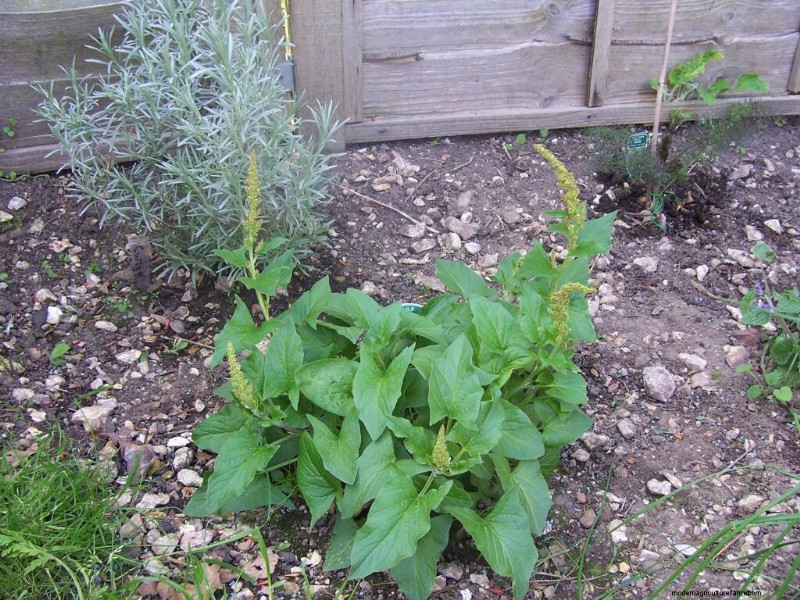
Good King Henry planted with perennial herbs
Good King Henry Growing Time
- Good King Henry grows best when planted outdoors in spring or in autumn. Avoid starting young plants in hot weather. In mild-winter regions Good King Henry will grow through the winter. In cold winter regions, plants will die back to the ground and re-emerge in spring.
- Sow Good King Henry indoors 10 to 12 weeks before the last average frost date in spring for transplanting out about the time of the last frost; germination takes 70 to 80 days.
- Seedlings may suffer transplant shock if the roots are disturbed at transplant time; young Good King Henry plants grow a single taproot.
- Direct sow Good King Henry outdoors or set out transplants 6 to 8 weeks before the last average frost date. You can also place seeds in the refrigerator for 8 weeks to stratify then direct sow them after the last spring frost.
- In mild-winter regions, plant Good King Henry in late summer or early autumn; seeds may or may not germinate before spring.
- Good King Henry can be grown through the winter everywhere in a cold frame or plastic tunnel.
- Good King Henry plants set out in autumn can survive the winter under thick mulch; plants will resume growing in the spring.
- Once established Good King Henry will grow for several years if left undisturbed.
Planting Good King Henry
- Plant Good King Henry seed 1/4 inch (6mm) deep. Cover seed lightly with soil.
- Refrigerate seeds 10 week before sowing to help germination.
- Sow seed 12 to 18 inches (30-45cm) apart.
- Space rows 18 inches (45cm) apart.
- Good King Henry seed will germinate in 70 to 80 days at 60°F (16°C). Germination could take longer if the soil is warmer; Good King Henry requires a period of stratificaiton.
- Thin Good King Henry to 12 inches (30cm) or more apart when seedlings are 3 inches (7cm). Thin to the strongest seedlings. Remove weak seedlings by cutting them off at the soil level with scissors.
- Grow 15 plants per household member or more.
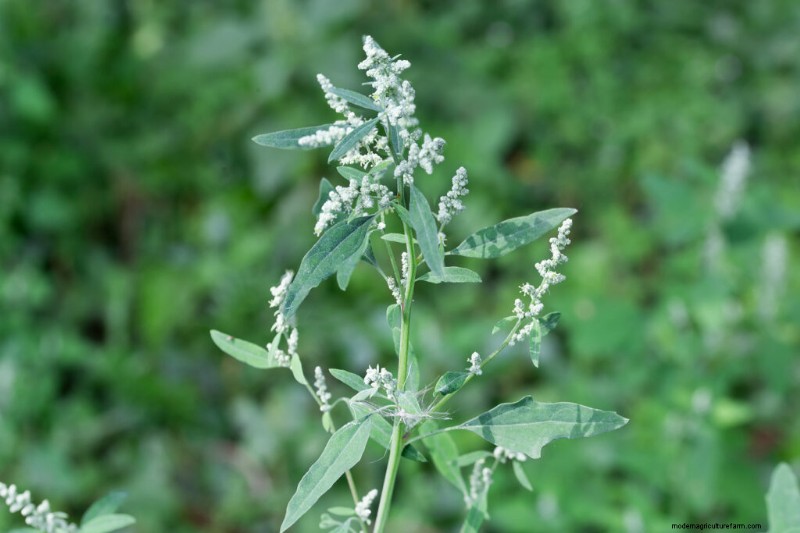
Top of stem of the flowering wild
Chenopodium album, Good King Henry
Watering and Feeding Good King Henry
- Keep the soil evenly moist throughout the growing season to grow Good King Henry steadily and without interruption.
- Avoid splashing muddy water onto leaves; mulch around plants with straw or chopped leaves to avoid getting soil on leaves.
- Side dress plants with compost tea or a dilute solution of fish emulsion every two weeks during the growing season.
- Side dress Good King Henry with aged compost once or twice a year. If growing Good King Henry as an annual, side dress with compost at midseason.
Caring for Good King Henry
- Keep planting beds free of weeds to avoid competition for light, water, and nutrients.
- Cut weeds at soil level rather than digging them out; Good King Henry has a deep taproot but shallow feeder roots that can be injured easily.
- Mature Good King Henry plants can tolerate temperatures as cold as 20°F (-6.7°C), but it is best to protect plants from freezing weather by covering the bed with a portable plastic tunnel or row cover.
- Good King Henry will bolt in temperatures greater than 75°F (24°C). If the weather warms, try protecting Good King Henry under shade cloth set over a frame.
Good King Henry Pests and Diseases
- Good King Henry does not typically suffer from attack by pests or diseases.
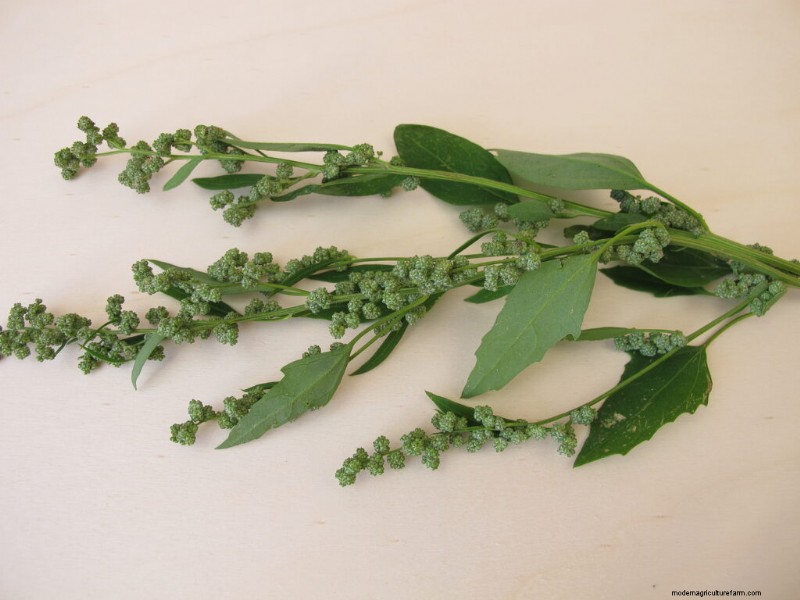
Good King Henry with seeds,
Chenopodium album
Harvesting Good King Henry
- The leaves, shoots/stems, and flowers of Good King Henry are edible.
- Good King Henry leaves can be harvested as soon as they are big enough to eat. However, it is best to allow the plant to grow for a year and establish itself before beginning harvest.
- Leaves can be harvested a few at a time from late spring to early autumn.
- Cut leaves 2 to 4 inches (5-10cm) long from plants that have 6 to 8 leaves. Cut the older leaves first. Allow the remaining young leaves to grow on to maturity.
- Very large leaves and older leaves can be bitter; harvest leaves sooner rather than later.
- New shoots are the most flavorful. New shoots can be thinned and harvested usually from mid sprig to early summer when they are most tender and flavorful. When summer arrives, stop harvesting shoots and allow the plant to grow on and gain strength for the coming winter.
- Lengthening days (days longer than 14 hours) and warming weather (temperatures greater than 75°F/24°C) will cause Good King Henry to bolt, flower, and set seed. Bolting will mark the end of the harvest for the year; leaves harvested after the plant bolts will be bitter tasting.
Storing and Preserving Good King Henry
- Wash Good King Henry thoroughly to eliminate the grit that may stick to the leaves or shoots.
- Good King Henry can be refrigerated for up to one week.
- To store leaves for more than a week, freeze them.
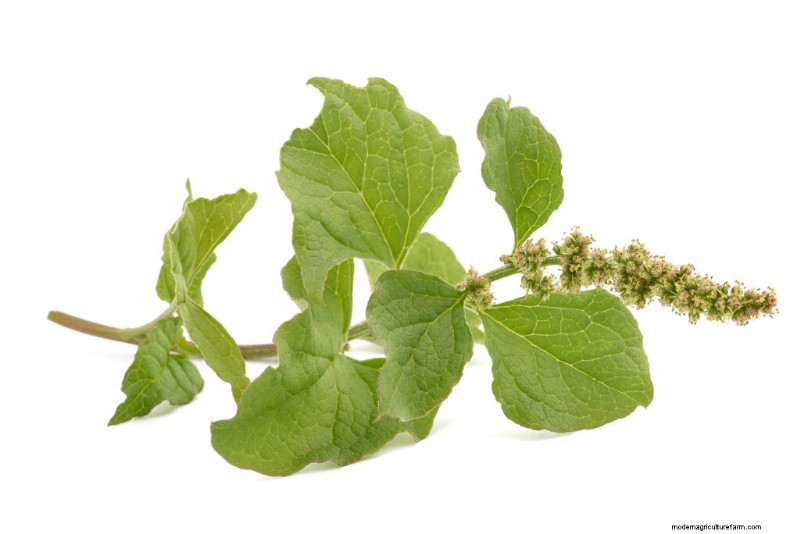
Stem, leaves, and flowers of wild spinach, Good King Henry
Serving Good King Henry
- Good King Henry leaves can be washed and eaten raw in salads. They wilt quickly so should be used quickly. Raw leaves have a high oxalic acid content and should be eaten in moderation to avoid upset stomach.
- Leaves can be cooked like spinach, steamed, sauteed, or boiled. Several changes of water will remove some of the oxalic acid.
- Shoots (stems) can be cut as soon as they appear and cooked like asparagus.
- Flowers can be sauteed in butter.
- Seed can be ground and mixed with flour to make bread or other baked goods. Soak the seed overnight and thoroughly rinse them before using.
About Good King Henry
- Good King Henry is a perennial grown for its leaves and shoots.
- Good King Henry grows 15 to 31 inches (40-80cm) tall; leaves are 2 to 4 inches (5-10cm) long, triangular to diamond shaped with a pair of broad pointed lobes neat the base; green flowers are produced on a tall, nearly leafless spike 4 to 12 inches(10-30cm) long.
- Good King Henry is related to beets and Swiss chard.
- Botanical name: Blitum bonus-henricus (syn. Chenopodium bonus-henricus)
- Origin: Southern Europe


