
Welcome to Modern Agriculture!

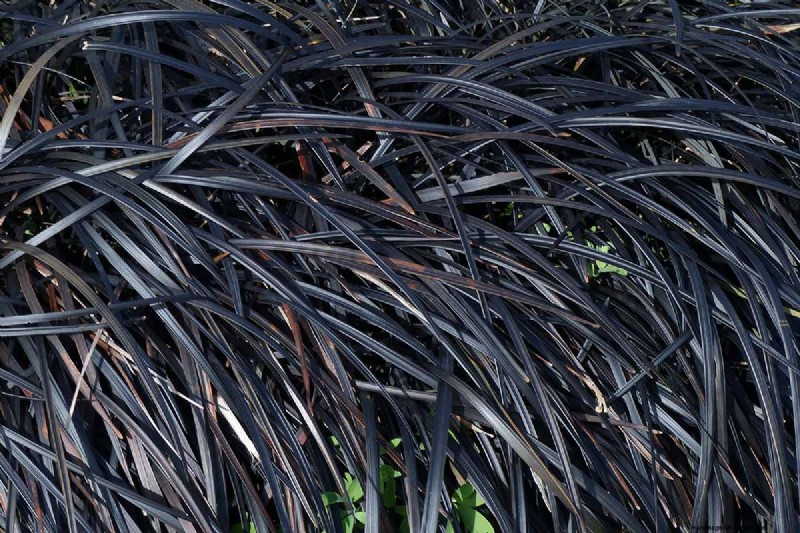
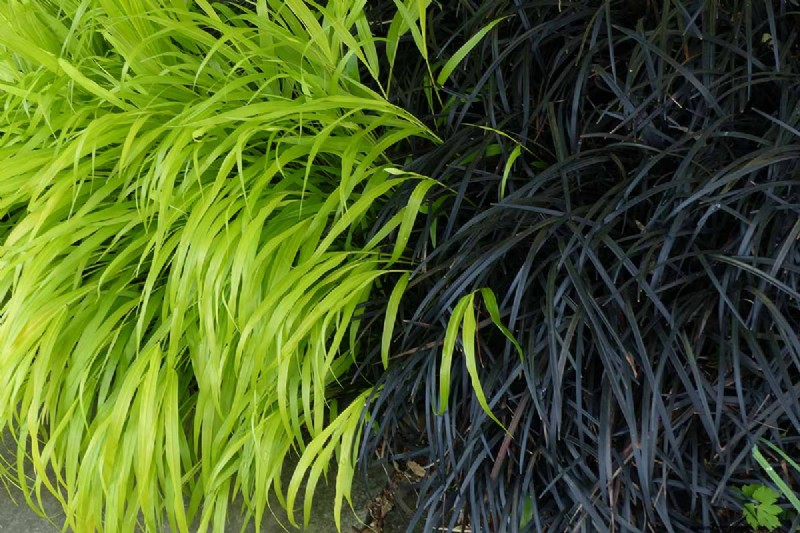
A unique ornamental, black mondo grass (Ophiopogon planiscapus) is highly valued for its versatility in the landscape, forming lush, arching mounds of black, bladed foliage.
An evergreen perennial that grows from stolons, the tufts of strappy, grass-like leaves are perfect for adding a dash of drama or polished finish to mixed borders, edging, and containers.
We link to vendors to help you find relevant products. If you buy from one of our links, we may earn a commission.
It can also be used in mass plantings, as ground cover, and throughout rock gardens.
Low maintenance and drought resistant once established, deer and rabbits prefer greener pastures and tend to leave black mondo grass alone!
Easy, attractive, and polished: are there spots in your garden that need a splash of dark drama? Then let’s shine a light on how to grow and care for black mondo grass!
Here’s what you’ll find ahead:
Sometimes called black lily-turf, black mondo grass is native to Japan, a mounding, grass-like perennial with running roots, or stolons, in the asparagus family, Asparagaceae.
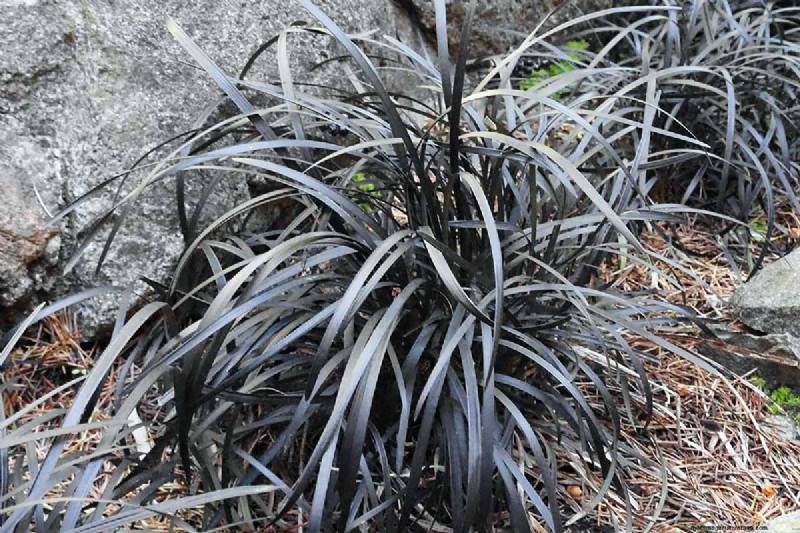 Photo by Lorna Kring.
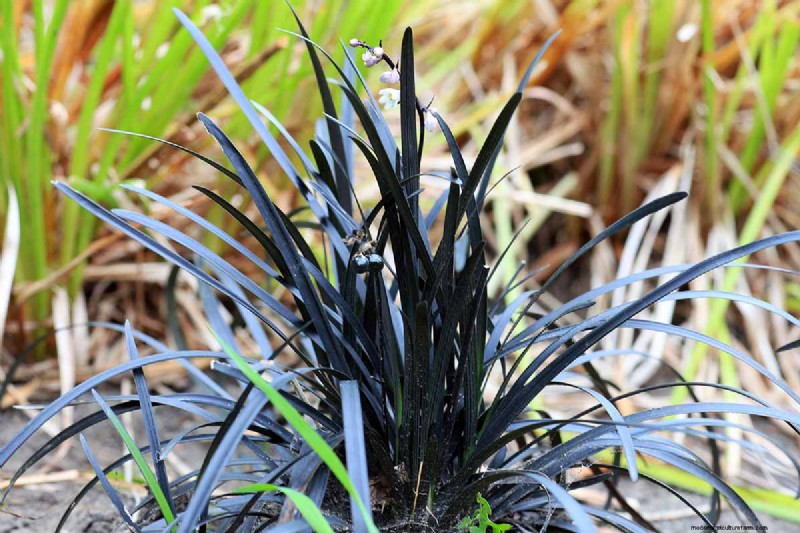
A stemless plant, the narrow, basal leaves grow in attractive arching clumps that spread slowly to a size of eight to 15 inches tall and up to 12 inches wide.
The lustrous leaves are typically dark green at the base and quickly transition to nearly black or deep, dark aubergine all the way to the tips.
In early to midsummer, flower scapes rise through the foliage and produce pretty racemes of lightly fragrant mauve, pale pink, or white bell-shaped flowers.
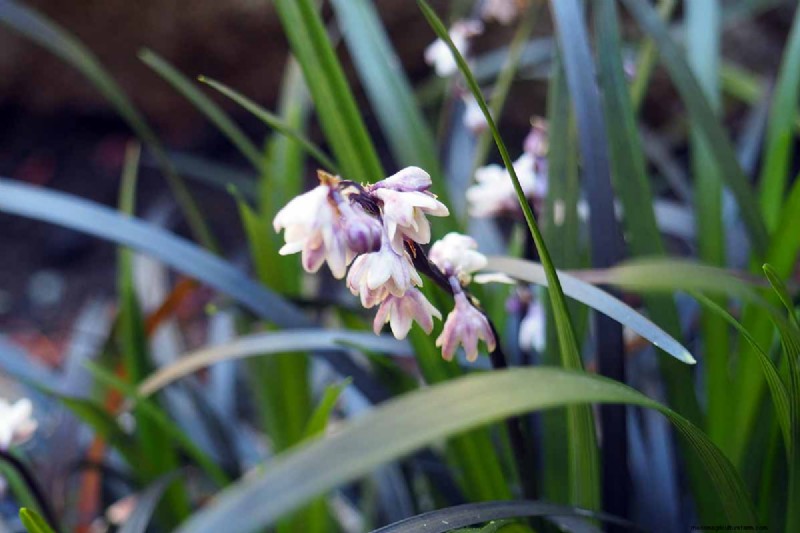 Photo by Lorna Kring.
By fall, the scapes are adorned with small, round berries of black or deep purple, which often persist through winter.
To learn about the equally attractive green-hued Ophiopogon varieties, head over to our guide on how to grow and care for mondo grass.
Common name(s): Black mondo grass, black lily-turf
Plant type: Perennial evergreen
Hardiness (USDA Zone): 6-10
Native to: Japan
Bloom time / season: Flowers in early summer, berries in fall
Exposure: Full sun to part shade
Soil type: Fertile, well-draining
Soil pH: 5.5-7.0, slightly acidic to neutral
Time to maturity: 3 years
Mature size: 8-15 inches tall by up to 12 inches wide
Best uses: Beds, borders, containers, ground covers, pond fringes, rockeries
Order: Asparagales
Family: Asparagaceae
Genus: Ophiopogon
Species: Planiscapus
Cultivar: ‘Kokuryu’ aka ‘Nigrescens’
Valued for the dense mounds of graceful foliage, a light spring cleanup is typically all that’s needed to maintain attractive, vibrant plants.
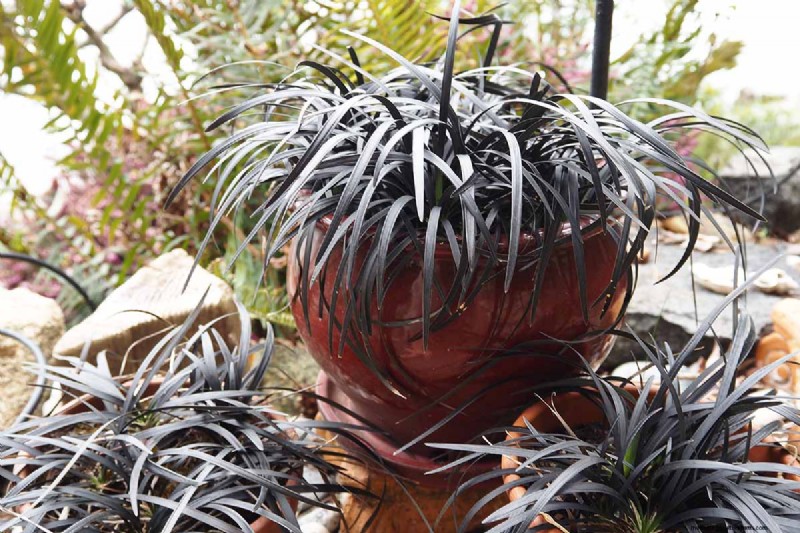 Photo by Lorna Kring.
Their easy nature thrives in full sun to dappled shade, and they flourish in most settings, including beds, borders, containers, edging, ground covers, underplanting trees and shrubs, and window boxes.
The dark color makes a striking contrast when mixed with other low-growing perennials like crocus, cyclamen, creeping phlox, and snowdrops, and the plants make a superb addition to gravel, meditation, or rock gardens.
Hardy in USDA Zones 6 to 10, plants are evergreen in areas with mild winters, although they may degrade somewhat in harsher conditions.
At the cold end of their range, they behave as a semi-evergreens or the foliage might die back to the crown, producing new blades in spring.
Plant in spring to ensure roots are well established before winter arrives.
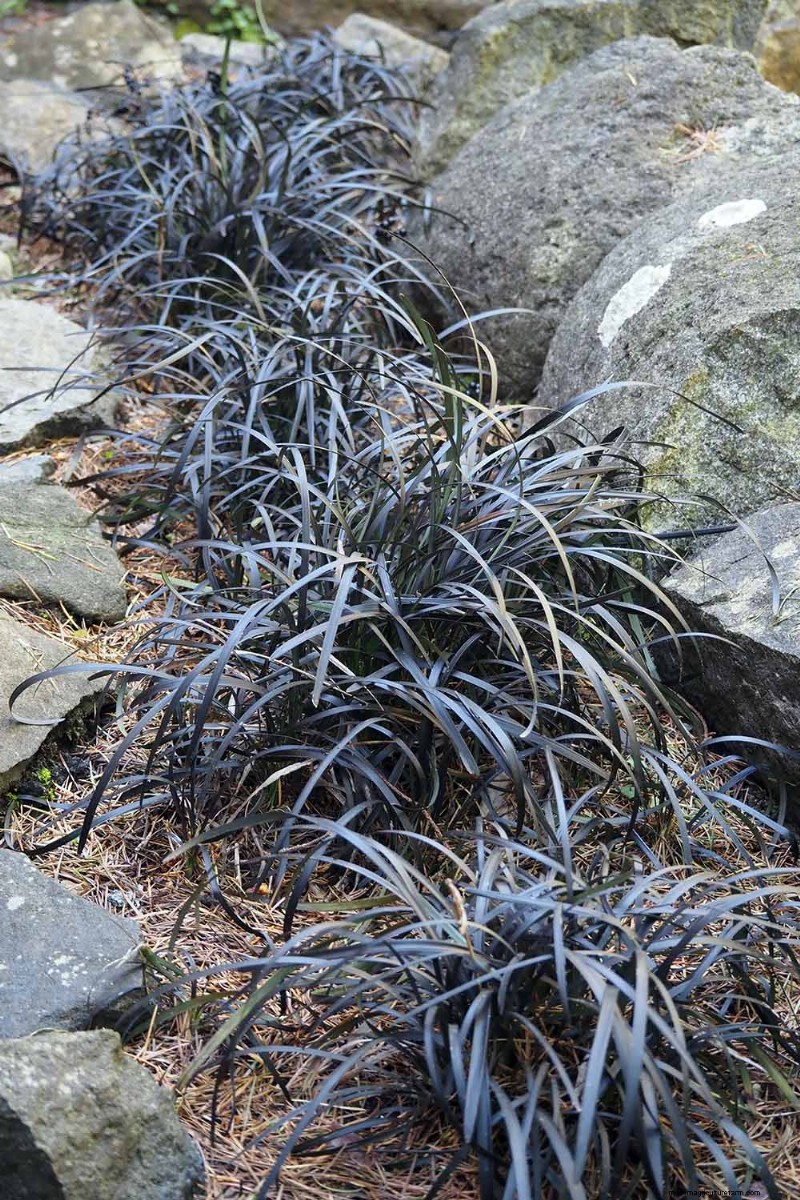 Photo by Lorna Kring.
Before planting, loosen the soil to a depth of 12 inches and enrich by mixing in compost, leafmold, well-rotted manure, or worm castings – use one shovelful for each plant.
To help establish strong, healthy roots, mix in a tablespoon of bone meal or a tablespoon of a balanced, slow-release fertilizer with a formula such as 5-5-5 (NPK).
Space plants 10 inches apart, placing the crown just below soil level. Backfill with soil, gently firming it in place over the rootball.
Water lightly to settle in place.
Adaptable to a range of conditions in Zones 6 to 10, black mondo grass thrives in a variety of humidity levels provided the soil is kept lightly moist.
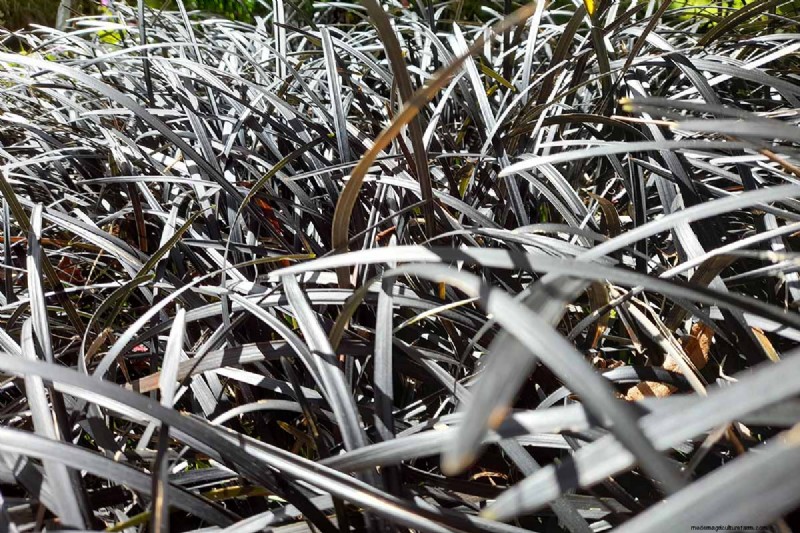
It’s also salt tolerant and makes a good choice for coastal gardens.
However, plants struggle in hot conditions if temperatures rise above 85°F.
Black mondo grows in full sun to part shade, but the darkest hues develop in full sun.
In areas with hot, intense sunshine, some afternoon shade is beneficial to protect the leaves from scorching.
These plants do best in moderately fertile, well-draining soil with a slightly acidic to neutral pH of 5.5 to 7.0.
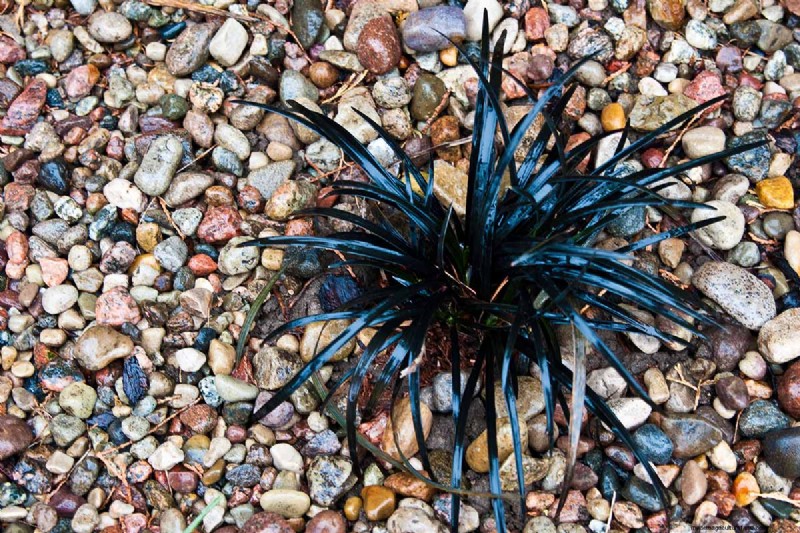
To sharpen the soil and improve drainage, mix in one shovelful of grit using materials like landscape sand, pea gravel, crushed shells, or stone chips.
To acidify the soil, the addition of garden sulfur is an economical, long-lasting solution.
But sulfur needs to be added in advance – the fall before a spring planting is best. First, test your soil with a pH probe to determine how much sulfur you need.
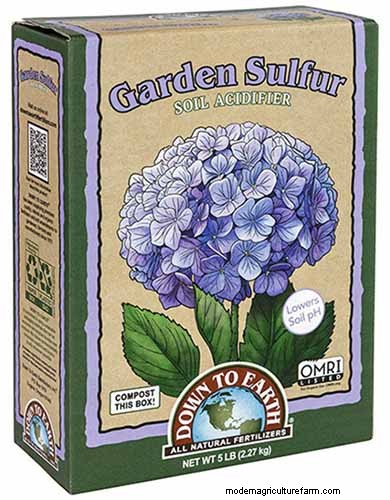
DTE Garden Sulfur Soil Acidifier
Then add in a product like DTE Garden Sulfur Soil Acidifier, available at Arbico Organics, it’s ideal for promoting bluer hydrangeas too.
Once established, black mondo grass has good drought resistance but plants do best in lightly moist conditions.
Provide one or two inches of water per week, applying when the topsoil is dry to a depth of one to two inches. Soak deeply to ensure the entire root ball is watered.
Container plants, especially those in full sun, need more frequent water applications in summer. Check regularly to keep the soil on the lightly moist side.
Although black mondo grasses aren’t heavy feeders, a spring feeding is beneficial for healthy growth.
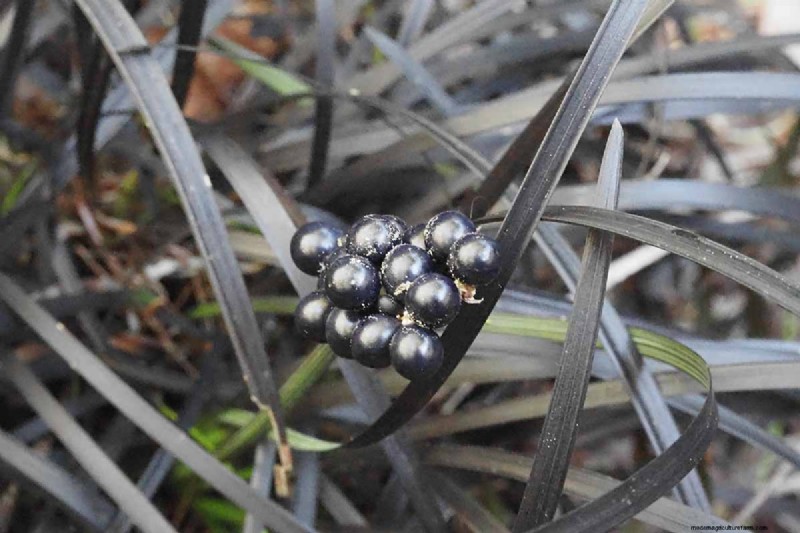 Photo by Lorna Kring.
In early spring, spread one or two inches of compost, leafmold, manure, or worm castings over the root zone.
Gently lift the foliage to spread the fertilizer close to the crown, but don’t crowd the base of the plant.
An alternative to compost is slow-release fertilizer granules. Gently scratch them into the soil surface over the root zone with a hand cultivar or garden knife like a hori hori.
Use a balanced, slow-release fertilizer with equal amounts of nitrogen, phosphorus, and potassium or an all-purpose formula with slightly higher nitrogen levels.

Burpee Enhanced Fertilizer
Burpee’s Enhanced Fertilizer, available from Burpee, is a good choice for a balanced formula with a 5-5-5 NPK.
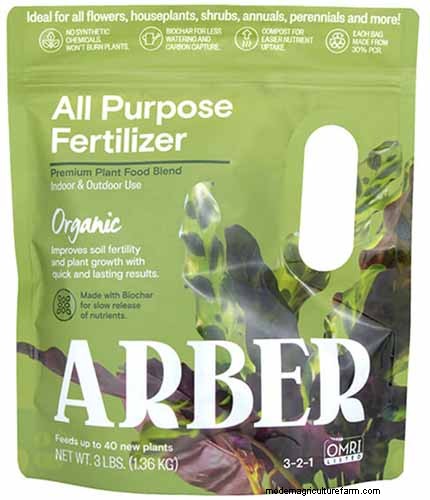
Arber All-Purpose Fertilizer
I also like Arber All-Purpose Fertilizer with a NPK of 3-2-1, which is available at Arbico Organics.
Both of these products are certified organic.
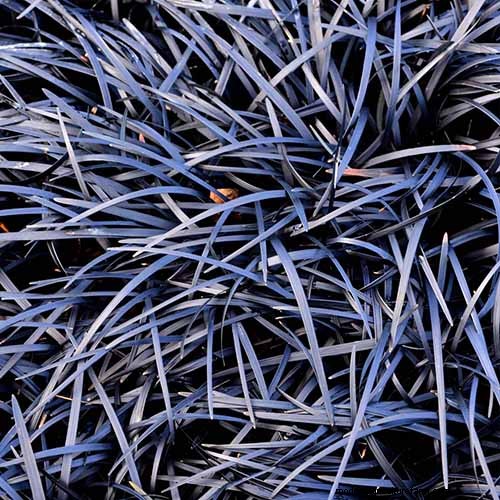
The most popular dark-colored cultivar of O. planiscapus is ‘Kokuryu,’ which goes by several synonyms including ‘Arabicus,’ ‘Black Dragon,’ ‘Ebony Knight,’ and ‘Nigrescens.’
‘Black Beard’ is another dark-hued variety and very similar to ‘Kokuryu.’
Black Mondo Grass
You can purchase plants in one-gallon pots at Fast Growing Trees.
Or if you prefer something smaller, starter plants of ‘Kokuryu’ in four-inch pots are available at Burpee.
Easy-care mondo grass requires only a light cleanup in early spring to maintain an attractive and healthy form.
Before new growth ramps up in spring, use clean, sharp garden scissors to snip off dry, dead, or brown blades, cutting close to the base.
Container grown plants, and mature black mondos in restricted spaces like beds or borders, require division every three to five years – we cover how to divide below, so keep reading!
Division of stolon offsets is the easiest and quickest way to propagate established plants and is best done in early spring when new growth starts to emerge.
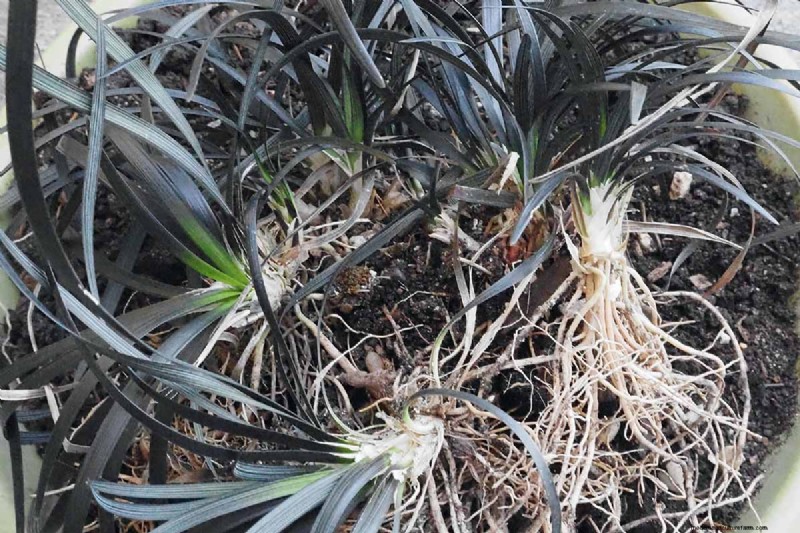 Photo by Lorna Kring.
Here’s how:
Replant one of your divisions in the original location and transplant the remainder as desired.
Black mondo grass has few problems, but there are a couple of issues to watch for.
Root rot can occur if the roots sit in oversaturated soil. Ensure a well-draining location for healthy roots and vibrant plants.
Smut (fungal spores that resemble soot) can present itself if the leaves remain wet at nighttime.
Water in the morning to allow the foliage to dry completely before nightfall. Also, avoid overhead watering with a soaker hose or drip irrigation.


