
Welcome to Modern Agriculture!

Plant Type: Deciduous shrub or small tree
Height/Spread: 12 to 20 ft tall and wide
Sunlight: Full sun (best flowering and fruiting) to partial shade
Soil: Well-drained; prefers pH 5.5 – 7.0
Water: Moderate; even moisture reduces fruit splitting
USDA Zones: 8 – 10 (Zone 7b with protection)
Bloom Time: Late May to fall
Notable Features: Ornamental flowers, edible fruit, drought tolerant, salt tolerant, hummingbird attractant
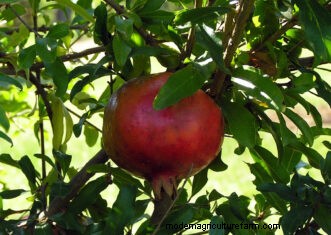
Ripe pomegranate fruit can look like holiday ornaments.
Karen Russ, ©2009 HGIC, Clemson Extension
Pomegranates (Punica granatum) have been a popular fruit throughout human history and are experiencing a surge in popularity due to the health benefits associated with their juice. Widely grown for their edible fruits, they are equally valuable as ornamental plants.
While their precise origin is unknown, pomegranates are considered native from the Middle East to the Himalayas. Early Spanish settlers probably introduced the first plants into the southeastern United States to their St. Augustine, FL colony.
Pomegranates have a long history of use in South Carolina. Plants are often found around old home sites and plantations, especially in the Midlands and Coastal Plain. They grow and flower well in most of SC, but tend to fruit poorly in our humid climate compared to the warm, arid regions where they are particularly well adapted.
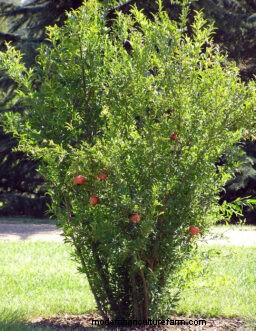
Pomegranates have glossy foliage and an upright growth habit.
Karen Russ, ©2009 HGIC, Clemson Extension
This deciduous (rarely evergreen) shrub or small tree typically grows from 12 to 20 feet tall and nearly the same in spread. Pomegranates sucker profusely from the base, and if not removed routinely, the plants quickly become dense with many stems. Stems tend to be slender and thorny with reddish-brown bark that becomes gray with age.
Leaves may be alternate, opposite, or whorled on the stem and are 1 to 3 inches long by ⅓ to ¾ inches wide. The leaves are glossy, dark green, and somewhat leathery; they turn yellow in the fall and may linger on the plant until early winter.
Pomegranate plants grow at a moderate pace. They will flower sporadically the first year after planting into the landscape and may bear one to two fruits. More commonly, they will begin to bear well three years after planting. Although considered long-lived plants (some in Europe are over 200 years old), their vigor will decline after about 15 years.
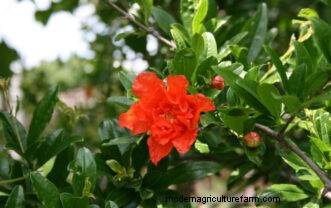
Pomegranate flowers have crepe-like petals.
Cory Tanner, ©2009, Clemson Extension
Pomegranate flowers, fruit, and landscape appeal.
Aside from their fruiting characteristics, pomegranates are enjoyed for their highly attractive flowers that occur over a long period from late May until fall.
Flowers are borne at the ends of branches with one to five flowers in a cluster. The flowers are 1 to 2 inches wide, with five to seven crepe paper-like petals emerging from a thick, fleshy calyx that is vase or urn-shaped.
Flower color varies from scarlet-red to orange, yellow, white or variegated depending on the cultivar. Plants may be single- or double-flowering, with double flowers resembling carnation blossoms. In general, double-flowering cultivars produce few, if any, fruit.
Pomegranate flowers are attractive to hummingbirds.
Plants may be striking in the fall during years when climatic conditions allow good fruit set. The globe-shaped fruit is generally 2 to 3 (but may be up to 5) inches in diameter, maturing from green to several shades of red, depending on the cultivar, and resembles a Christmas ornament. Fruit typically ripens in early fall (August-October).
Pomegranate plants are well suited for the shrub border and make a great backdrop for small shrubs and perennials. These shrubs are effective in groups and make good screens. The compact forms perform quite well in large containers.
Pomegranate plants are easy to grow and require little maintenance once established. These growing guidelines apply throughout South Carolina.
Most pomegranate cultivars are cold-hardy in USDA Zones 8 to 10, and should survive with little trouble south and east of the Sandhills.
In the Piedmont and Upstate (USDA Zone 7b), they will typically survive the winter, but may be damaged or killed to the ground by temperatures below 10°F. They will usually re-sprout vigorously from the crown after such events. Planting in a protected location may prevent cold injury.
Cold-hardy pomegranate cultivars such as those in the “Russian series” have proven adaptable across South Carolina gardens. The “Russian series” of cultivars has greater cold hardiness (up to USDA Zone 6), good fruit production, and excellent flavor.
Pomegranate fruits are berries filled with hundreds of seeds ranging from white to dark red depending on cultivar. The fleshy, juicy coating surrounding each seed, often referred to as the aril, is the edible portion.
Most cultivars have hard seeds within the aril, but a few are soft-seeded and considered choice edibles because there is no crunching or spitting of seeds. Unfortunately, soft-seeded varieties tend to be less cold-hardy.
Pomegranates may be propagated from seed, but will not come true to variety. Both hardwood and softwood cuttings root easily, but softwood cuttings require mist to prevent desiccation.
Pomegranate cuttings root easily, making propagation simple for home gardeners.
Pomegranate plants are relatively trouble free when the proper conditions are provided. Leaf and fruit spots are common in SC due to our high humidity, but don’t require treatment. Deer occasionally browse the foliage.
The most common problem with pomegranates is their failure to set fruit. The most common reasons pomegranates do not set fruit include:
Plant two or more pomegranate plants, as cross-pollination increases fruit set.
Most pomegranate issues are environmental rather than disease related; ensure adequate sun exposure and cross-pollination for consistent fruit set.
South Carolina gardeners should seek cold-tolerant cultivars. Below are some of the best pomegranate varieties for South Carolina gardens.
Document last updated on 10/25 by N. Jordan Franklin.
Originally published 05/09
If this document didn’t answer your questions, please contact HGIC at hgic@clemson.edu or 1-888-656-9988.


