
Welcome to Modern Agriculture!

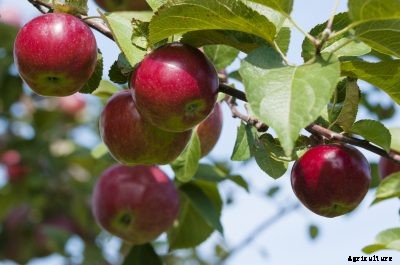
Apple trees that are cultivated for fruit production use a lot of energy. Annual pruning and fertilizing of apple trees is integral to helping the tree focus that energy on producing a bountiful crop. While apple trees are moderate users of most nutrients, they do use a lot of potassium and calcium. Thus, these should be applied each year when apple tree feeding, but what about other nutrients? Read on to find out how to fertilize apple trees.
As mentioned, it is likely that an apple tree will need both calcium and potassium feedings annually, but to really ascertain what other nutrients your tree will need, you should do a soil test. A soil test is the only way to really determine what type of fertilizer for apples might be needed. Generally, all fruit trees thrive in a soil pH of between 6.0-6.5.
If you are just planting an apple sapling, go ahead and add a pinch of bone meal or a starter fertilizer mixed with water. After three weeks, fertilize the apple tree by spreading ½ pound (226 gr.) of 10-10-10 in a circle 18-24 inches (46-61 cm.) from the trunk.
Before fertilizing apple trees, know your boundaries. Mature trees have large root systems that can extend outwards 1 ½ times the diameter of the canopy and can be 4 feet (1 m.) deep. These deep roots absorb water and store excess nutrients for the successive year, but there are also smaller feeder roots that reside in the top foot of soil that absorb most nutrients.
Fertilizer for apples needs to be broadcast evenly on the surface, beginning a foot away from the trunk and extending well beyond the drip line. The best time to fertilize an apple tree is in the fall once the leaves have dropped.
If you are fertilizing apple trees with a 10-10-10, spread at the rate of one pound per inch (5 cm.) of trunk diameter measured one foot (30 cm.) from the ground up. The maximum amount of 10-10-10 used is 2 ½ pounds (1.13 kg.) per year.
Alternatively, you may spread a 6-inch (15 cm.) band of calcium nitrate with the drip line at a rate of 2/3 pound (311.8 gr.) per 1 inch (5 cm.) of trunk diameter along with ½ pound (226 gr.) per 1-inch trunk (5 cm.) diameter of sulfate of potash-magnesia. Don’t exceed 1-¾ pound (793.7 gr.) of calcium nitrate or 1 ¼ pound (566.9 gr.) of sulfate of potash-magnesia (sul-po-mag).
Young apple trees, from 1-3 years of age, should grow about a foot (30.4 cm.) or more per year. If they aren’t, increase the fertilizer (10-10-10) in the second and third year by 50%. Trees that are 4 years or older may or may not need nitrogen depending upon their growth, so if they grow less than 6 inches (15 cm.), follow the above rate, but if they grow more than a foot, apply the sul-po-mag and boron if needed. No 10-10-10 or calcium nitrate!
Take a soil sample each year to amend your apple tree feeding regimen. Your local extension office can help you interpret the data and recommend additives or subtractions from your fertilizing program.


