
Welcome to Modern Agriculture!

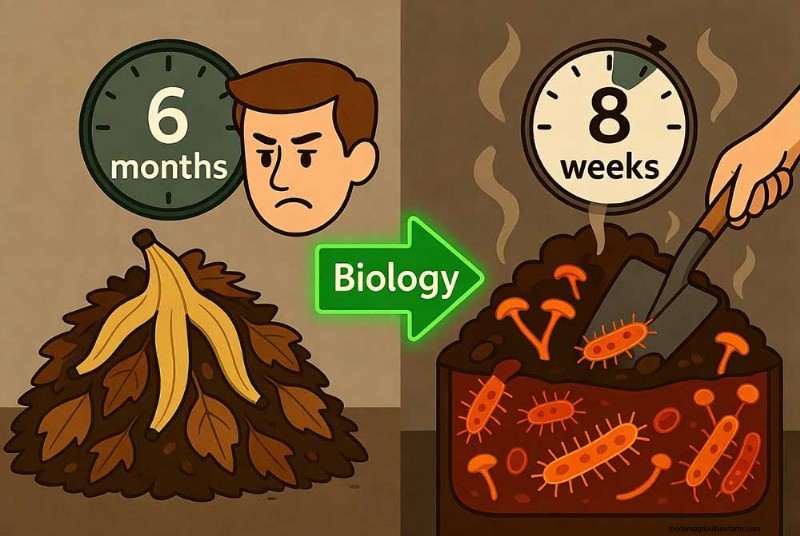
Most composting advice emphasizes patience: nature takes time, and a well‑built pile needs up to six months to mature. That’s not wrong— it’s simply an incomplete view. The difference between a pile that turns into rich, dark compost in eight weeks and one that remains a recognizable heap of kitchen scraps after half a year is not just a matter of time; it’s the underlying biology that can be nudged.
Compost accelerators are precisely that nudge. They have become one of the most searched topics among new gardeners who hit the frustrating wall of a “dead” pile—one that keeps adding to it, yet the walls of the garden beds stay unfed. Understanding what they are, how they work, which ones truly add value, and when they’re unnecessary is key to turning that frustration into a productive, thriving system.
In essence, a compost accelerator introduces or boosts the microbial communities that break down organic matter. They can meaningfully shorten composting timelines when the right conditions are met—but they’re not magic, and a poorly built pile won’t be saved by a splash of powder.
Composting is a controlled feeding frenzy. Bacteria, fungi, actinomycetes, and other micro‑ and macro‑organisms break down organic material into simpler compounds. The resulting dark, crumbly, earthy‑smelling “black gold” is the by‑product of trillions of organisms eating, reproducing, and dying in your pile.
When composting is slow, it usually means one of four things: not enough nitrogen (the pile is too “brown”), insufficient moisture, inadequate oxygen, or the microbial populations simply haven’t established yet in a new pile. The last scenario is where accelerators come into play.
A compost accelerator is any substance that jump‑starts or amplifies this biological process. The category spans commercial dry powders and liquid inoculants sold in garden centers, to free household materials that achieve the same effect. What they share is the goal of getting the pile’s microbial community up to speed faster than it would on its own.
The key insight: a healthy, functioning pile that’s already cooking for a while doesn’t need an accelerator. The organisms are already active, multiplying, and operating at peak efficiency. Adding more microbes to an already thriving system is like adding more cooks to a kitchen that’s already busy—it doesn’t accelerate the process. Accelerators are most useful at the beginning of a new pile, after a major disturbance, or when conditions have been suboptimal and the biological community has crashed.
Commercial products often carry names that suggest complexity and proprietary technology. Some truly deliver; some are mostly marketing.
Most commercial accelerators contain a blend of:
Bacterial strains — typically thermophilic bacteria that thrive in the 130–160°F range of a hot, active compost pile. These include species from the Bacillus and Thermus genera and may also include nitrogen‑fixing strains.
Fungal inoculants — such as Trichoderma, which excels at breaking down tough lignocellulosic materials like wood chips and straw. Fungi are slower than bacteria but essential for digesting material that bacteria can’t handle alone.
Ammonia‑free nitrogen sources — many products include urea or ammonium sulfate as a built‑in nitrogen boost, which is genuinely helpful if your pile is carbon‑heavy.
Enzymes — some add cellulase and other enzymes that start pre‑digestion of plant cell walls.
The honest assessment: the bacterial and fungal strains in commercial products are real and work. Whether they outperform free alternatives depends on your local conditions; for most home composters, the locally sourced options are just as potent and better calibrated to the specific inputs of your site.
Experienced composters often deviate from the product‑focused advice found on commercial sites, and this is worth noting.
Finished compost from a previous batch is the single best accelerator for a new pile. Adding a few shovelfuls of “up‑to‑date” compost introduces a fully established, diverse microbial community that’s already adapted to your local temperature, moisture, and material mix. Commercial products use standardized strains that may not be the most effective for your specific environment.
Fresh grass clippings are an extremely high‑nitrogen material (C:N ratio around 15:1). When layered between brown materials in a new pile, they can raise pile temperatures dramatically within 24–48 hours. Use them in moderation and always mixed with browns; a pile that’s only clippings will become a slimy, compacted, anaerobic mess that smells exactly as bad as you imagine.
Urine is possibly the most under‑used garden accelerator in existence. Human urine is approximately 2% nitrogen by weight, sterile when fresh, and immediately available to soil microbes. Diluted roughly 10:1 with water and applied over a new or stalled pile, it provides a rapid nitrogen boost without the pathogen concerns associated with manure. Many seasoned composters use it routinely, and the science supports its efficacy.
Manure from herbivores — chickens, horses, rabbits, cows — is nitrogen‑dense and packed with digestive bacteria already primed for breaking down plant material. Chicken manure is especially high in nitrogen (around 3% or more) and acts like a fertilizer‑accelerator hybrid. Must be used when it’s truly “mandible” (hot) so that the manure’s pathogens are killed by the pile’s heat before the compost becomes safe for edible gardens.
Soil from your garden — just a few shovelfuls scattered through the pile — adds local microbial diversity. It’s less potent than finished compost but still better than nothing and costs zero.
They’re not always redundant. Certain scenarios benefit from a high‑quality commercial inoculant.
Starting a pile in late fall or early winter. Microbial activity slows in cold conditions. A product that includes thermophilic bacteria specifically selected for cold‑start conditions can help a pile get going when ambient temperatures would otherwise keep it dormant. Look for cold‑weather performance claims.
Accelerating a pile that’s never really heated up despite a correct C:N ratio. If you’re building a new pile in a brand‑new garden space with no prior organic‑matter cycle, a commercial inoculant can seed the pile to compensate for a sparse local soil microbiome.
Bokashi fermentation systems. Bokashi is an anaerobic fermentation process that uses effective microorganisms (EM) cultures. The EM inoculant is essential—without it, bokashi will simply rot.
Vermicomposting without a starter culture. When setting up a worm bin from scratch, a small amount of commercial microbial inoculant can help the bedding ecosystem establish faster and reduce the adjustment period for newly added worms.
Before spending, run through this diagnostic:
| Situation | Recommended Approach |
|---|---|
| New pile, first time composting, no finished compost available | Commercial inoculant or add topsoil + urine |
| New pile, have finished compost from a previous batch | Use 2–3 shovelfuls of finished compost — skip the product |
| Existing pile that’s stalled and dry | Add water first. Assess nitrogen levels next. Accelerator only if both are adequate |
| Existing pile that smells bad (anaerobic) | Turn it and add dry browns. No accelerator will fix an oxygen‑starved pile |
| Composting in cold weather (<40°F) | Insulate the pile. Consider thermophilic commercial product. Manage expectations |
| Pile seems active (heat + steam) but slow visually | You’re fine. Keep turning. Don’t add accelerator to an already working system |
| Bokashi system | EM inoculant required — this is the one non‑optional commercial product in composting |
The pattern is clear: most stalled piles have a structural problem (wrong C:N ratio, insufficient moisture, lack of aeration) that no accelerator can fix. An accelerator applied to a fundamentally imbalanced pile is wasted. Fix the foundation first.
Assuming you’ve decided an accelerator makes sense for your situation, application matters more than most product instructions suggest.
Dry granular accelerators should be applied in thin layers between additions of compostable material, not dumped on top of an existing pile. The goal is distribution through the pile, not concentration on the surface. Moisture is essential—after adding a dry product, water the pile thoroughly. Microbes need liquid to move, colonize new material, and reproduce.
Liquid accelerators (concentrated bacterial and fungal solutions) work fastest when diluted and applied with a watering can or sprayer as you build the pile, not poured on top of a finished stack. Saturating every layer as you build gives the organisms maximum surface contact with decomposable material.
After applying any accelerator, turn the pile within 24–48 hours. This distributes the organisms into oxygen‑rich zones throughout the pile rather than letting them concentrate in one area. Temperature should begin rising within 2–5 days in a well‑built pile with an accelerator.
One more thing: store unused accelerator products correctly. Most contain live organisms or viable spores that degrade rapidly in heat, light, or moisture. A bottle of liquid inoculant left in a hot shed over summer is probably largely dead by the time you use it. Cool, dark, dry storage extends efficacy substantially.
With a well‑built pile, correct C:N ratio, adequate moisture and aeration, and an accelerator applied at the start, what timeline should you actually expect?
Hot composting (turning every 3–5 days, maintaining moisture, with an accelerator): 4–8 weeks to finished compost in warm weather. This is genuinely achievable and the accelerator does help at this pace.
Cold composting (occasional turning, less management): 3–6 months even with an accelerator. The biology is simply constrained by temperature, and no product overcomes that at scale.
Passive pile (add and forget): 6–18 months, accelerator or not. At this management level, the microbial community self‑establishes eventually, but the accelerator’s head‑start advantage fades completely over a timeline this long.
The takeaway is that accelerators compress the timeline most meaningfully when you’re already actively managing the pile. The more effort you’re putting in, the more the accelerator amplifies that effort. For passive piles, the investment is harder to justify.
After enough seasons, most dedicated composters stop buying accelerators regularly. Not because they’ve given up, but because they’ve built a system that doesn’t need them — a mature pile ecosystem, an established worm population in the garden, a rotation of bins where finished compost from one feeds the next, and a calibrated feel for what a pile needs before it slows down.
That’s the real destination. Accelerators are a useful tool while you’re building that system. They’re training wheels in the best possible sense — they help you experience what an active, working pile looks and smells like, which teaches you how to maintain that state without external input.
The gardeners who talk about composting as effortless aren’t using secret products. They’ve just run the experiment long enough to understand what their specific piles need, in their specific climate, with their specific inputs. You get there by starting, by watching what happens, and by occasionally giving the biology a boost when it genuinely needs one.
Your pile isn’t failing. It’s just waiting for the right conditions. Sometimes the right conditions need a little help.
Composting biology and microbial dynamics referenced here align with peer‑reviewed literature on thermophilic decomposition and vermicomposting, including research published through the Rodale Institute and various university extension programs specializing in organic waste management. Timeline estimates are based on widely documented ranges for hot and cold composting methods under typical temperate climate conditions. Results vary significantly with climate, input materials, and management intensity.


