
Welcome to Modern Agriculture!

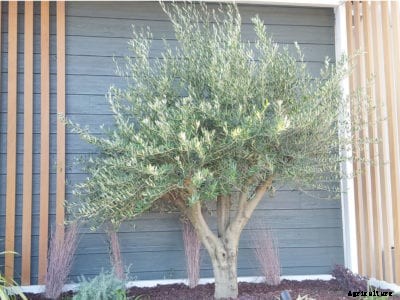
What is a fruitless olive tree, you may ask? Many are not familiar with this beautiful tree, commonly used for its beauty in the landscape. The olive tree with no olives (Olea europaea ‘Wilsonii’) is hardy in USDA zones 8-11. Read more to learn if this is the perfect tree for your southern landscape.
This olive tree is described as a distinctive evergreen, growing at a slow to medium rate. At maturity, it may reach 25-30 feet (7.6 to 9 m.), with approximately the same width. Consider this width if contemplating one in your landscape. It may have a single trunk, but more often it has several. These are twisting and contorted, topped by greenish-gray foliage. This tree must have at least 8 hours of full sun.
While described as an olive tree with no olives, some owners of the tree say this is an overstatement. Trees may bloom in spring with sterile, yellow flowers that produce a spray of olives. These underdeveloped fruits fall from the tree and are few and far between. This is why growing fruitless olive tree varieties is a good alternative to growing the real thing.
Fruiting olive trees are banned in some areas of the southwest U.S. because of extensive dropping of fruits. This creates a problematic mess, clogging drains and staining driveways and decks. The fruits also attract undesirable wildlife. Flowers often produce pollen to which many are allergic. Growing fruitless olive trees eliminates these issues.
When choosing a location to plant a new fruitless olive tree, measure how long sun reaches the area. As mentioned, at least eight hours is necessary. If looking at this aspect in spring, take into account the shade that might occur when neighboring trees leaf out. Ideally, you can check out the sun in the spot at different times of the year. Make sure, as well, that there is a 30-foot space around all sides of the area, allowing room for the fruitless olive to spread its branches.
The planting site must have well-draining soil. Once established, most fruitless olive tree varieties are drought tolerant, but they need regular water until a good root system has developed. If water does not drain quickly, root rot is a potential problem. Add drip irrigation if convenient, as the root system will need almost daily watering for some time.
Other fruitless olive tree care includes a feeding of high nitrogen fertilizer in spring while the tree is young. Pruning to remove suckers may be included in annual maintenance. While you have the pruners handy, remove any twigs or branches with holes, as they may have been attacked by borers. Most pests and disease don’t bother the fruitless olive tree, however.


