Welcome to Modern Agriculture!

Miscellaneous ●
Average garden soil with excellent drainage.
Full sun in late winter, partial shade in summer.
Excellent. Most crocuses are hardy to -25F (-32C).
Topdress with rich compost in spring, when new growth appears. When given too much fertilizer, crocuses may form thick stands that do not bloom well.
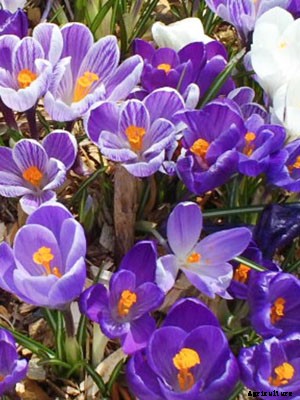
Snowdrop. Crocuses are wonderful little bulbs to naturalize in grass beneath deciduous trees, or to plant in groups near entryways. Scatter them in small groups along a woodland edge. Crocuses combine well with scillas and early-blooming daffodils.
Single Plants: 3" (10cm) each way (minimum)
Rows: 3" (10cm) with 3" (10cm) row gap (minimum)
Set out dormant bulbs from late summer to early winter, planting them 3in (8cm) deep. Spacing can be as close as 2in (5cm) between crocus bulbs, which look best when planted in groups of seven or more.
Our Garden Planner can produce a personalized calendar of when to sow, plant and harvest for your area.
Crocuses are considered harbingers of spring. The flowers close at night and on rainy days.
Seeds can be gathered and re-sown in early summer. Established clumps can be dug and moved in the fall, but are best left undisturbed.
Crocuses needs a period of winter chilling, and will not persist long in warm climates. Varieties classified as C. tommasinianus are not tempting to deer.