 Peaches and nectarines are easy to grow.
Peaches and nectarines are semi-hardy deciduous woody perennial trees. They grow best where summer is hot and where winter temperatures regularly fall below 45°F. Nectarines like slightly warmer conditions.
Peaches and nectarines are less hardy than apples; their range is farther south and at lower elevations than apples.
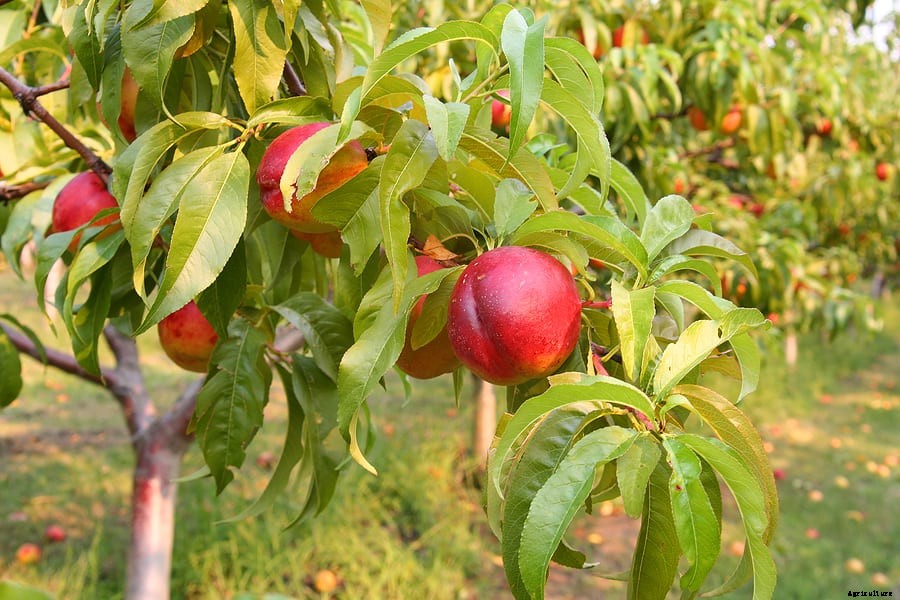
Peaches and nectarines are different forms of the same fruit. The peach has a fuzzy skin. The nectarine is a smooth-skinned peach. Peaches are round slightly smaller than an apple or baseball. A nectarine is usually smaller than a peach
Nectarines are sweeter than peaches with a more distinctive aroma.
If you don’t live in an optimal climate for peaches and nectarines, plant them against a sheltered, south-facing wall or in containers that can be moved to warm, sheltered spots that stay warm and sunny.
Types of Peaches and Nectarines
- The flesh of peaches and nectarines is most often yellow, but some cultivars have white flesh. White flesh, like yellow flesh, is tender and tasty.
- Peaches and nectarines are divided into freestone and clingstone cultivars.
- The flesh of a freestone peach or nectarine will separate easily from the seed. Freestone peaches and nectarines are best for eating fresh out of hand.
- The flesh of a clingstone peach or nectarine does not separate from the seed easily. Clingstone peaches and nectarines are a good choice for cooking and preserving.
- Nectarines are smooth-skinned peaches; nectarines are usually smaller and sweeter than peaches with a more distinctive aroma; nectarines are less hardy than peaches.
- Nectarines are grown and used just like peaches
Best Climate Growing Peaches and Nectarines
- Peaches and nectarines grow best in USDA zones 5 through 9.
- Grow peaches and nectarines where summers are hot and where winter temperatures dip below 45°F.
- Most peach and nectarine trees require a chilling period of between 700 and 900 hours each winter in order to resume growing and set fruit the following spring. A chilling hour is one hour at a temperature of 45°F or less. Where there is insufficient chilling, peach trees may flower but they will not set fruit and the foliage could be sparse.
- Peaches do not grow well where the temperature falls below 0°F for extended periods. Where winter temperatures fall lower than -10°F, peach wood will be damaged. Nectarines will suffer at slightly higher temperatures.
- The optimal peach and nectarine fruit ripening temperature is 75°F. Where temperatures are consistently hotter the flavor may be astringent.
- Cool, wet climates and constantly humid climates will leave peaches and nectarines susceptible to disease.
- In cool summer regions, choose the warmest microclimate in your garden to plant peaches and nectarines. Choose a spot near a building where reflected heat will warm the tree.
- Choose a site that is protected from the wind by trees, a large hedge, a wall, or a building.
- Where weather warms gradually in spring, a southern slope is best for planting peaches and nectarines; this will give trees a longer warm, growing season before autumn frosts.
- Where spring temperatures fluctuate in spring—warm then cold then warm, a cool northern slope or exposure is best because the trees will warm slowly and buds will not open too soon; buds that open early during a warm spell are susceptible to damage by any frost that follows. One hour of 25°F temperatures during bloom time can destroy the blossoms and the crop.
Best Site for Growing Peaches and Nectarines
- Peaches and nectarines grow best in full sun. They can tolerate partial shade but the yield will be diminished.
- Plant peaches and nectarines in light, loamy soil that is well-drained. Do not plant them where the soil stays wet; roots will rot.
- Peaches and nectarines prefer a soil pH ranging from 6.0 to 7.0. If the soil pH is lower than 6.0 add lime to the soil.
- Avoid planting peaches and nectarines in low spots where cold air or frost may settle.
- Do not plant a peach or nectarine tree where another peach or nectarine has recently grown; the decaying roots will emit a chemical that can kill new tree roots.
- Avoid planting peaches and nectarines near where wild chokecherries are growing; wild chokecherries can harbor viral diseases.
- Peach and nectarine trees live 10 to 15 years; set out new trees every 4 to 5 years for uninterrupted harvest.
- Choose a peach or nectarine variety that grows well in your region; check with the nearby Cooperative Extension Service or garden center for a cultivar recommendation.
- Follow all recommendations for growing peaches when growing nectarines.
Peach and Nectarine Tree Pollination
- Most peaches are self-fertile and do not require pollinators. A peach can set a full crop without another variety for pollination with just a few exceptions. (Exceptions include ‘J.H. Hale’, ‘June Elberta’, and ‘Halberta’, ‘Indian Free’, and ‘Chinese Cling’.)
- When the weather is cool and insect pollinators are not active, peaches and nectarines can be pollinated by hand.
Peach Tree Rootstock
- Most peach varieties are grafted, meaning the rootstock (the root system) and the fruiting section of the tree is different.
- Most standard peach varieties are grafted onto seedlings rootstock is grown from ‘Lovell’ and ‘Halford’ peach seed.
- In cold climates, choose peach varieties grafted onto ‘Siberian C’ rootstock; ‘Siberian C’ increases the hardiness of trees in cold winter regions; a tree grown on ‘Siberian C’ rootstock will be 10 to 15 percent smaller than a standard peach.
- ‘Citation’ is a dwarfing rootstock. ‘Red Haven’ peach is a genetic dwarf peach.
Peach and Nectarine Tree Yield
- A standard peach or nectarine can produce 100 to 150 pounds of fruit each year.
- A dwarf peach or nectarine can produce 30 to 60 pounds of fruit each year.
Spacing Peach and Nectarine Trees
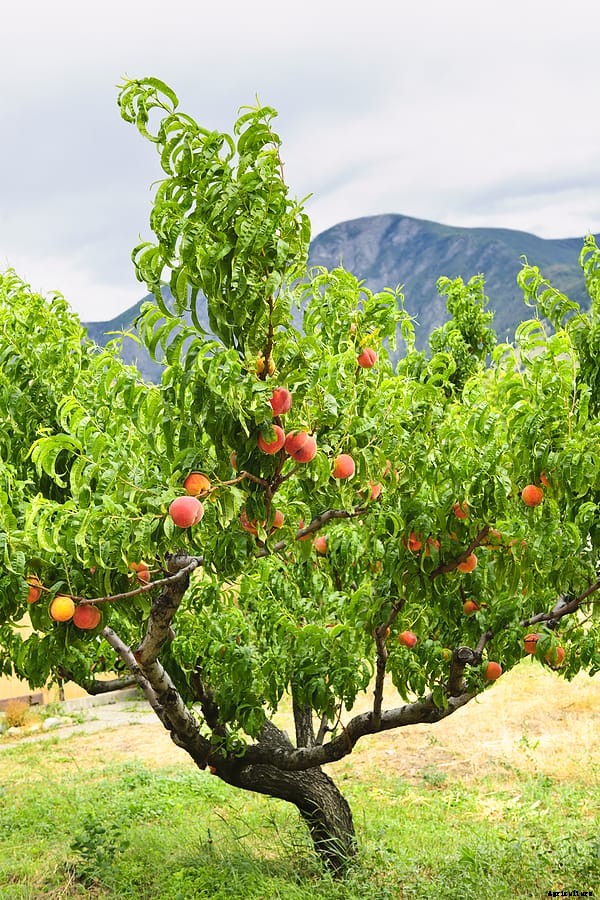
- A standard peach or nectarine tree can grow 18 to 20 feet tall and wide. Plant standard trees 20 feet apart.
- A semi-dwarf peach or nectarine tree can grow 8 to 12 feet tall and wide. Plant semi-dwarf trees 12 feet apart.
- A dwarf peach or nectarine tree can grow 5 to 6 feet tall and wide. Plant dwarf trees 6 feet apart.
- Choose a dwarf tree if your space is limited.
Planting Peaches and Nectarines
- Peach and nectarine trees can be purchased either bare-root, ball-and-burlap, or in a container.
- Choose a tree at least one-year-old stock, 4 to 5 feet tall, and with a stem at least ½ inch in diameter.
- Bareroot trees are available in the winter and early spring when the trees are dormant and without leaves. Plant bare-root trees in spring as soon as the soil can be worked and before the trees begin to significantly leaf out. Bareroot trees are commonly grafted and without branches, and so are called whips. Make the planting hole large enough that the roots can be spread out fully. Look for the soil line on the tree and plant the tree at that level or an inch deeper. If the tree is grafted, set it in the hole so that the graft is visible when planted, an inch or so higher than the surrounding soil.
- A ball-and-burlap tree is a tree whose roots are in soil; the roots are enclosed in burlap. Ball-and-burlap trees are commonly available in spring; however, they may be available later in the year. Plant a ball-and-burlap tree by positioning the tree in the planting hole at the same depth that it was growing at the nursery. After positioning the root ball into the hole, remove all twine or rope used to hold the burlap and ball together. Then open the top of the burlap and slide the burlap out of the hole. Lightly tamp in soil around the root ball; see General Planting Instructions below.
- A container-grown tree can be planted at any time during the growing season. Remove the container carefully and plant the root ball at the same depth as in the container.
- Avoid planting peach and nectarine trees in hot, dry weather.
- In mild winter regions, trees can be planted in autumn.
General Planting Instructions
- Prepare a planting site in full sun that is sheltered from a prevailing breeze or wind.
- Work well-rotted compost or manure into the soil and add a cupful of all-purpose fertilizer to the bottom of the hole.
- Dig a hole half again as deep and twice as wide as the tree’s roots.
- Put a tree stake in place before planting. Drive the stake into the ground to the side of the hole to at least 2 feet deep.
- Set the tree in the hole so that the soil mark on the stem is at the surface level of the surrounding soil. Remove all twine and burlap from ball-and-burlap trees. Spread the roots out in all directions.
- Re-fill the hole with half native soil and half aged compost or commercial organic planting mix; firm in the soil so that there are no air pockets among the roots. Water in the soil and create a modest soil basin around the trunk to hold water at watering time.
- Secure the tree to the stake with tree ties.
- After planting, water each tree thoroughly and fertilize with a high-phosphorus liquid starter fertilizer.
Container Growing Peaches and Nectarines
- Dwarf peach and nectarine trees can be grown in containers.
- Choose a large pot or tub at least 18 inches wide and deep that is well-drained.
- Plant trees in a commercial organic potting mix.
- Keep the soil evenly moist but not wet.
- Feed peaches and nectarines growing in containers with an all-purpose fertilizer that is slightly higher in potassium.
- Repot the tree after two years into a container that is 24 inches wide and deep.
- ‘Stark’, ‘Sensation’, and ‘Garden Gold’ dwarf peach varieties are good choices for containers.
- In cold regions, protect trees growing in containers by moving them to a protected place–a garage or covered porch–in frigid weather.
 Peach and Nectarine Care, Nutrients, and Water
- Water peaches and nectarines regularly–at least weekly–during the first year in the ground. Established trees need a regular supply of water throughout the growing season.
- For the most succulent, juicy fruit keep the soil evenly moist, not wet.
- Mulch around peach and nectarine trees to reduce soil moisture evaporation and to keep weeds down. Weeds compete with trees for nutrients and soil moisture.
- Avoid weeding more than one or two inches deep; peach and nectarine tree roots are shallow and can be damaged by deep weeding or spading.
- Feed peaches and nectarines with a mulch of aged compost applied liberally around the base of the tree in spring when fruit sets.
- Feed a peach or nectarine tree a half-pound of balanced 10-10-10 fertilizer for each year the tree has been alive to a maximum of 10 pounds per tree per year. Feed the tree in spring.
- For additional feeding, spray leaves with liquid kelp every 3 to 4 weeks during the growing season.
- In fall after trees have dropped their leaves apply aged cow manure around the base of the tree; this will allow rain and melting snow to leach the nutrients deep into the soil.
- A young peach or nectarine tree should make 18 to 24 inches of new growth each year; if there is less remove more wood during pruning and fertilize lightly; if there is more, then you are probably pruning too heavily and forcing the tree’s energy into the few remaining shoots.
- Once the tree is fruiting full crops, 10 to 12 inches of new growth each year indicates healthy growth
- Place a plastic cover over trees to keep the rain off buds and flowers between early winter and late spring; this will reduce the risk of peach leaf curl.
- A peach or nectarine will burst into flower the first warm spell after the chilling hour requirement is met; this leaves flowers susceptible to damage
- by frost. Protect open blossoms by placing a heavy plant blanket over the tree if frost threatens.
Training and Pruning Peach and Nectarine Trees
- Peaches and nectarines are most commonly trained to an open center. A mature open-center tree has a vase-like shape.
- At planting time, the top of the young tree—called a whip–is cut off at about 30 inches above the ground.
- In the first year select four even spaced lateral branches; these should be spaced along the trunk about 4 to 8 inches apart and should be growing in different directions from the central stem/trunk (these will become the main scaffold branches); cut off all other small branches. Cut back the selected laterals by two-thirds their length; cut to an outward-facing bud. All other laterals should be removed.
- At the end of the second season, cut off the main trunk or leader just above the top lateral branch; you have just created an open center. At the same time, shorten the laterals by one-third to one-half to encourage sub-lateral branching; cut all other small branches back to four or five buds.
- In the next two years, prune back the laterals and sub-laterals by one-quarter at the end of each season to encourage strong growth. Allow even spaced smaller side branches (sub-sub-laterals or side shoots) to grow even spaced; prune the sub-laterals and their side shoots to two or three buds.
- In the following years as the tree begins to fruit, cut back one out of every four shoots that fruited the previous year; cut these shoots back to a replacement shoot—replacement shoots should be upward and outward-facing; replacement shoots will bear fruit the next season.
- Each summer when fruits are developing, prune away older, unproductive branches and shoots; this wood will be obvious because it will have no developing fruit. New wood is favored over old wood. Upward pointing replacement shoots are favored over downward-facing shoots.
Maintenance Pruning Step-by-Step
- Peaches and nectarines are pruned more heavily than other deciduous fruit trees. Annual pruning is important to keep the tree productive and from becoming unwieldy. Pruning will enhance productivity and ensure a quality crop. It is necessary to replace all fruiting wood each season; unpruned trees will have a very large crop with very small fruit the season after it is not pruned and in successive years may bear no fruit at all.
- A peach tree can be lightly pruned at any time of the year; heavy pruning should be done in late fall after the tree has dropped its leaves and gone dormant or in early spring before new buds appear.
- Remove all diseased, dead, or broken branches.
- Remove crossing or rubbing branches. If two branches cross and rub against each other they can cause a wound that may allow insects or fungal disease to attack the tree. Remove the least desirable branch.
- Remove all water sprouts. Water sprouts are fast-growing vertical branches that usually have no side branches.
- Remove all suckers. Suckers are fast-growing shoots that grow out of the soil from the roots below the soil surface.
- Remove a branch that creates a tight V-branch crotch, a crotchless than 45 degrees. These branches will not support the weight of a full crop of fruit.
- Prune to create an open center; the center should be shaped like a vase or a funnel. Prune so that branches are evenly distributed throughout the tree. Favor new branch growth; new branch growth will fruit the next season. When pruning is complete, one-year-old twigs should be about 12 inches apart.
- As scaffold branches age or become diseased or broken, select new branches from the forks of the main branches to replace old branches.
- Peaches bear fruit on the previous season’s wood; allow as much one-year-old growth as possible to remain; this will be next season’s fruiting wood. Cut back all one-year-old growth by one-third its length. This pruning will allow the tree to put maximum energy into the fruit buds which remain. Cut back growth just beyond an outward-facing branch or bud. Remove branches that are no longer productive.
- Pruning is best done during the dormant season from late fall to late winter but before trees break dormancy in spring. Peach trees can be thinned of unproductive shoots during the summer.
- Do not prune in winter where bacterial canker is a problem; wait until spring when new growth has begun
Thinning Peaches and Nectarines
- Do not allow young peach and nectarine trees to set fruit during the first two growing seasons. Remove flowers or young fruits before they sap the energy the tree requires for root growth. During the third year, allow the tree to bear a small crop. Do not let a tree set more fruit than its limbs can bear.
- Never let a peach or nectarine tree ripen all of the fruit that it sets. If a peach tree is not thinned it will yield small peaches that are just pit and skin; all peach and nectarine trees will benefit from thinning.
- Thin fruits when they reach thumbnail size, about 1 inch in diameter. Thin early season fruit from 6 to 8 inches apart.
- Thin after the tree naturally drops fruit in late spring–called “June drop.” June drop is the tree’s own natural thinning of fruit which usually occurs a few weeks after fruit set.
- Thin peaches and nectarines again while the fruit is still green—usually in early summer. Thin fruits from 4 to 5 inches apart. This will allow the remaining fruit to grow large and sweet. Thinning increases the sugar content and flavor of the remaining fruit.
- The fewer the fruitlets on a stem the larger the fruit will grow.
- In drought weather, water often; lack of water will keep fruit from reaching full size and fruit will be mealy.
Harvest and Storing Peaches and Nectarines
- Peach and nectarine trees reach sufficient size to bear harvestable fruit 2 to 4 years after planting; trees will begin bearing heavily by the fifth year.
- Peach and nectarine fruit require 3 to 5 months to reach harvest from the time flowers are pollinated. Peaches and nectarines usually come to harvest from mid- to late summer. Trees have fruit-producing lives of about 12 years.
- Peaches and nectarines are most flavorful and have the highest sugar content when they are allowed to mature on the tree. A peach or nectarine can expand 50 percent in size in the last three weeks of ripening.
- A peach or nectarine is ready for picking when the fruit is well colored–the skin changes from green to yellow–and the flesh gives slightly to the touch. Ripe fruit shows no green; it is slightly soft and pulls away from the stem when you lift the fruit with a slight twisting motion.
- The flesh at the end of the fruit away from the stem will give slightly with thumb pressure when the fruit is ripe; this is called firm-ripe; firm-ripe peaches and nectarines will store in the refrigerator for two weeks; they will ripen at room temperature when brought out of the refrigerator
- A peach or nectarine will continue to grow and sweeten as long as it is left on the treed; when the flesh under the stem end yields to thumb pressure, the fruit is tree-ripe; tree-ripe fruit will keep only a few days in the refrigerator. Sugar content and flavor are best when fruits are allowed to come to maturity on the tree.
- Periodic taste-testing will also help determine when most of the fruit on the tree is ripe.
- If peaches or nectarines are to be stored, pick them firm-ripe.
- Ripe peaches and nectarines are best eaten just picked. Fruit will keep in the refrigerator for up to a week. Peaches and nectarines can be canned, frozen, or dried.
Also of interest:
Peaches: Kitchen Basics
Canning Peaches
Propagating Peaches and Nectarines
- Peaches and nectarines are usually propagated by budding.
- Peaches and nectarines can be propagated on their own roots by hardwood or softwood cuttings.
- It is possible for peach trees to grow from nectarine pits and for nectarines to grow from peach pits; a peach tree can sprout a limb bearing nectarines and a nectarine tree can sprout a limb bearing peaches.
Pest Insects that Attack Peaches and Nectarines
- Plum curculios are beetles common east of the Rockies. They cause the fruit to become scarred and drop. Place a tarp under the tree and knock or shake the tree. The beetles will drop from the tree and you can collect and destroy them.
- Peachtree borer is the larval stage of a moth that resembles a wasp. The larvae tunnel into the inner bark of the tree; trees are weakened and can die. Probe with a wire into the holes and kill the borers.
- Oriental fruit moth larvae will tunnel into growing shoots and cause shoots and branches to wilt. A pheromone trap will attract moths. Branches infested with borers should be trimmed away. Both pests can be controlled if the tree is kept healthy with regular watering and feeding.
- European red mites suck juices from leaves. Mites can be knocked from trees with a strong spray of water. Predatory mites will also attack red mites.
- Scale is a sucking insect that looks like a small bump on the bark. Spray trees with dormant oil in the winter.
- Aphids are tiny sap-sucking insects; a heavy infestation can cause leaf curl and stunted growth. Spray with insecticidal soap or neem oil spray.
- Spider mites suck sap from the undersides of leaves. Leaves become dull and mottled; plants become covered with a fine silk webbing. Knock mites off with a spray of water; spray with insecticidal soap or neem oil spray.
- Japanese beetles are metallic green and bronze insects; they feed on foliage and fruit and skeletonize leaves. Shake beetles off plants onto a tarp and drop the pests into a bucket of soapy water.
- Tarnished plant bugs are small flying insects that feed on the sap in leaves and fruit; leaves are deformed. Spray with insecticidal soap or pyrethrum.
- Birds eat fruit; cover trees with bird netting.
- Wasps feed on fruit; set out wasp traps.
Diseases that Attack Peaches and Nectarines
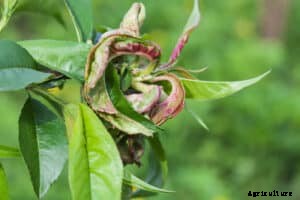
- Peach leaf curl is a fungal disease that causes leaves to curl up and die; new leaves will appear after leaves drop. Preventive spraying with a copper fungicide will help control the disease. Resistant varieties include: ‘Candor’, ‘Clayton’, ‘Com-Pact Red Haven’, ‘Correll’, ‘Dixieland’, ‘Elberta, Red Haven’, and ‘Stark Earligro’.
- Bacterial cankers cause branches to become sunken with lesions and ooze. Infected branches should be pruned off or cankers can be cut out and the healthy wood treated with lime sulfur.
- Brown rot is a bacterial disease that attacks flowers and shoots and can spread to fruit. This disease can be controlled by spraying with lime sulfur when buds begin to turn green in spring.
- Bacterial leaf spot and peach scab cause spots or cracks on leaves and fruit. Both leaf spot and peach scab can be controlled with a lime-sulfur spray every 15 days.
- Trunk sunburn can be controlled by whitewashing the trunk in early spring. Whitewashing will also discourage ants.
- Scab fungal disease causes dark-brown scabs on the skin of the fruit. Remove infected fruit; spray the tree with a fungicide.
- Peach rosette mosaic virus causes plants to produce abnormal shoots. There is no treatment.
Fall and Winter Peach and Nectarine Care
- Rake old mulch away from trees in early fall. Remulch around trees in late autumn after rodents have found winter homes elsewhere.
- Clean up leaves and mummified fruits in winter.
Peach Varieties to Grow
- Yellow-fleshed fruit: ’Cresthaven’, ‘Earliglo’,’ Garnet Beauty’, ‘Redhaven’, ‘Compact Redhaven’, ‘Briscoe’, ‘Elberta’, ‘Redskin’, ‘Reliance’, ‘Madison’.
- White-fleshed fruit:‘Belle of Georgia’. (White-fleshed peach, very soft-bodied.)
- Genetic dwarfs:‘Compact Redhaven’, ‘Compact Elberta’.
- Late flowering or cold-tolerant:‘Clayton’, ‘Jayhaven’, ‘Emery’, ‘Redhaven’, ‘Jefferson’, ‘Cresthaven’, ‘Nectar’, ‘Reliance’, ‘Sunapee’.
- Early season:‘Springold’, ‘Earlgrande’.
- Midseason:‘Derby’, ‘Redhaven’, ‘Raritan Rose’.
- Late season:‘Veteran’, ‘Redglobe’, ‘Canadian Harmony’.
- Heat tolerant:‘Florida King’, ‘Florida Prince’.
- Bacterial leaf spot resistant:‘Raritan Rose’’, Clayton’, ‘Ouchita Gold’, ‘Candor’, ‘Redhaven’, ‘Biscoe’, ‘Champion’, ‘Nectacrest’.
- Canker resistant:‘Biscoe’, ‘Elberta’, ‘Candor’, ‘Brighton’, ‘Raritan Rose’, ‘Harken’, ‘Madison’, ‘Reliance’, ‘Harbrite’, ‘Champion’, ‘Harbelle’.
- Brown-rot resistant:‘Carmen’, ‘Elberta’, ‘Orange Cling’, ‘Red Bird’, ‘Sunbeam’.
- Peach leaf curl resistant:’Candor’, ‘Com-Pact Redhaven’, ‘Correll’, ‘Clayton’’, Dixiland’, ‘Elberta’, ‘Redhaven’, ‘Stark EarliGold’.
Also of interest: Peach Varieties
Nectarine Varieties to Grow
- White flesh varieties: ‘Arctic Jay’, ‘Arctic Rose’, ‘Arctic Fantasy’, ‘Artic Star’, ‘Snow Queen’, ‘Goldmine’.
- Yellow flesh varieties: ‘Double Delight’, ‘Flavortop’, ‘Harko’, ‘Juneglo’.
- Cold hardy varieties: ‘Harko’, ‘Mericrest’
- Low chill varieties: ‘Arctic Star’, ‘Double Delight’, ‘Goldmine’, ‘Panamint’, ‘Snow Queen’, ‘Sunred’.
- Great flavor: ‘Liz’s Late’, ‘Heavenly White’, ‘Arctic Fantasy’, ‘Artic Rose’’.
Botanical name. Prunus persica
Origin. China
Also of interest: Donut Peach


