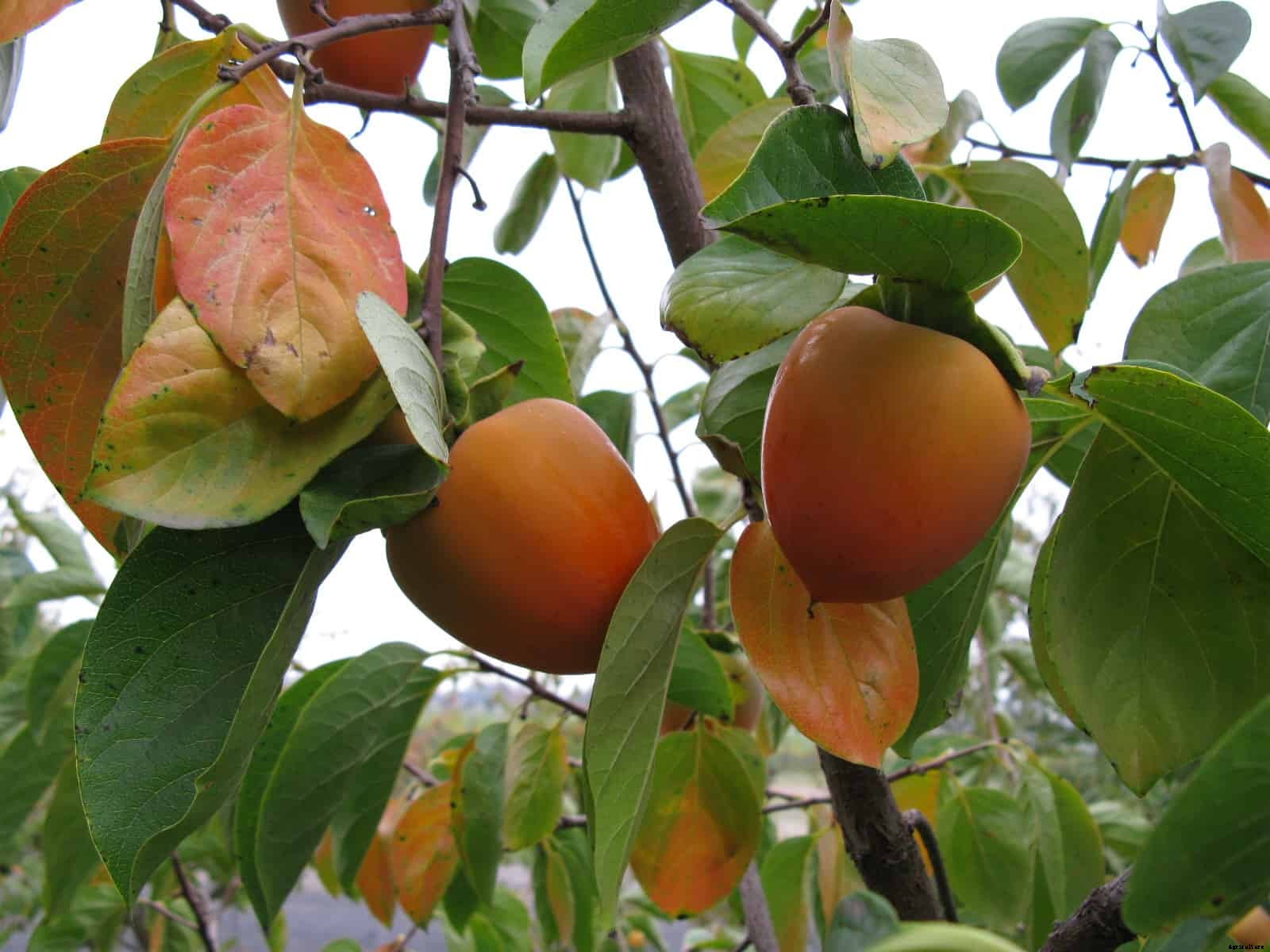
 Ripe persimmon makes a delicious breakfast food or snack, halved and eaten like a melon. Persimmons can also be sliced and used in winter salads or compotes. They can be pureed for sorbets, ice cream, steamed puddings, cookies, and quick bread.
Persimmon trees are relatively easy to grow. They are tolerant of most soils as long as the drainage is good, and they are rarely bothered by pests or diseases.
The key to growing persimmons is choosing a variety or varieties that grow well where you live. Winter cold is the chief decider when narrowing down persimmons to grow. Asian persimmons demand mild winter weather. American and hybrid persimmons grow in relatively cold winter regions.
American, hybrid, and some Asian persimmons are astringent until soft-ripe. They will make you pucker unless you wait until the fruit is mushy ripe; then the flavor is very sweet. Most Asian persimmons—not all—are non-astringent and can be eaten while the fruit is still hard; the fruit will be sweet, but the flavor will improve and sweeten more if they are allowed to soften off the tree.
Types of Persimmons and Climate Where You Live
There are three types of persimmons: Asian, also called Oriental or Japanese, persimmons, American persimmons, and hybrids of Asian and American persimmons. Asian persimmons can be grown in mild winter regions, Zones 7 to 10. American persimmons can be grown in both cold and mild winter regions, Zones 5 to 9. Hybrids can be grown in the same regions as American persimmons. Consider winter temperatures where you live when choosing a persimmon for your garden.
Persimmons also can be divided into two groups related to taste. Some persimmons are astringent and some are not. This is an important distinction. Astringent taste is a flavor of dryness, a mouth sensation of dry or chalky; astringent fruit will cause the mouth to pucker. Astringent taste is generally produced by tannins in the rind of the fruit; it causes the mucous membranes in the mouth to contract or pucker—thus a mouthfeel of dryness. Some persimmons have an astringent taste when ripe, some do not. Allowed to ripen and soften either on or off the tree, the flavor of most persimmons will sweeten. Consider taste and flavor when you choose a persimmon.
Asian or Oriental persimmons (Diospyros kaki), also called Japanese or kaki persimmons, have a honey-sweet taste and smooth soft texture; they are mostly, not wholly, non-astringent (but some are). Asian persimmons can be eaten out of hand like an apple. Asian persimmons are 3 to 4 inches in diameter; they are larger than American persimmons. Asian persimmons grow 25 to 30-feet tall with a 25-foot spread. They are adapted to Zones 7 to 10. The leaves of Asian persimmons turn bright orange or yellow in fall. The fruit hangs on the tree in late fall after leaves have dropped. Note: some Asian persimmons are astringent, though not as astringent as American persimmons. In Zones 9 and 10 choose non-astringent Asian persimmons; in Zones 7 and 8, astringent Asian persimmons may be better suited for colder winter temperatures and milder summer temperatures.
American persimmons (D. virginiana) are richly flavored and all are astringent unless fully ripe (the mouthfeel is dry). American persimmons lose some of their astringent taste after the tree has been hit by frost. Ripe fruit can be very soft and have a rich, sweet flavor. American persimmons are hardier than Asian persimmons; they can grow in Zones 5 to 9. The fruit is smaller than Asian persimmons 1½ to 2 inches in diameter. American persimmons trees grow larger than Asian persimmons; trees grow 30 to 40 feet tall and 30 feet wide. Leaves turn yellow in fall.
Hybrid persimmons—crosses between Asian and American varieties—are hardy like American persimmons with larger fruit (2 to 2½ inches in diameter). They are sweet and flavorful when allowed to fully ripen.
There are multiple cultivars of Asian, American, and hybrid persimmons. Consider closely the grower description of the persimmon variety you are considering. Some cultivars may vary from the general description of the persimmon type they are grouped with.
Make sure to choose a persimmon that is suited to the climate where you live (see above). Contact the nearby Cooperative Extension Service or a nearby garden center for a list of persimmon varieties that grow well in your area. A quick rule of thumb is: in mild winter regions grow non-astringent Asian persimmons, in mild-to-cool summer regions grow astringent Asian persimmons, and in cold winter regions plant American and hybrid persimmons.
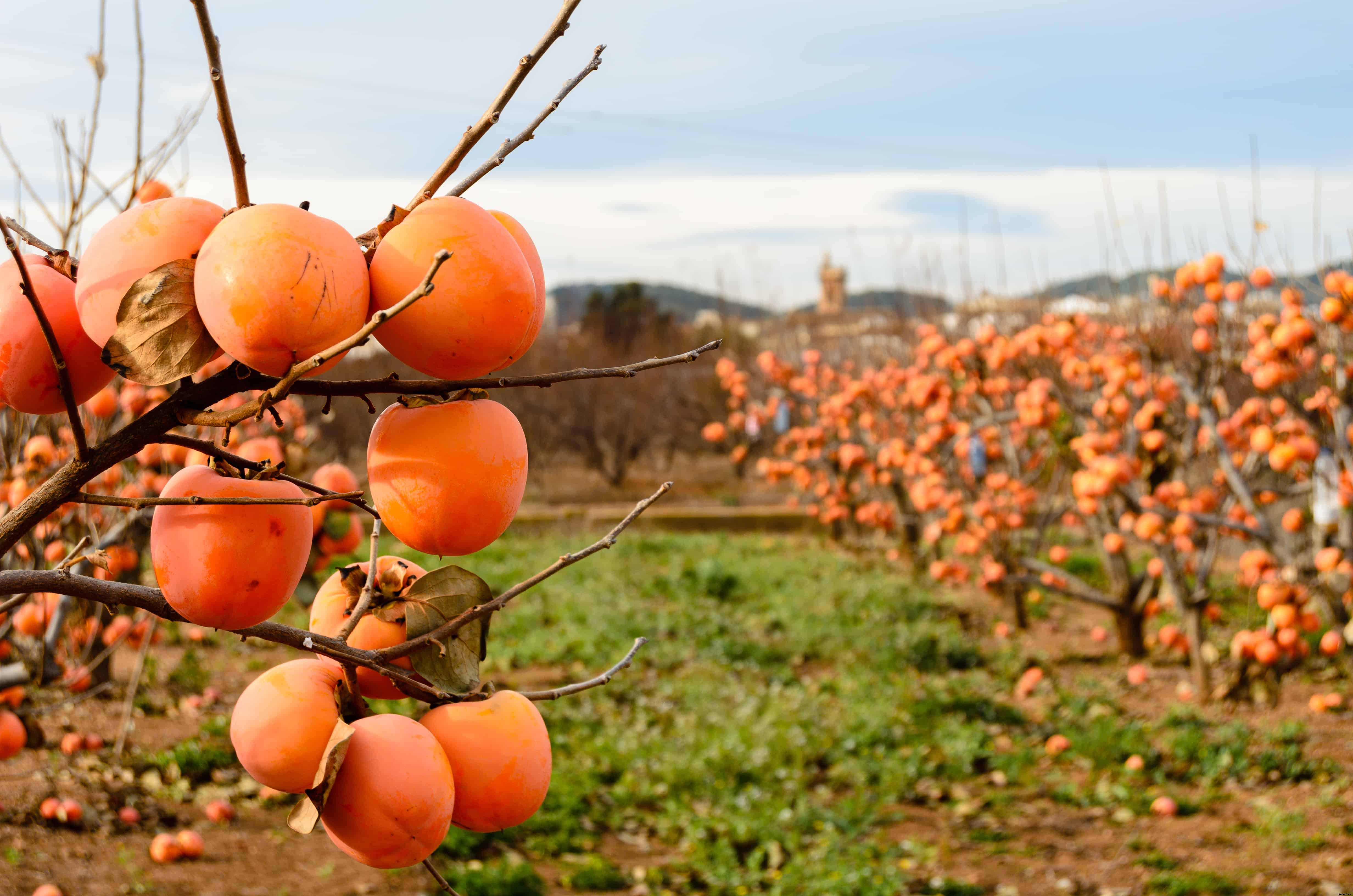 Best Site for Growing Persimmons
- Plant persimmons in full sun.
- Plant persimmons in compost-rich, loamy soil that is well-drained.
- Persimmons have a long taproot so deep, loamy soil is best. Asian persimmons prefer sandy-loam soil. American persimmons will tolerate a wide range of soils.
- Choose a site that will allow the tree to grow to maturity; consider the height and spread of the persimmon you want to grow. Make sure there is enough room for the tree to reach maturity.
Persimmon Pollination
- Check the pollination requirement of the variety you want to plant to know if you will need a second tree for cross-pollination and fruit.
- Most Asian persimmons are more or less self-fruitful; all Asian persimmons will bear fruit better if two varieties are planted.
- American persimmons can be male, female, or bisexual; some are some self-fruitful, some are not.
- Most female cultivars of Asian persimmons and a few female cultivars of American bear fruit without pollination.
Persimmon Yield
- Asian persimmon trees will bear 1 to 2 bushels of fruit each year.
- American persimmon trees will bear 2 to 3 bushels of fruit each year.
Spacing Persimmon Trees
- Space persimmon trees 20 to 35 feet apart depending on the variety. Allow enough room between trees for air circulation and sunlight.
Planting Persimmons
- Plant bare-root persimmons in spring before the tree breaks dormancy. Plant ball and burlap trees in spring also before the tree breaks dormancy. Plant container-grown trees any time from spring to autumn; avoid planting when the weather is hot and dry.
- Persimmons have a long taproot. Dig a deep hole and transplant carefully; damaged taproots regenerate slowly.
- Prepare a planting site in full sun that is sheltered from a prevailing breeze or wind.
- Dig a hole half again as deep and twice as wide as the tree’s roots.
- Work well-rotted compost or manure into the soil and add a cupful of all-purpose fertilizer to the bottom of the hole.
- Put a tree stake in place before planting. Drive the stake into the ground to the side of the hole to at least 2 feet deep.
- Set the tree in the hole so that the soil mark on the stem is at the surface level of the surrounding soil. (Remove all twine and burlap from balled and burlapped trees.) Spread the roots out in all directions.
- Re-fill the hole with half native soil and half aged compost or commercial organic planting mix; firm in the soil so that there are no air pockets among the roots. Water in the soil and create a modest soil basin around the trunk to hold water at watering time.
- Secure the tree to the stake with tree ties.
- After planting, water each tree thoroughly and fertilize with a high-phosphorus liquid starter fertilizer.
Container Growing Persimmons
- Persimmons can be grown in large containers, though this is not ideal since persimmons have taproots that grow deep.
- Choose a container at least 18 inches wide and deep.
- Plant trees in a commercial organic potting mix.
- Keep the soil evenly moist but not wet.
- Feed persimmons growing in containers with an all-purpose fertilizer that is slightly higher in potassium.
- Repot the tree after two years into a container that is 24 inches wide and deep. Be careful whenever transplanting a persimmon not to injure the taproot.
- A persimmon growing in a container will have to be pruned to keep the tree size small.
- Persimmons can be trained as espaliers.
Training and Pruning Persimmons
- Persimmons are best trained to a central leader or modified central leader. Leave six to eight scaffold branches placed evenly around the trunk. Persimmon branches can be brittle so develop a tree with strong crotches that can bear the weight of fruit.
- Persimmon fruit is borne on current season wood—branches that have grown this year will produce fruit this year. The fruit is also borne on one-year-old branches. Heading back will deprive the tree of fruit production.
- Keep the tree thinned out with even spacing of the fruit-producing branches. Remove excess growth and any dead or poorly positioned wood. Remove all suckers.
- If a tree becomes too tall, picking fruit may become difficult. Tall branches can be headed back; new shoots will grow below where the limb was cut.
- The best time to prune a persimmon is in winter when the sap is dormant.
- Hand thin fruit that appears crowded. Heavy fruiting can break branches.
- Persimmons can be trained to cordons or espaliers.
Persimmon Care, Nutrients, and Water
- Keep the soil evenly moist soil for optimal fruit production.
- Feed persimmons in late winter before trees break dormancy; spread several inches of aged compost around the tree to the dripline each spring.
- Feed trees with compost tea or a dilute solution of fish emulsion during the growing season. Excess nitrogen will cause fruit drop.
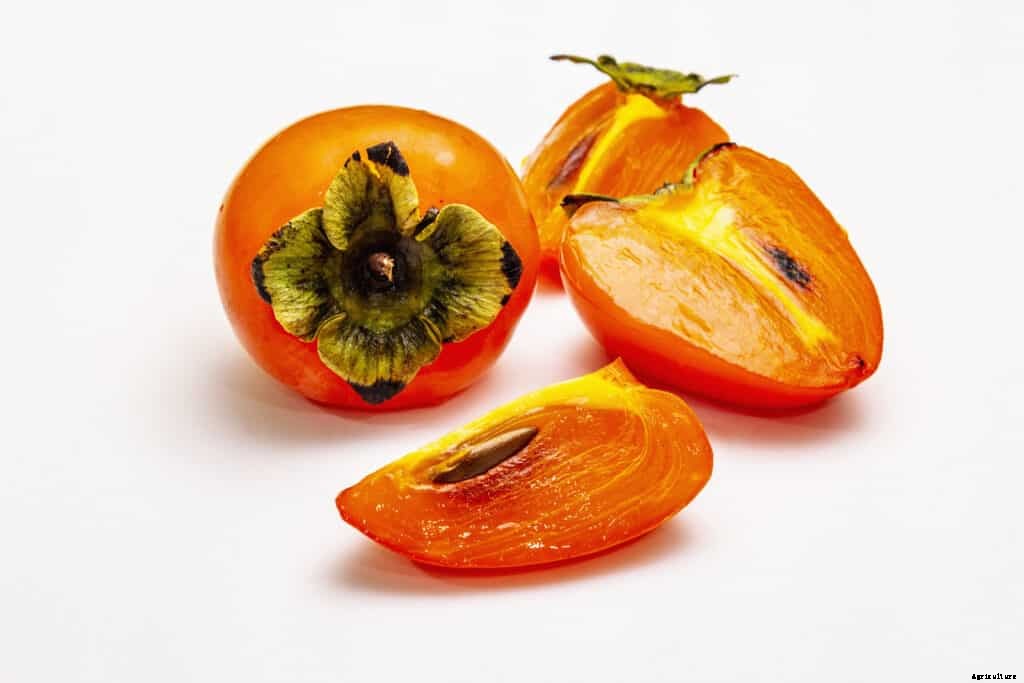 Harvest and Storing Persimmons
- Persimmons begin bearing fruit 2 to 3 years after planting; some grafted trees will bear fruit the year after planting.
- Most persimmons are not edible until they are soft.
- Pick astringent persimmons when they are very soft, and their skins are almost translucent or collect the fruit after it falls to the ground. Most American persimmons drop their fruits when they are ripe; mulch under trees to cushion the fall. Astringent fruits can be left on the tree to ripen if they do not fall.
- Pick non-astringent cultivars, most Asian varieties, when they are fully colored but still slightly firm.
- Harvest ripe persimmons by clipping the fruit from the tree with a pruner or shear. Leave some stem attached to the fruit.
- Slightly underripe persimmons will ripen off the tree. Speed ripening by placing the fruit in a bag with an apple.
- Persimmons can be eaten fresh; they can be frozen or dried.
- Fresh persimmons keep for two months in the refrigerator.
- Persimmons can be dried and eaten like figs and dates.
- Persimmons can be pulped and used for puddings, pies, cookies, and ice cream.
Persimmon Problems and Control
- Persimmon twig gridler is a horned beetle that chews on stems and branches to the point of severing the wood. These pests are best controlled by picking up and putting debris in the trash; debris will contain insect eggs.
- Scale are insects with a shell-like covering; they suck sap from leaves and branches. Spray trees with dormant oil spray in winter or crush the insects with your fingers.
- Anthracnose is a fungal disease that will cause leaves to develop small brown or gray spots. It can infect fruit as well causing soft translucent spots in the fruit that will turn to rot. Remove and destroy infected leaves and fruit.
- Raccoons will steal fruit; place a tin collar 1 foot wide around the trunk to keep raccoons out of the tree.
Fall and Winter Persimmon Care
- Prune persimmons in winter.
- Train young trees to an open center or modified central leader (see Training and Pruning above).
- Wrap the trunks of young trees with burlap or tree tape to prevent sunscald in winter.
Propagating Persimmons
- Grafting is the most common way to propagate persimmon cultivars; join persimmon stock and scion by whip grafting, bark grafting, or cleft grafting just as buds on the rootstock are pushing out.
- Persimmons can be grown from seed. Stratify seeds for two to three months by placing them in the refrigerator immediately after extracting them from the fruit. Seedlings begin bearing fruit whey they are about six years old.
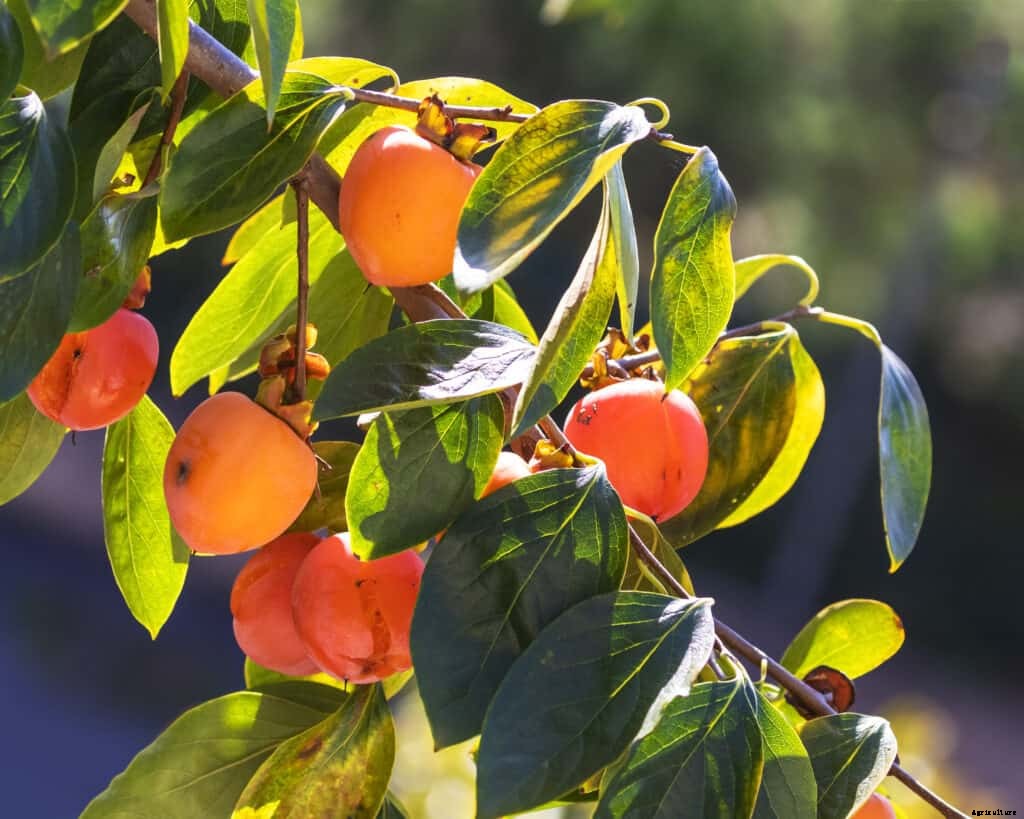 Persimmon Varieties to Grow
Asian persimmon varieties include:
- ‘Fuyu’ popular non-astringent type; reddish-yellow flesh is sweet and mild; about the size of a tennis ball; requires a pollinator. ‘Jiro’ is very similar and often mislabeled as ‘Fuyu’.
- ‘Hachiya’ fruit is astringent and soft; skin and flesh become yellow to orange when ripe; fruit is large and oblong to cone-shaped with a pointed tip; fruit grows to 4 inches long and 3 inches across. Requires a pollinator
- ‘Tamopan’ astringent fruit; large, turban-shaped fruit; must be fully ripe before eating; thick skin; orange, juicy flesh can be eaten with a spoon; excellent flavor.
- ‘Tanenashi’ large, excellent quality; orange-red tapered fruit; the flesh is astringent until soft; bears fruit without pollination.
- ‘Gosho’ (‘Giant Fuyu’) sweet, flavorful, non-astringent; large, round fruit.
- ‘Izu’ non-astringent; round fruit is borne on a tree half the size of a standard persimmon.
- ‘Maru’ non-astringent; medium-size, round, orange fruit.
- ‘Saijo’ hardy Asian cultivar; astringent, elongated, dull yellow fruit.
American persimmons varieties include:
- ‘Meader’ self-fruitful, almost seedless.
- ‘John Rick’ excellent flavor; requires pollinator.
- ‘Early Golden’ flavorful; need cross-pollination for the best crop.
Hybrid persimmons include:
- ‘Russian Beauty’ and ‘Nikita’s Gift’.
Also of interest:
Persimmons: Kitchen Basics


