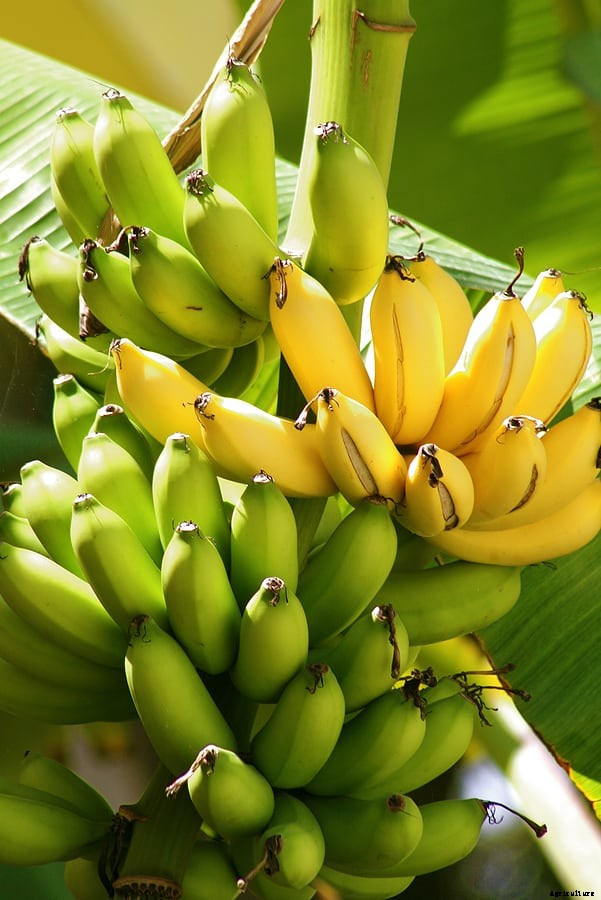
 Bananas can grow and fruit where conditions are right.
Fruiting banana plants require temperatures that average about 80°F during the day and about 70°F at night. Constant humidity of about 50 percent and daylight around twelve hours each day are ideal. Bananas will fruit in less than ideal conditions but the quality of the fruit will suffer.
There are two types of bananas: dessert bananas which are commonly eaten out-of-hand and in various desserts, and cooking bananas which are starchy and almost exclusively used for cooking. Cooking bananas include plantains.
Dessert bananas are the common yellow bananas. They are yellow and generally about 7 to 9 inches long and about 1½ inches in diameter. When ripe, the flesh is moist, slightly sticky, soft, and sweet.
Cooking bananas resemble a yellow banana, but they are larger and thicker-skinned with three or four well-defined sides. They are green when unripe, turning yellow, then brown, then black when ripe. They must be cooked to be edible. When cooked they have a mildly sweet flavor similar to winter squash.
About Banana Plants
Banana plants are perennial herbs, not trees. A banana plant has a trunk which consists of leaf stalks wrapped around each other in concentric circles. The trunk is leafy, not woody. New leaves grow up from the center of the trunk, pushing older leaves outward. At the base of a banana plant, under the ground, is a big rhizome or corm; this is the plant’s root system.
Banana fruit grows on flowering stalks that emerge from the center of the trunk. It takes about 9 months for a flowering stalk to produce fruit. Flowers turn into clusters of fruit; clusters of banana fruits are called “hands”; each individual fruit, each banana, is called a “finger”.
Banana fruits form in late summer. They reach mature size the following spring. When the fruit is green and plump it is nearly ripe; it is then cut off the stalk. The fruit finishes ripening after it is cut from the plant. Mature fingers commonly change color from green to yellow. Plantains, cooking bananas, turn yellow, then brown, then black as they ripen.
After a banana plant produces fruit, the leafy trunk dies back to the ground. New banana plants emerge from the plant’s rhizome root (also called a corm) which has many growing points. The baby plants are called “pups”; pups replace the mother plant; they also can be separated from the mother plant’s rhizome to start new plants elsewhere.
Banana plants grow up to 25 feet tall depending on the cultivar. There are cultivars that grow just 3 to 4 feet tall. Banana leaves can grow up to 2 feet wide and 9 feet long depending on the cultivar.
Best Climate and Site for Growing Banana
- Bananas grow best in humid tropical regions. In the United States bananas can be grown in USDA Zones 9 through 11. A few cultivars can survive in cold regions with protection, as cold as Zone 5.
- The optimal temperature for banana growing is 78° to 86°F.
- Plants require 10 to 15 months of frost-free weather to produce a flower stalk. Most varieties stop growing when temperatures drop below 57° Freezing temperatures will kill the foliage. Conversely, bananas will also begin to slow growth at 80°F and stop growing at 100°F. In very hot weather, bananas must receive ample water.
- Bananas grow best in full sun, but the leaves and fruit will sunburn and scorch in bright sunlight when temperatures are high. Check the growing requirements of the variety you choose to grow; in some locations, some varieties are best planted in partial shade.
- Plant bananas in compost-rich, loamy, well-drained soil.
- Bananas prefer a soil pH between 5.5 and 6.5.
- Protect bananas from wind for maximum yield. Bananas are susceptible to wind damage; they can be uprooted and blown over by the wind.
- It is best to plant bananas in a block or clump of several plants. Block planting allows shallow-rooted plants to support one another; block planting also increases humidity around plants; plants in the center or blocks tend to fruit the best because they are protected from the wind. A block might be 5 rows of 5 plants in each row; each plant spaced about 5 feet apart.
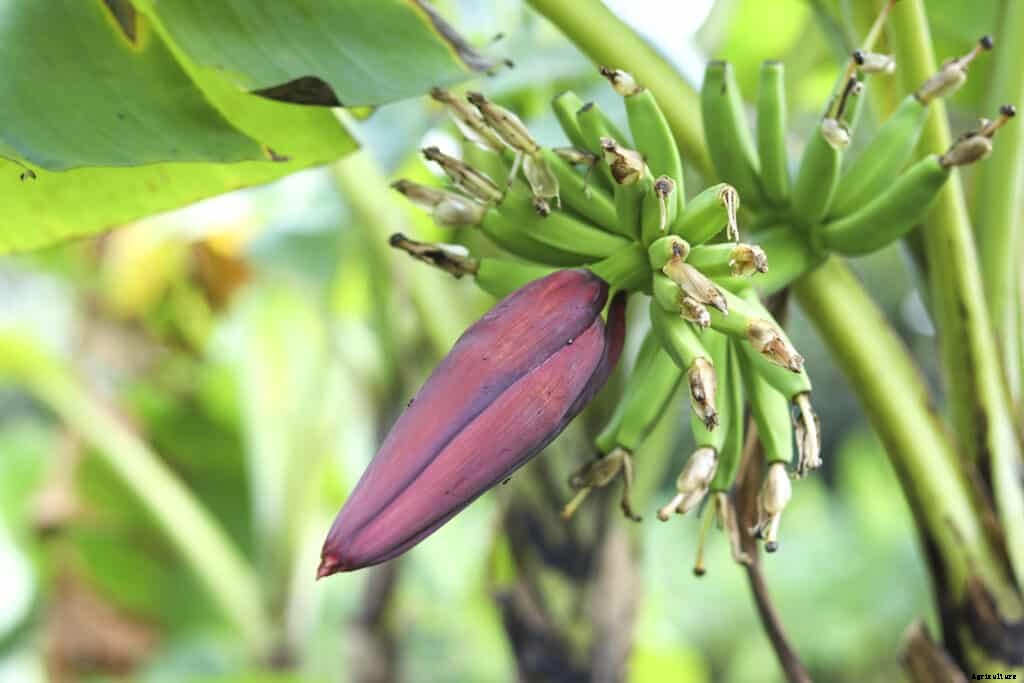
Banana Pollination
- Banana inflorescences have both male and female flowers.
- Here’s how pollination happens: Banana stalks spiral upward from an underground rhizome; the stalk is comprised of a series of concentric layers of leaves. A flowering stem grows from the center of the stalk about 10 to 15 months after planting. A long, tapering, oval-shaped purple-colored bud emerges from the tip of the stem. The purple covering of the bud encases slim, tubular flowers in clusters of 15 rows. The first five rows are female flowers; then come male and sterile female flowers. Male flowers in the cluster open and pollinate female flowers. Female flowers with banana-shaped ovaries produce the banana fruits. The fruits grow in clumps; the clumps are called “hands” and the individual fruits are called “fingers’. In some cultivars, the fruit develops without pollination.
Spacing Bananas
- Space banana plants 5 to 6 feet apart. Bananas are best grown in blocks or clumps. Plant several plants together at 5 to 6-foot intervals.
Planting Bananas
- Bananas are grown from root divisions or cuttings (see Propagation below). A portion of the root is sliced off a mother plant and replanted; the division may or may not include leafy growth, called suckers. Using a root division with leafy growth is best.
- Choose a sucker from a vigorous banana plant. Choose a sucker that has small, spear-shaped leaves. A sucker about 3 or 4 feet tall is optimal. Smaller suckers take longer to fruit and the first banana bunch will be smaller.
- Cut the sucker from the main banana plant with a sharp spade. Cut downwards between the mature plant and the sucker. If a spade is not sharp enough, cut the sucker away with a pruning knife or saw. The sucker must include roots.
- Replant the division so that the roots are covered at about the same level they were growing with the mother plant. If you replant a root division only with no leaves attached, set the division 1 to 2 inches below the ground.
Container Growing Bananas
- Dwarf banana varieties grow well in containers.
- Choose a container at least 24 inches wide and deep. Use a potting mix formulated for citrus or palms.
- Repot bananas at least once every three years.
- Do not let the soil dry out; keep it evenly moist, not wet.
- Feed container-grown bananas one a month; use a light solution of fish emulsion.
- Bananas in containers can be grown indoors if there is ample light and the temperature is warm enough.
Banana Care, Nutrients, and Water
- Keep the soil evenly moist. Regular deep watering is essential during warm weather. Bananas thrive in humid conditions; water two or three times a day with sprinklers to keep humidity high around plants.
- Be sure the soil is well-drained. Standing water or constantly wet soil can cause root rot, especially in cool regions.
- Mulch to conserve soil moisture and protect shallow roots.
- Bananas are heavy feeders; feed bananas once a month with a complete fertilizer slightly higher in phosphorus such as 8-10-8. Do not let fertilizer come in contact with the leafy trunk of the plant.
- Protect plants from frost; place a plant blanket over plants or build a frame around the plant and cover it with clear plastic sheeting when frost threatens.
Pruning Bananas
- Bananas fruit from a stem growing from the plant’s rhizome roots. Several stems will form. Allow only one strong stem to fruit; prune away other stems as they develop; this directs the plant’s energy to fruit production and away from leafy growth. When the main stalk is 6 to 8 months old, allow a new sucker or stem to begin to develop as a replacement stalk for the following season.
- When fruit is harvested, cut the fruiting stalk back to about 30 inches above the ground; the stub will die back and can be removed after several weeks.
- Leafy trunk growth commonly dies back after fruiting; clean up and remove from the garden this leafy debris. New growth will emerge from the plant’s undergrown rhizome.
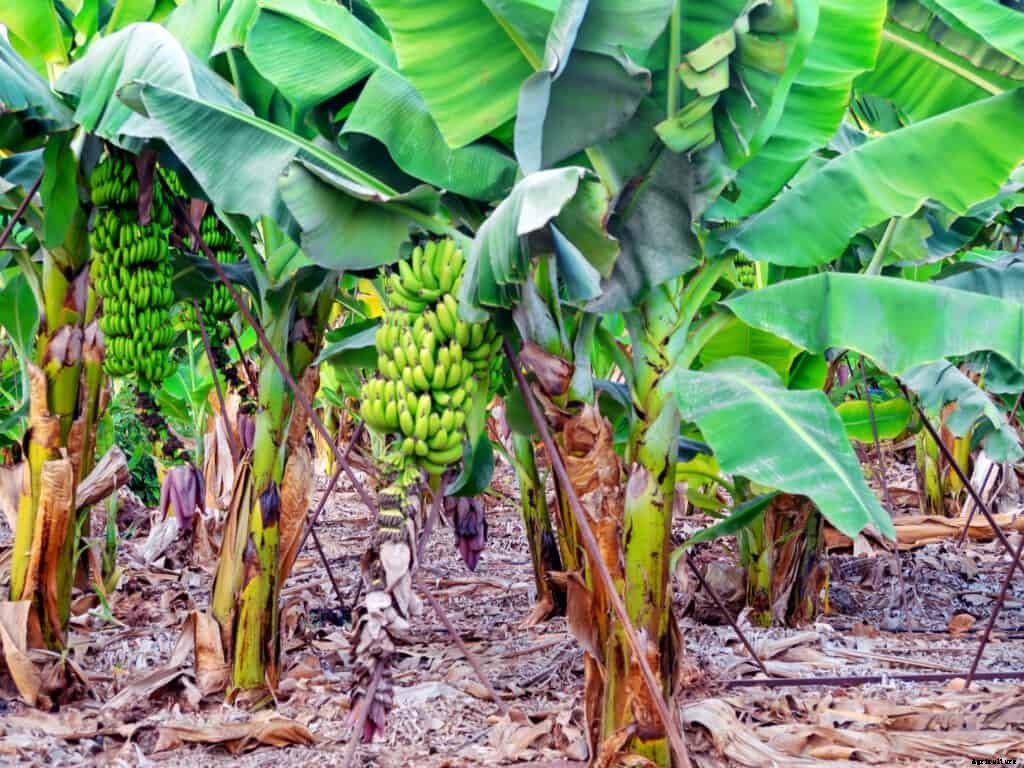
Harvesting and Storing Bananas
- Banana plants flower about six months after planting. Purple flowers appear at the end of stalks. In time the flower petals curl back to reveal a “hand” of bananas (see Pollination above). The fruit is ready for harvest 15 to 18 months after planting.
- Stalks with fruit form in late summer and then winter over; in spring the fruit will plump up and will ripen by mid to late spring. Occasionally, fruiting stalks may form in early summer and ripen in autumn.
- Harvest fruit by cutting off the fruiting stalk when bananas are plump and still green. The fruit, called “fingers”, grow plumper as they ripen. The fruit is ripe when the longitudinal ribs are evident and the flower at the end of the finger is dry and shriveled.
- Bananas ripen from the stalk end to the flower end turning from green to yellow.
- Tree ripened fruit can be harvested one at a time. However, do not let ripe fruit linger on the plant; rodents are attracted to ripe fruit.
- Hang harvested “hands” in a cool, shaded location to finish ripening. Commonly all the fingers on a hand will ripen at the same time.
- Unripe bananas can be placed in a plastic bag; the ethylene gas emitted by the fruit will help ripen the fruit.
- Shortly after the fruit is picked, the plant will die. Cut foliage back to the ground and allow a sucker growing from the rhizome to form a new plant.
- Bananas can be peeled and frozen for future use.
Propagating Bananas
- Seeds of banana plants are not fertile.
- Bananas are propagated by division. Here’s how division works: banana rhizomes (roots) produce suckers called pups. Several suckers or pups will develop around the base of a banana plant; the suckers or pups grow from the rhizome root. Pups surrounding the mother plant help balance and anchor the mother plant. Pups can be removed from the mother plant and replanted to grow new plants; this is propagation by division. When there are three or four pups surrounding the main plant, cut one from the base of the mother plant with a spade. Choose a pup with leafy growth at least 3 feet tall that has formed its own roots; when you slice the pup away from the mother be sure it includes its own roots. Replant the pup to grow a new plant. If you take a root division that does not have leafy growth, let the surface of the rhizome section dry for two days before replanting. (See Planting above)
Banana Problems and Control
- Bananas stop growing when temperatures drop below 57°F; if temperatures drop lower banana skins turn greyish-brown and the leaves will yellow. Frost can kill all leafy growth, but the rhizome root will survive and may send up new shoots.
- Root rot can attack bananas in cold, wet soil; make sure the soil is well-drained.
- Snails can climb into plants and eat foliage; trap snails and destroy them
- Panama Wilt can cause lower leaves to yellow; Panama Wilt is a fusarium fungal disease. Treat plants with a fungicide. Panama wilt often kills infected plants.
- Bacterial leaf spot can cause yellow patches on leaves; these spots will darken and can eventually darken and kill the leaf. Make sure the soil is well-drained; remove diseased foliage.
- Anthracnose is a fungal disease that can attack leaves and fruit turning them black; spray with a fungicide; ensure the soil is well-drained.
- Crown rot can rot the stalk from the soil line; make sure the soil is well-drained.
- Aphids and mites can attack bananas and suck sap from leaves; look for clusters of aphids on the stems and under leaves; knock them off with a strong spray of water or spray with insecticidal soap.
- Banana weevils tunnel into plant roots and stem; remove infected stems and foliage; spray with Spinosad.
Banana Varieties to Grow
There are more than 1,000 banana cultivars. Here are several varieties that can grow in home gardens:
- ‘Cavendish’: dessert banana; stout plant that fruit heavily; commonly sold in markets; several named clones include ‘Lacatan’ (12 to 18 feet tall), ‘Robusta’ and ‘Giant Cavendish’ (10 to 16 feet tall), ‘Dwarf Cavendish’ (4 to 7 feet tall); resistant to Panama Wilt disease.
- ‘Cuban Red’: cooking banana; dark red skin; cream-orange flesh; aromatic; 20 months from planting until harvest.
- ‘Gros Michel’: dessert banana; considered by many to be the most flavorful; it needs a lot of heat; susceptible to Panama Wilt disease.
- ‘Ice Cream’ or ‘Blue Java’: dessert banana; flavorful fruit melts in the mouth; fruit is 7 to 9 inches long with a bluish cast; the plant grows 15 to 20 feet tall; 18 to 24 months from planting until harvest.
- ‘Lady Finger’: dessert banana; excellent quality; fruit tolerant cool temperatures; the tree grows 20 to 25 feet tall; 15 to 18 months from planting to harvest.
- ‘Manzano’ also called ‘Apple’ or ‘Silk’: dessert banana; pleasant apple flavor when ripe; fruit is 4 to 6 inches long; the plant grows 10 to 15 feet tall; about 15 months from planting to harvest.
- ‘Orinoco’: cooking banana; good flavor; the plant grows to 16 feet tall; 15 to 18 months from planting to harvest.
- Plantains (cooking bananas): are a type of banana used for cooking; dry and starchy flesh.
- ‘Popoulu’: cooking banana; plump fruit for fresh eating or cooking; salmon-pink flesh; grow best with high humidity and filtered light; the plant grows to about 14 feet tall.
- ‘Red Iholena’: (dessert or cooking): very good flavor; pink flesh; yellow-skinned; rapid growth to 10 feet tall.
- ‘Valery’: dessert banana; similar to ‘Robusta Cavendish’; maybe the same.
- ‘Williams’: dessert banana; same as ‘Giant Cavendish’; the plant grows 10 to 16 feet tall.
Also of interest:
Banana: Kitchen Basics
How to Grow Guava
How to Grow Mango
How to Grow Papaya
How to Grow Cherimoya
How to Grow Passion Fruit
How to Grow Feijoa Strawberry Guava
How to Grow Citrus
How to Grow Loquats


