
Welcome to Modern Agriculture!

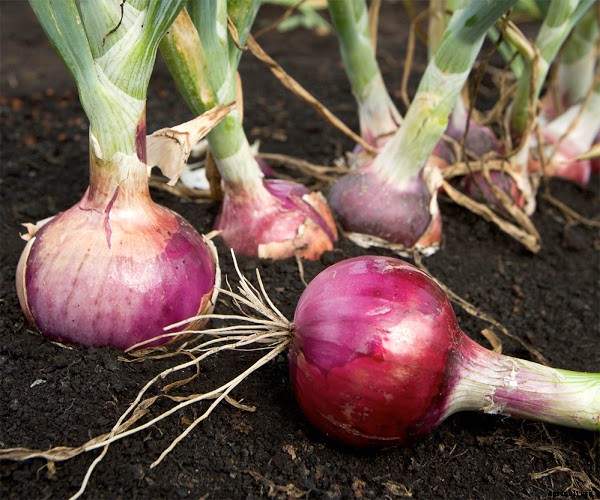
There is no shortcut to success with onion growing. For you to get a good harvest, you must perfect the processes and follow them religiously, understand your market and know the weather patterns. Below find the key factors:
Do a soil test to know if your land is ideal for growing the crop;
Have the following considerations:
Pay attention to this because if you live where day length never hits 14 hours (for instance, in certain European countries), long-day onions will never form a bulb.
The practices that you carry out on your farm will be the second most important thing. As with most crops, if you fail to do the right thing at the right time, you are likely to fail.
Where possible, soak your seeds in an optimizer 30 minutes before planting to help them break dormancy, increase the vigour of seedlings, and ensure uniform, high percentage germination. A farmer from Matu in Kitui County, Ms Jane Kadogo, recorded minimum germination from her nursery in her first attempt at planting onions. However, not one to give up easily, she made a second attempt, but this time soaked her seeds in the organic fertiliser, DI Grow, before planting. To her delight, her seedbed recorded over a 90 per cent germination rate.
Agronomist Dennis Rapongo, however explains that the combination of nutrients in the optimiser or the foliar feed is what breaks seed dormancy. It is, therefore, important to consult an expert, as not all foliar feeds will result in successful breaking of dormancy.
80-100gm/1mx5m bed (for seeds >90% germination), 1.5 to 1.6 kg/acre
Make furrows using a stick or your fingers 0.5 to 2cm centimetre deep. Spacing between rows should be 10 to 15 centimetres. You can mix your seed with sand at a ratio of 2:1 (sand: seed) for more uniform sowing.
During planting, mix your soil with DAP fertilizer at a rate of 20gms-30gms per square foot or apply well-prepared manure.
After planting, cover your bed with about three to five centimetres of dry grass. Do not use green grass or broad-leaved materials to cover the beds. This grass cover should be removed after the seedlings emerge. Do this in the morning or late in the afternoon.
Avoid the use of herbicides in the nursery. Instead, weed regularly. Water your bed twice a day in the morning and in the afternoon until two weeks after the seedlings emerge.
Thereafter, once daily until they are ready for transplanting. If the weather is too hot, try to water them twice a day until transplanting. Your onions will take six to seven weeks before they are ready for transplanting.
Begin tilling your farm in preparation for transplanting when your seeds have been in the nursery for four weeks. This provides adequate time to expose any soil pests in your main farm to the sun. Depending on the soil test results, add manure and lime as onions are very sensitive to soil pH. Ten days after ploughing, till again using a harrower to get a fine tilth. The second tilling should fall about two to three days before transplanting.
Immediately after the second tilling, start making furrows at a spacing of 30 centimetres between rows and 5cm to 10cm between seedlings. Plant in full sun, and water them adequately. Wet your seedbed to ensure minimum damage to the seedling as you uproot them for transplanting.
Add DAP fertiliser at a rate of 100kg/bag or one small teaspoon per hole. Mix it with the soil. Apply a thin layer of mulch around the plants. For small farms, seeds can be sown directly. However, they are likely to require thinning at about three to four weeks.
Water and weed regularly. You can weed by hand or using selective herbicides, which are best applied between seven and 14 days after transplanting.
Fertilisation:
Onions need a lot of nutrients, especially, during bulb formation but over-fertilisation should be avoided. At two to three weeks top-dress with CAN, or NPK 26:0:0 or Urea at 75-100kg/acre.
Carry out a second top dressing after three weeks. This time use NPK (Nitrogen, Phosphorus and Potassium) commonly called triple 17 or NPK 23:23:23. However, adjust the amount as 23:23:23 has a higher percentage of the nutrients than 17:17:17. The general amount for 23:23:23 is about 50kg/acre and 75kg/acre for 17:17:17.
Onions will develop their leaves first, then depending on the variety and the day length, they will begin forming bulbs. As soon as the day length hours of onions are achieved, they stop forming the top and start forming bulbs.
To harvest good-sized onions proper feeding is important. The number and size of the green leaves or tops at the time of bulb maturity will give you an idea of the size of the bulb you will harvest. For each leaf there will be a ring of onion; the larger the leaf, the larger the ring will be.
Some of the most commonly grown varieties in Kenya are Neptune F1, Russet F1, Sivan F1, Red Creole F1, Red Bombay, Red Pinoy, and Texas Grano. The have the following good characteristics:
Pests:
Thrips are notorious and severely attack the onions in both the nursery and the farm, causing a lot of damage. They can be controlled by integrated pest management (cultural, biological), or chemical methods. Chemical methods should be used as a last resort. In addition, overhead irrigation and the use of blue insect traps also help control them.
These diseases, if not controlled cause significant losses.
Farm hygiene (keep your crop free from weeds) As a last resort, use pesticides and fungicides or bio-pesticides (for organic farmers), as recommended by the agronomist.
Agronomist/consultant:
Mr Joshua Mouti, BSC Horticulture, Egerton University,
Post graduate Diploma in crop protection of vegetables and fruits
Email: moutijoshua@gmail.com Cell: 0719 212 112
Download Magazine To Read More: Edition 46


