
Welcome to Modern Agriculture!

Introduction to the preparation of organic fertilizer for home gardening
Well, the demand for growing vegetables or any other crops organically increasing, and here is the information on the preparation of organic fertilizers of Panchagavya, Brahmastra, Agniastra, Jeevamrut, Neemastra, Dasagavya, Sanjivak, and Amrutpani at home.
Panchagavya or Panchakavya
How to make Panchagavya or Organic fertilizer using Cow by-products.
Panchagavya is prepared from cow dung, curd, ghee, urine, and milk. This is the best organic homemade manure.
Things you need for preparing Panchagavya
How to use Panchagavya
To use Panchagavya dilute it with 30 times of water and it is ready to use as a liquid fertilizer. To usePanchagavya as a foliar spray separate or filter the liquid using a cotton cloth to separate the waste. If you do not filter the liquid it will block your spray nozzle.
As a fertilizer, we use it once every two weeks during the normal growth of a plant and once a week during flowering and fruiting. And, as a foliar spray, we use it every week. We have noticed that when Panchagavya is sprayed all pests disappear and start to make an appearance after about a week. Hence we spray once in a week. Spraying must be done early in the morning or late in the afternoon. Plants and leaves should be dry when you spray Panchagavya. You can spray it between 8-9 AM on a normal day in the morning time. In the evening spray about an hour before the sunset and do not waste your Panchagavya on rainy days.
Effect of Panchagavya in plants
Leaf – Plants sprayed with Panchagavya invariably produce bigger plant leaves and develop denser canopy. The photosynthetic system is activated for enhanced biological efficiency and enabling the synthesis of maximum metabolites and photosynthates.
Roots-The rooting is profuse and dense. Further, they remain fresh for a long time. The roots spread and grow into deeper layers were observed. All such plant roots help maximum intake of nutrients and water.
Yield- The key feature of Panchagavya is its efficacy to restore the crop yield level of all crops when the land is converted from an inorganic cultural system to organic culture from the very first year. The harvest is advanced by 15 days in all the plants. It not only enhances the shelf life of vegetables, fruit plants, and grains but also improves the taste. By reducing or replacing costly chemical inputs, Panchagavya ensures higher profit and also liberates the organic farmers from the loan.
In case if you miss this: Growing Microgreens in Aquaponics.
Brahmastra is a natural insecticide/pesticide. Brahmastra Control Bigger Caterpillar and Bigger Pests.
Ingredients for preparation for Brahmastra are Cow urine, castor leaf, Indian beech, and Neem
How to prepare Brahmastra
How to prepare Agniastra
It acts as manure for the soil and plants and it can remove all kinds of pests, insects and increase the richness of the soil. Moreover, it acts as an enriched for the greenery of the plant, can be used for vegetables, fruits, flowers, and other agriculture crops.
The below ingredients will get you 2 liters of Agniastra solution.
Ingredients of Agniastra
Grind all the above ingredients into a fine paste and then mix with cow urine. Boil this for 4 times. Then, leave it for 48 hours, filter it, and mix some water and sprinkle over the plants. You can save and use it for 3 months. Spray this medicine Agniastra on the pest such as Leaf Roller, Stem Borer, Fruit borer, and pod borer.
Method of Agniastra preparation
The pesticide must be kept in the shade and then covered with a wire mesh to prevent houseflies from laying eggs and the formation of maggots or worms in the solution.
Jeevamrut is a combination of two words – Jeevan + Amrut. Jeevan means life and Amrut means medicinal potion. Jeevamrut is an excellent source of natural Carbon, Nitrogen, Phosphorous, Potassium, and other micronutrients which are mainly used as natural manure in Organic farming. As compared to other forms of Manure, Compost, and Vermicompost; Jeevamrut can be prepared very easily and quickly. It along with other manure can also be very beneficial for crops. It is liquid organic manure popularly used as a means of organic farming. It is considered to be an excellent source of ‘natural carbon’, ‘biomass’, ‘Nitrogen’, ‘Phosphorous’ ‘Potassium’, and a lot of other micronutrients required for the plants.
Benefits of Jeevamrut
Preparation of Jeevamrut
Materials Required for Neemastra
How to prepare Neemastra
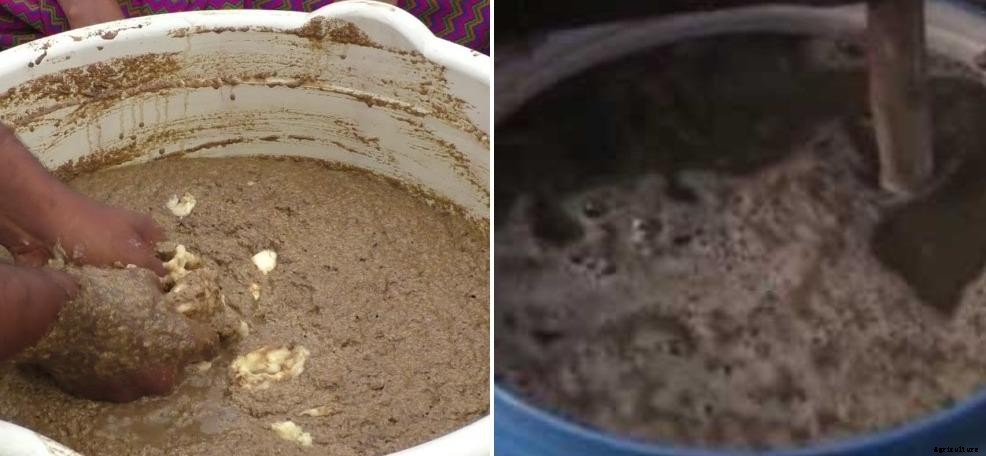
Step 1) Mix all the above ingredients in a plastic or cement tank. Make sure there is no lump in cow’s dung and use a wooden stick to mix the mixture of the ingredients. The wooden stick must be rotated in the mixture according to the clockwise direction so that positive energy spreads in the mixture.
Step 2) Then, cover the tank with a jute sack or poly net. The tank must be in shadow and the tank should not be directly exposed to sunlight or rainwater. Leave the mixture for 48 hours for fermentation.
Step 3) Using a wooden stick for at least 1 minute, mix the mixture in a clockwise direction in the morning and evening every day.
Step 4) Filter the mixture and use it after 48 hours.
Use – The mixture must be sprayed on plants. Do not mix the water in the mixture, sprinkle the same mixture.
It is an organic growth promoter for crops, which is prepared by mixing certain plant extracts along with Panchagavya.
How to prepare Dasgavya
Ingredients for preparing Dasagavya is cow dung 5 kg, cow urine 3 liters, cow milk 2 liters, curd 2 liters, cow deshi ghee 1 kg, sugarcane juice 3 liters, tender coconut water 3 liters, a banana paste of 12 fruits and toddy or grape juice 2 liters.
Advantages of Dasgavya
You may also check this: Growing Vegetables Organically in the Backyard.
What is Sanjivak
Sanjivak is an organic nutrient used for enriching the soil with microorganisms and quick residue decomposition.
Ingredients to prepare Sanjivak
How to prepare Sanjivak
Amrutpani is used to improve soil fertility.
Materials required for Amrutpani
How to prepare Amrutpani
Phase 1:
Phase 2:
Mix the water again in the mixture and stir it slowly in the same direction and bind the container’s face to the clothes.
Phase 3:
Amrutpani is ready for use in 4 days, mixed with wooden sticks 3 times a day.
Use of Amrutpani
If you are interested in How to Make Money from Organic Fertilizer Production.


