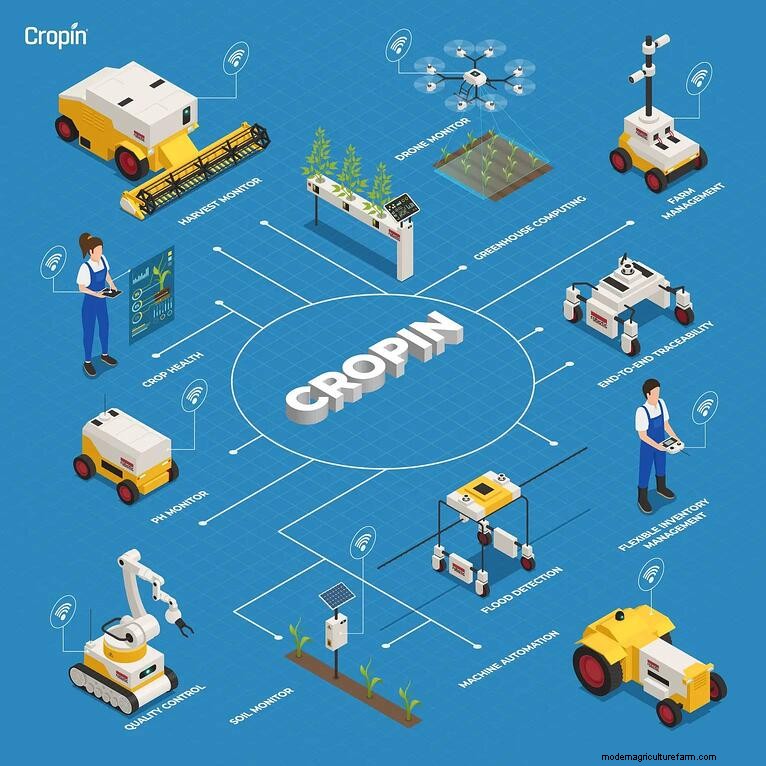
As per a recent UN report, the global population will hit 9.7 billion in 2050. Therefore, an increase of nearly 70% in worldwide food production is essential for fulfilling the consumption needs of this rising population. The IoT technologies seek to bring about a revolution in the agricultural sector through connectivity-fueled transformation. Applying machine learning to analyze IoT data to deliver insights that are otherwise lost in the massive volumes of unstructured data. They pave the way for rapid, automated responses, and superior decision making, while also helping analysts project future trends, detect anomalies, and enrich artificial intelligence capabilities. These applications are used extensively in precision agriculture for improved crop management, leading to higher efficiency and productivity.
Achieving Enhanced Yield with IoT Farming
Listed below are a few benefits of incorporating IoT in agriculture.
- Crop monitoring from anywhere: It is challenging to monitor farms spread over a large area manually. However, smartphones with high-speed internet connectivity allow field staff to capture critical information at ground level. They can communicate with agronomists and higher levels of management instantly to take corrective measures instantly. On the other hand, cloud computing enables advanced data analysis and data modeling to arrive at conclusions and recommendations for more intelligent decision-making. Consequently, producers can monitor all aspects of farm operations in real-time from any corner of the world without having to step out from the comforts of their homes. As a result, precision farming techniques provide an accurate and detailed analysis of various stages of crop production. Furthermore, they help predict crop yields weeks in advance, which further improves planning for post-harvest activities.
- Predictive analysis: IoT devices enable growers to monitor environmental parameters, soil parameters, and plant parameters remotely. Through various applications such as crop and soil sensors, farm mapping systems, and aerial drones, farmers can detect stresses in crops, including pests and diseases, weeds, soil salinity, nutrient deficiencies, and excesses of trace elements, which together affect crop yield. The sensors also provide critical information concerning the weather and water stress. With these timely insights, farmers can proactively prevent extensive crop losses and ensure optimum yield.
- Resource conservation: Land resources have become scarce in the present scenario, and the soil quality has deteriorated in several areas. Further, unpredictable weather conditions contribute to the existing problems in the agricultural sector. IoT applications in agriculture helps overcome these problems by allowing farmers to make informed decisions for sustainable farming and conserve available natural resources.
- Cost-effective production: By identifying crop health and soil requirements, IoT farming helps limit the excessive and often needless application of chemical fertilizers and pesticides that lead to soil degradation. IoT technologies also prevent other forms of wastage and help in the optimal use of land, water, and energy resources. Positioning sensors strategically across the farm provides data that helps farmers allocate the appropriate resources to the crops. Precision agriculture incorporates automation at crop production stages, which reduces manual intervention and brings down operational costs.
- Increased productivity: IoT devices make it easier to automate multiple processes across the production cycle, such as irrigation, fertilizing, or pest control. They also make farm automation possible by equipping a wide range of farm machinery and equipment with sensors and telematics solutions. Producers can thus effectively manage a fleet of machinery, track their usage, and gather real-time data on equipment status and farm activity. Employing robotics, autonomous vehicles, and automated hardware further help maintain higher standards for crop quality and quantity while achieving better control over the production process.
- Expansion of the Agricultural Process: IoT-based closed-cycle agricultural systems, including greenhouses, soil-less cultivation, and associated systems, allow the development of food crops anywhere, paving the way for urban farming in supermarkets, apartment rooftops, and backyards of your own home. This process will ensure food security for the rising global population and give people access to fresh, healthy food.
- Quick response to production risks: The agricultural sector is highly dependent on various environmental factors such as precipitation, temperature, and humidity, among others. IoT farming techniques employ real-time monitoring of crops that help farm owners respond quickly to any change in environmental conditions.
Should you implement IoT Solutions & Drones for your farm? Read about it here:
The Proximity vs Scale Debate: What Is the Best Fit for Smart Farming?
Use of Drones in Agriculture
The agricultural industry is incorporating drones for the effective management of precision farming operations. This technology aims to revolutionize the working of the agricultural sector through data analytics. According to recent reports, the drone market for agricultural operations will reach $4.8 billion by 2024.
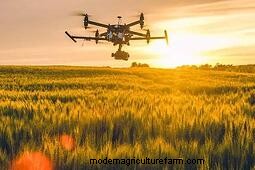
Drones or Unmanned Aerial Vehicles (UAV) usually work in two ways: humans control them through wireless remotes, or these devices determine their route through various sensors. In addition, they carry numerous recording devices, sensors, and navigation systems to capture data and images of the conditions of crops.
Drone data provide instant, actionable insights on plant health indices, chlorophyll measurement, yield prediction, nitrogen content in wheat, plant counting, canopy cover mapping, plant height measurement, scouting reports, field water ponding mapping, drainage mapping, weed pressure mapping, stockpile measuring, and so on.
How do agricultural drones contribute to the ease of crop management?
- Tracking Field Conditions: Drones are used for field mapping to provide information regarding the irregularities and elevation of the field. This information is essential for gaining knowledge about drainage patterns and dry spots, if any, to optimize the watering of crops. Specialized drones also allow monitoring of the nitrogen level in the soil to determine the appropriate quantities of fertilizers required, thus maintaining the soil health.
- Monitoring of Plant Health: Drones use installed cameras to track crop health. Since they fly close to the ground level, clouds and low light conditions do not hamper their working. Drones use the Normalized Difference Vegetation Index, which uses color coded information to determine plant health. As a result, the farmers receive instant information regarding diseases or pests, immediately addressing machinery and equipment management.
- Spraying on Crops: Drone sprayers eliminate the need for manual intervention required for spraying chemicals on crops and hence reduce the extended exposure to toxic chemicals. In addition, they can reach areas with high elevations or places where it is difficult for humans to work. These devices also increase efficiency by spraying on targeted areas, thereby reducing wastage and chemical costs.
- Planting Seeds: Drone seeders can also plant seeds in remote locations that are difficult or unsafe for humans to reach. Consequently, these seeders help cut back on equipment and workforce costs and ensure safe working conditions for the growers.
- Ensuring Security of Crops and Livestock: Drones are employed to protect crops, especially high-value ones like cannabis, instead of incorporating many security personnel. Moreover, farmers can utilize these handy devices to locate farm animals that may have wandered far off.
- Irrigation: Climate change has led to an increase in drought conditions in many areas. Thus, it is necessary to increase the efficiency of irrigation in these parts. Drones use microwave sensing technology to collect accurate information about soil health and its current moisture level. They can then distribute the appropriate amount of water required, thereby conserving natural resources.
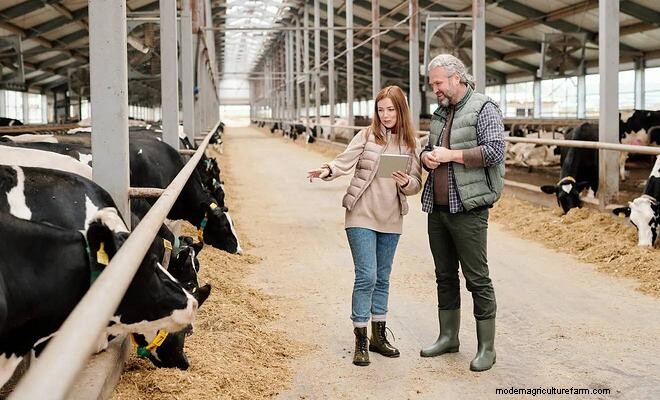
Apart from drones, IoT is a part of several other applications that lead to high yields and provide ease of farm management. Following are a few such applications:
- Precision agriculture
- Monitoring of livestock
- Smart greenhouses
- Monitoring of weather conditions
- Crop monitoring and management
#ThePlusFactor from Cropin
SmartFarm Plus provides a one-stop integrable farm management platform that increases efficiency, predictability and sustainability. With SmartFarm Plus, agribusinesses can integrate IoT, drone, weather, sensor, and partner data on the API-first Cropin platform.
- Capture meaningful data points from remote sensing and IoT devices and discover insights on crop detection, crop health, and crop yield on a single dashboard.
- Receive data-driven recommendations for challenging problems.
- Seamlessly integrate with multiple third-party ERPs and software systems for better connectivity and communications between teams.
Watch the video to know how SmartFarm Plus also simplifies machinery and equipment management on a single dashboard.


